
In short: Achilles tendon pain (Achilles tendinopathy) usually affects runners and people who have suddenly increased their activity. What helps most is calf strengthening, done regularly for several months. You do not have to stop moving completely: mild pain during exercise is acceptable if it settles by the next morning.
What Achilles tendinopathy is
The Achilles tendon connects the calf muscles to the heel and takes a large load when you walk, run and jump. When you load it more than it can handle, for example by suddenly increasing your mileage or speed, the tendon becomes painful and thicker. The old term “tendinitis” suggests inflammation, but the main problem is that the tendon can no longer cope with the load.
Typical signs
- pain and stiffness in the tendon, 2–6 cm above the heel, especially in the morning;
- pain at the start of a run that sometimes eases after warming up and returns afterwards;
- the tendon is tender to touch and may look thicker.
Some medicines, for example fluoroquinolone antibiotics, increase the risk of tendon problems. Tell your doctor if you took such treatment before the pain started.
What helps
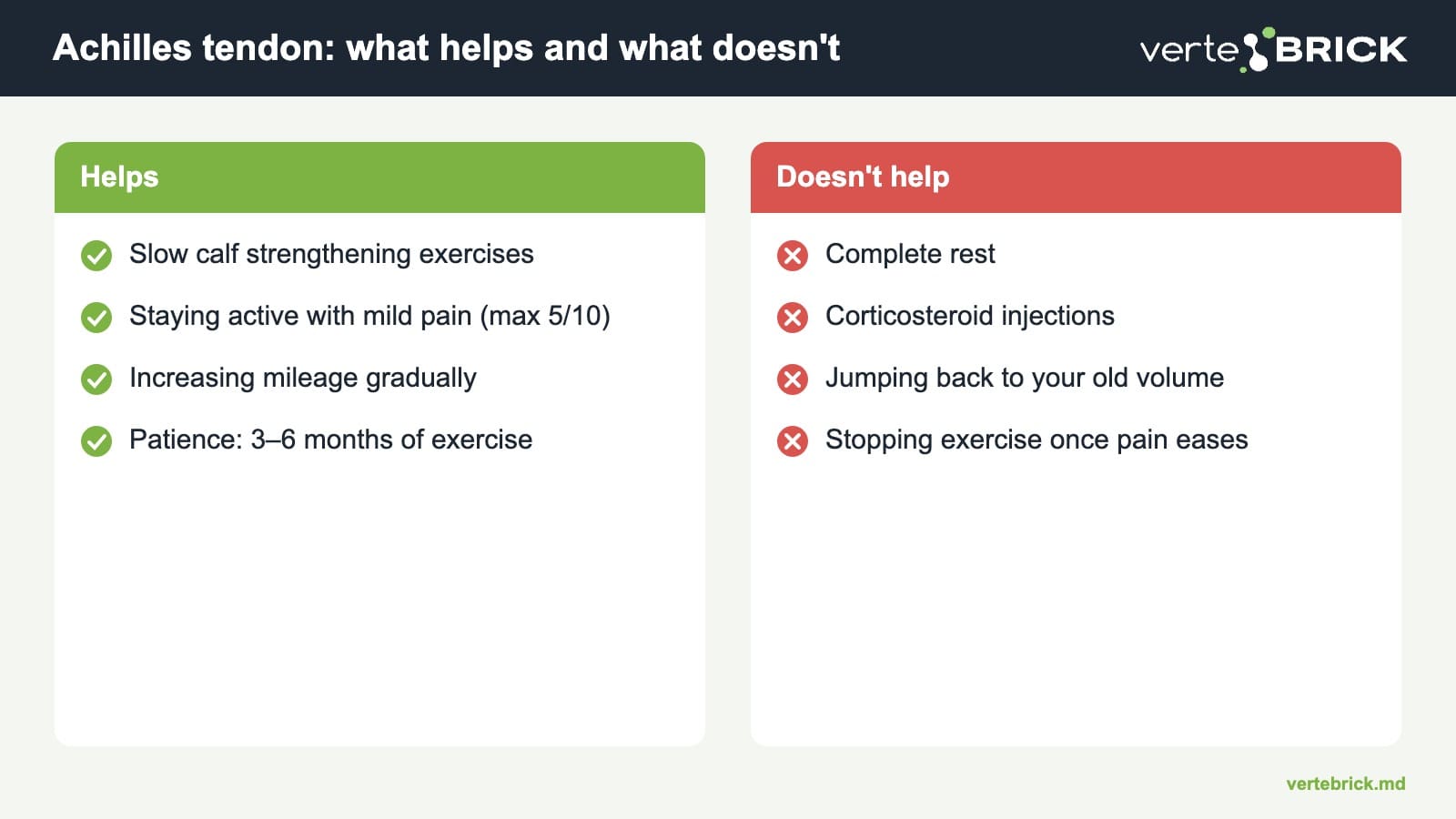
- Calf strengthening, slow and with weight, for example heel raises on a step. This is the treatment with the best evidence and is usually done for 12 weeks or more.
- Staying active with pain monitoring: you can keep walking and even running if pain during activity stays mild (no more than 5 out of 10) and settles by the next morning.
- Temporarily reducing the load: fewer kilometres, jumps and hills, then a gradual return.
- A small heel lift in your shoe for a short time, if walking is very painful.
What does not help or needs caution
- Complete rest. The tendon needs load to adapt; without it, the pain returns on your first run.
- Corticosteroid injections around the tendon. They can weaken the tendon and increase the risk of rupture.
- Waiting for it to go away without exercise. Tendinopathy often lasts for months, and exercise shortens the road.
- Jumping straight back to your previous volume. Increase the load gradually, week by week.
How long it takes
Tendons adapt slowly. Many people feel a clear improvement after 6–12 weeks of exercise, and full recovery can take 3–6 months. It is important not to stop the exercises once the pain goes down.
When to see a doctor urgently
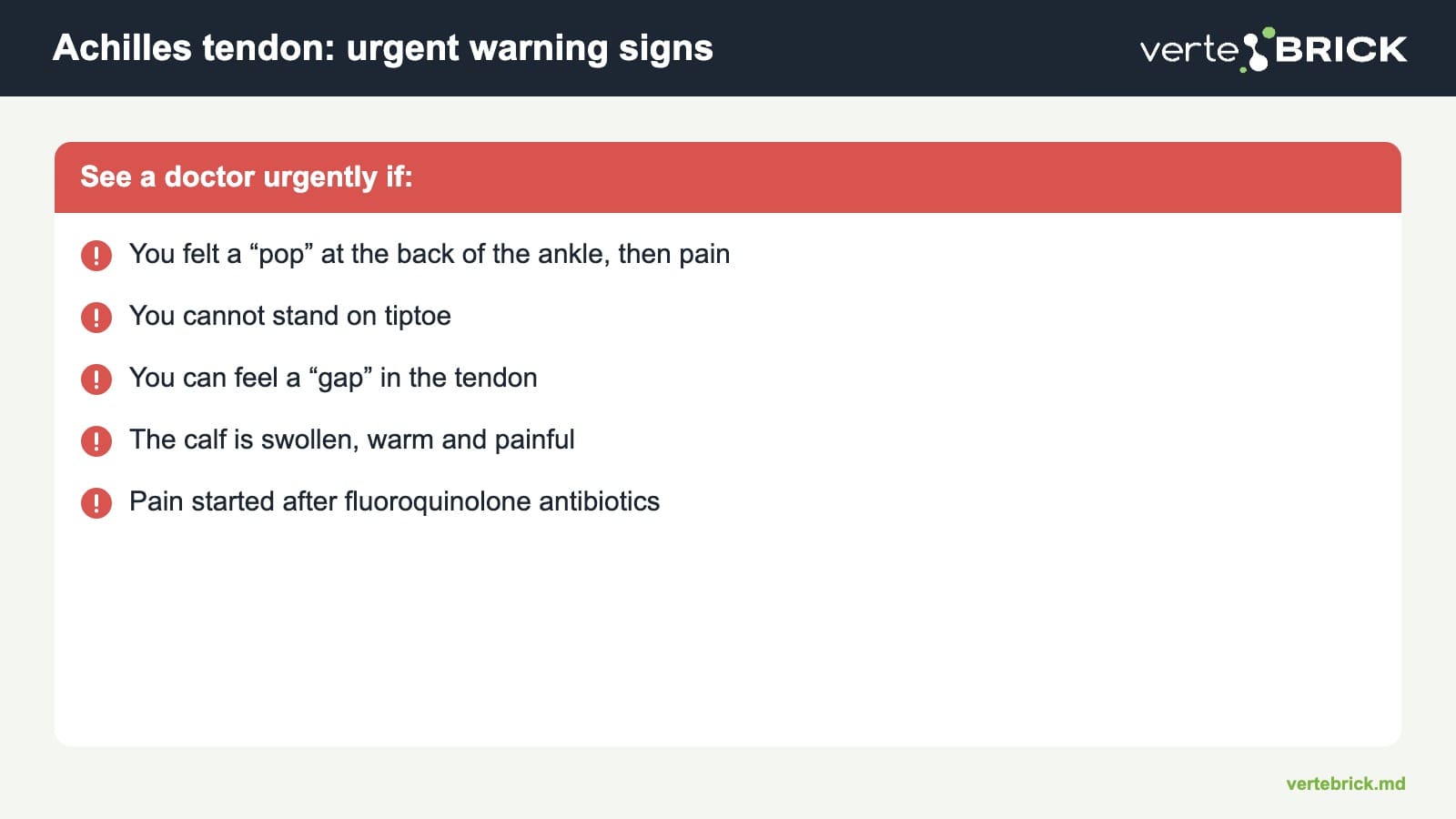
- you felt a “pop” or what felt like a kick at the back of the ankle, followed by pain;
- you cannot stand on tiptoe on the affected leg;
- you can feel a “gap” in the tendon;
- the calf is swollen, warm and painful;
- the pain started after a course of fluoroquinolone antibiotics.
The first three signs can mean a tendon rupture, which needs to be assessed the same day.
How we work at Vertebrick
At the assessment we check the tendon, calf strength, ankle mobility and how you walk or run, and we find out how you increased your training. You get a strengthening programme with clear progression, simple rules for pain monitoring and a plan to return to running or your sport.
Frequently asked questions
Can I run with Achilles tendinopathy?
Often yes, if pain during the run stays mild and settles by the next morning. If the pain builds from day to day, reduce your distance and speed.
How long does Achilles tendinopathy last?
Usually several months. With regular exercise, many people feel a clear improvement within 6–12 weeks.
Which exercises help Achilles tendon pain?
Calf strengthening, especially slow heel raises with gradually increasing weight. A physiotherapist chooses the right level for you.
Where can I get physiotherapy for Achilles tendon pain in Chișinău?
At the Vertebrick clinic, 12/2 Traian Blvd, Chișinău. Book on +373 69 82 62 12.
Book an assessment
Come in for an assessment at Vertebrick, 12/2 Traian Blvd, Chișinău, Moldova. We are open Monday to Saturday, 08:00–20:00.
📞 +373 69 82 62 12 · WhatsApp: wa.me/37369826212 · Fill in the form
Author: the Vertebrick team, physiotherapy clinic in Chișinău. This article is for information only and does not replace a medical consultation.
Sources
- Alfredson H, Pietilä T, Jonsson P, Lorentzon R. Heavy-load eccentric calf muscle training for the treatment of chronic Achilles tendinosis. American Journal of Sports Medicine, 1998.
- Beyer R, Kongsgaard M, Hougs Kjær B, et al. Heavy slow resistance versus eccentric training as treatment for Achilles tendinopathy: a randomized controlled trial. American Journal of Sports Medicine, 2015.
- Silbernagel KG, Thomeé R, Eriksson BI, Karlsson J. Continued sports activity, using a pain-monitoring model, during rehabilitation in patients with Achilles tendinopathy: a randomized controlled study. American Journal of Sports Medicine, 2007.
- Martin RL, Chimenti R, Cuddeford T, et al. Achilles pain, stiffness, and muscle power deficits: midportion Achilles tendinopathy revision 2018. Journal of Orthopaedic & Sports Physical Therapy, 2018.
- Stephenson AL, Wu W, Cortes D, Rochon PA. Tendon injury and fluoroquinolone use: a systematic review. Drug Safety, 2013.