
In short: an anterior cruciate ligament (ACL) tear is one of the most common serious knee injuries in people who play sport. Not everyone needs surgery: a large study showed that in active adults, well-run rehabilitation, with surgery only if the knee stays unstable, gave results similar to early surgery. Whether you have surgery or not, physiotherapy is what decides how well you come back.
How the tear happens
The anterior cruciate ligament stops the shin bone from sliding forward and stabilises the knee when you twist. It usually tears without contact: a sudden stop, a change of direction or a bad landing from a jump. Many people hear a “pop”, the knee swells within hours, and later the knee feels like it “gives way”.
The first weeks
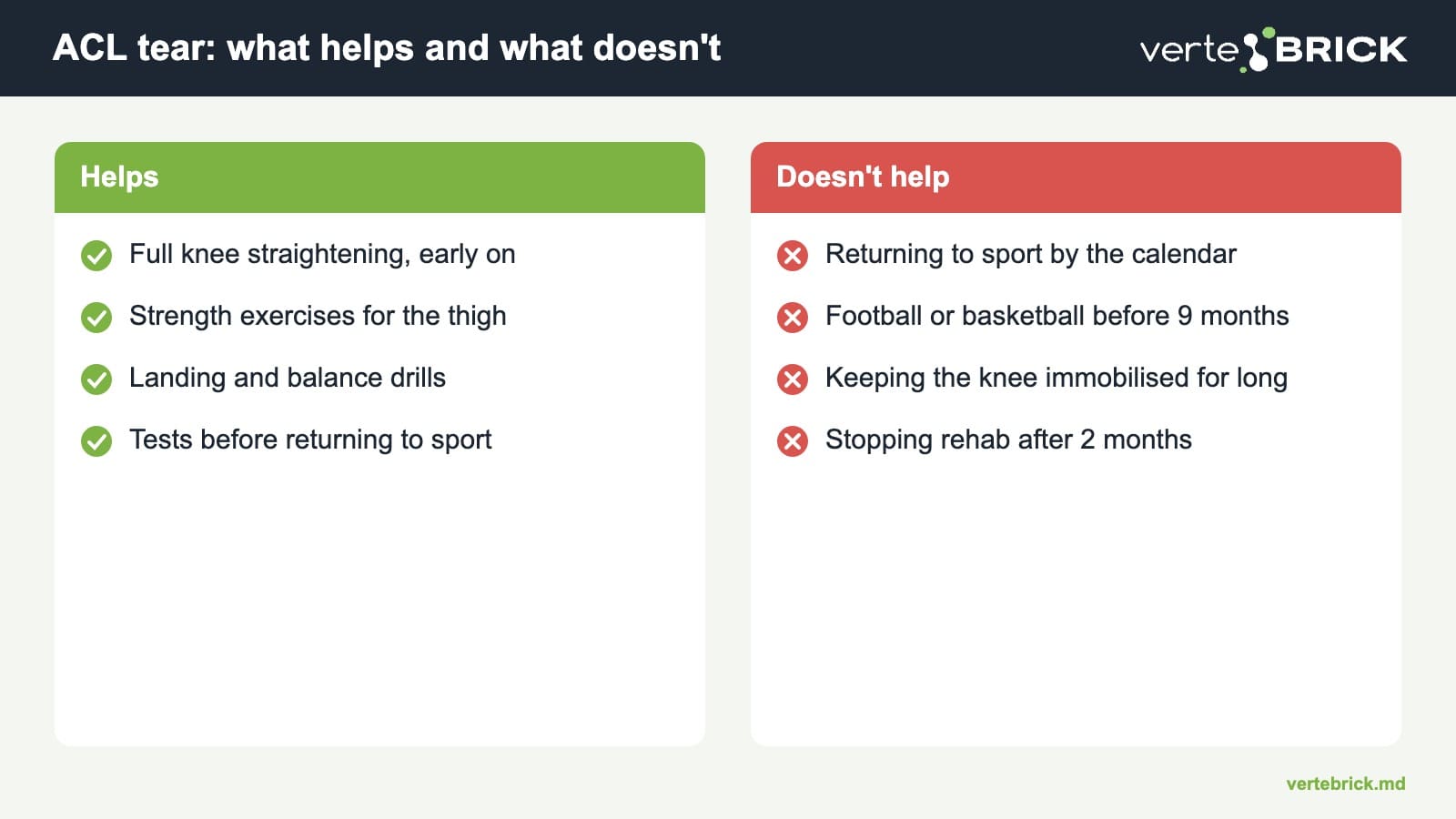
The aim is to reduce the swelling, get back full straightening of the knee and “wake up” the muscle at the front of the thigh. At first, crutches, ice and raising the leg help. Full knee straightening is very important: once it is lost, it is hard to get back.
Surgery or rehabilitation without surgery?
Surgery (ligament reconstruction) is usually recommended for people who want to return to sports with jumping and changes of direction, such as football, basketball, handball or skiing, and for people whose knee often gives way in daily life.
A large study compared early surgery with structured rehabilitation and surgery only if needed. After 2 and after 5 years the results were similar, and about half of the people in the second group never needed surgery. The decision is made together with an orthopaedic surgeon, based on your goals.
Rehabilitation after surgery, step by step
The time frames below are approximate. You move to the next stage when you meet the criteria, not just when time has passed.
- First 6 weeks: swelling goes down, full straightening returns, walking without crutches, thigh muscles switched on.
- 6 weeks – 3 months: strength exercises, balance, cycling.
- 3 – 6 months: running, jumping and correct landing drills.
- After 6 months: changes of direction and training specific to your sport.
When to return to sport
Return is decided by tests, not by the calendar: thigh strength in the operated leg should be almost equal to the healthy leg (at least 90%), hop tests should be passed, and you should trust your knee. Returning to sports with sudden changes of direction earlier than 9 months after surgery increases the risk of another tear.
When to call your doctor after surgery
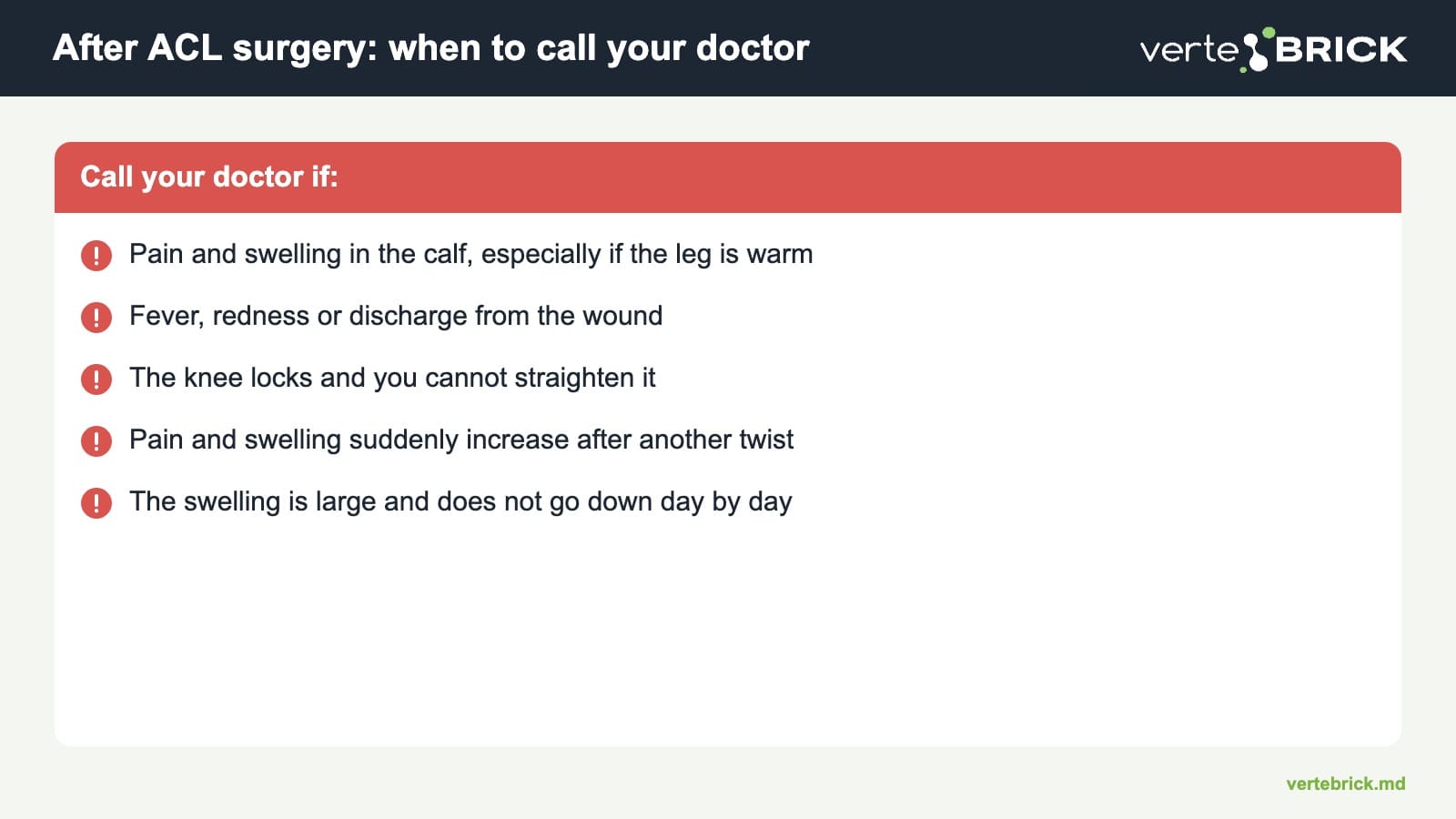
- pain and swelling in the calf, especially if the leg is warm (it may be a blood clot);
- fever, redness or discharge from the wound;
- the knee locks and you cannot straighten it;
- pain and swelling suddenly increase after another twist;
- the swelling is large and does not go down from day to day.
How we work at Vertebrick
At the assessment we check the swelling, movement, strength and stability of the knee, and together we set your goal: walking without pain, running or returning to your sport. You get a step-by-step plan, strength and hop tests before each important step, and we work together with your orthopaedic surgeon. We can also prepare you before surgery, so that recovery afterwards is easier.
Frequently asked questions
Can I live without an anterior cruciate ligament?
Yes. Many people live an active life without reconstruction, especially if they do not play sports with sudden changes of direction. What matters is muscle strength and whether the knee stays stable.
How long is recovery after ACL surgery?
Returning to sports with changes of direction usually takes at least 9 months. Normal walking and daily activities come back much sooner.
When should I start physiotherapy after an ACL tear?
As early as possible, even before surgery. A knee without swelling, with full straightening and active muscles, recovers more easily after surgery.
Where can I get ACL rehabilitation in Chișinău?
At the Vertebrick clinic, 12/2 Traian Blvd, Chișinău. Book on +373 69 82 62 12.
Book an assessment
Come in for an assessment at Vertebrick, 12/2 Traian Blvd, Chișinău, Moldova. We are open Monday to Saturday, 08:00–20:00.
📞 +373 69 82 62 12 · WhatsApp: wa.me/37369826212 · Fill in the form
Author: the Vertebrick team, physiotherapy clinic in Chișinău. This article is for information only and does not replace a medical consultation.
Sources
- Frobell RB, Roos EM, Roos HP, Ranstam J, Lohmander LS. A randomized trial of treatment for acute anterior cruciate ligament tears. New England Journal of Medicine, 2010.
- Frobell RB, Roos HP, Roos EM, et al. Treatment for acute anterior cruciate ligament tear: five year outcome of randomised trial. BMJ, 2013.
- Grindem H, Snyder-Mackler L, Moksnes H, Engebretsen L, Risberg MA. Simple decision rules can reduce reinjury risk by 84% after ACL reconstruction: the Delaware-Oslo ACL cohort study. British Journal of Sports Medicine, 2016.
- van Melick N, van Cingel REH, Brooijmans F, et al. Evidence-based clinical practice update: practice guidelines for anterior cruciate ligament rehabilitation based on a systematic review and multidisciplinary consensus. British Journal of Sports Medicine, 2016.
- Filbay SR, Grindem H. Evidence-based recommendations for the management of anterior cruciate ligament (ACL) rupture. Best Practice & Research Clinical Rheumatology, 2019.