
In short: an ankle sprain is the most common foot and ankle injury. Many people treat it with “patience” and go back to normal life once it stops hurting. The problem is that up to 4 in 10 people are left with an unstable ankle that keeps giving way. Balance and strength exercises clearly reduce the risk of another sprain.
What happens in a sprain
In most cases the foot rolls inwards, and the ligaments on the outside of the ankle are stretched or partly torn. Sprains are graded by severity:
- Grade 1: the ligament is stretched, pain and swelling are mild, you can walk.
- Grade 2: the ligament is partly torn, the ankle is swollen and bruised, walking hurts.
- Grade 3: the ligament is completely torn, the ankle is very swollen and unstable.
When you need an X-ray
Not every rolled ankle needs an X-ray. Doctors use simple rules: an X-ray is needed if you cannot take four steps right after the injury or at the appointment, or if it is very painful to press on the back edge or tip of the ankle bones, on the base of the bone behind the little toe on the outer edge of the foot, or on the bone in the middle of the inner edge of the foot. These signs may point to a fracture.
What to do in the first days
- Protect the ankle for 1–3 days: avoid movements that hurt a lot.
- Keep the foot raised when sitting and use an elastic bandage for the swelling.
- Ice can ease the pain but does not speed up healing.
- Start walking as soon as you can, within the limits of pain. Early movement helps the ligament heal better than long immobilisation.
In severe sprains, a brace or a short period of immobilisation, about 10 days, can speed up recovery. After that you return gradually to movement and exercise.
Why exercise is essential
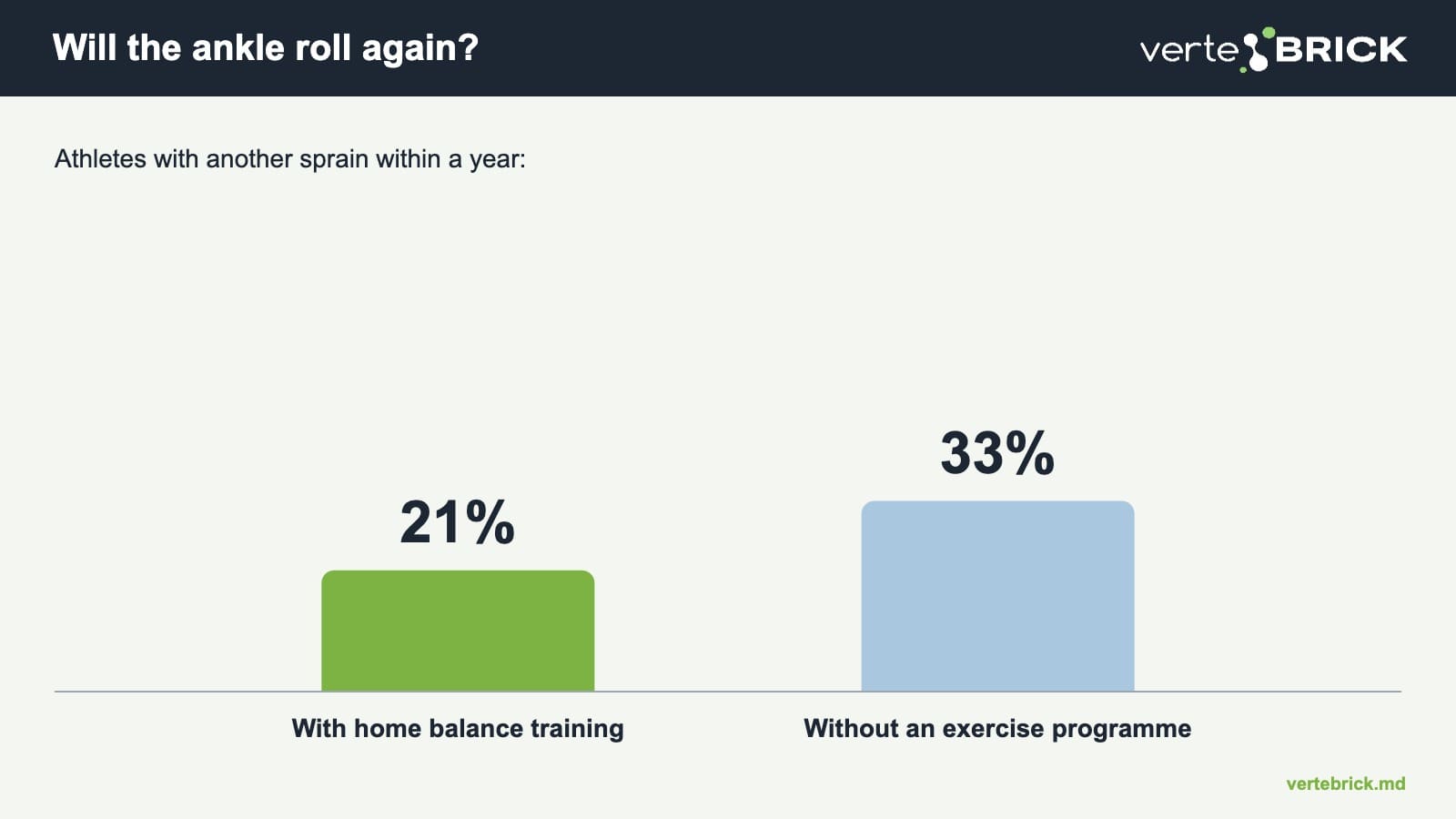
After a sprain the ligament heals, but the “sensors” in the ankle that tell the brain where the foot is stay impaired. That is why the ankle rolls again more easily. In a large study of athletes, an 8-week home balance training programme reduced the risk of another sprain by about a third.
What helps
- Balance exercises: standing on one leg, then with eyes closed, then on unstable surfaces.
- Strength exercises for the calf and the muscles around the ankle.
- A gradual return to sport: running in a straight line, then changes of direction, then jumping.
- A brace or functional taping for sport in the first months, especially after repeated sprains.
What does not help, or helps little
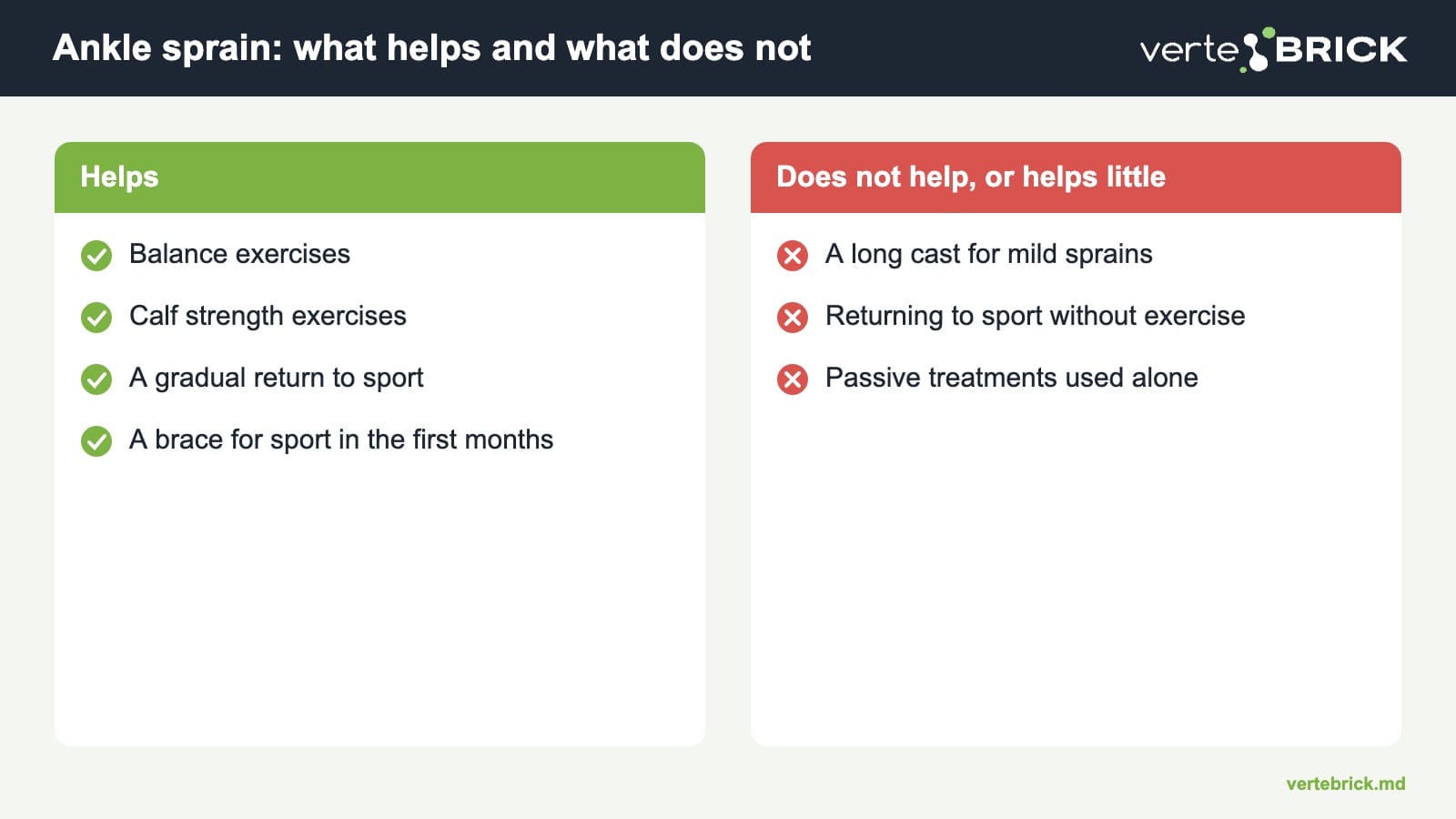
- Long immobilisation in a cast for mild and moderate sprains. The ankle becomes stiff and weak.
- Going back to sport only “when it stops hurting”, without exercise. The risk of re-injury stays high.
- Passive treatments used alone. They can ease pain for a short time but do not restore balance and strength.
How long recovery takes
A mild sprain usually settles in 1–3 weeks, a moderate one in 3–6 weeks, and a severe one may need several months. Return to sport should come when the injured ankle has strength and balance similar to the other side, not just when the pain is gone.
When to see a doctor urgently
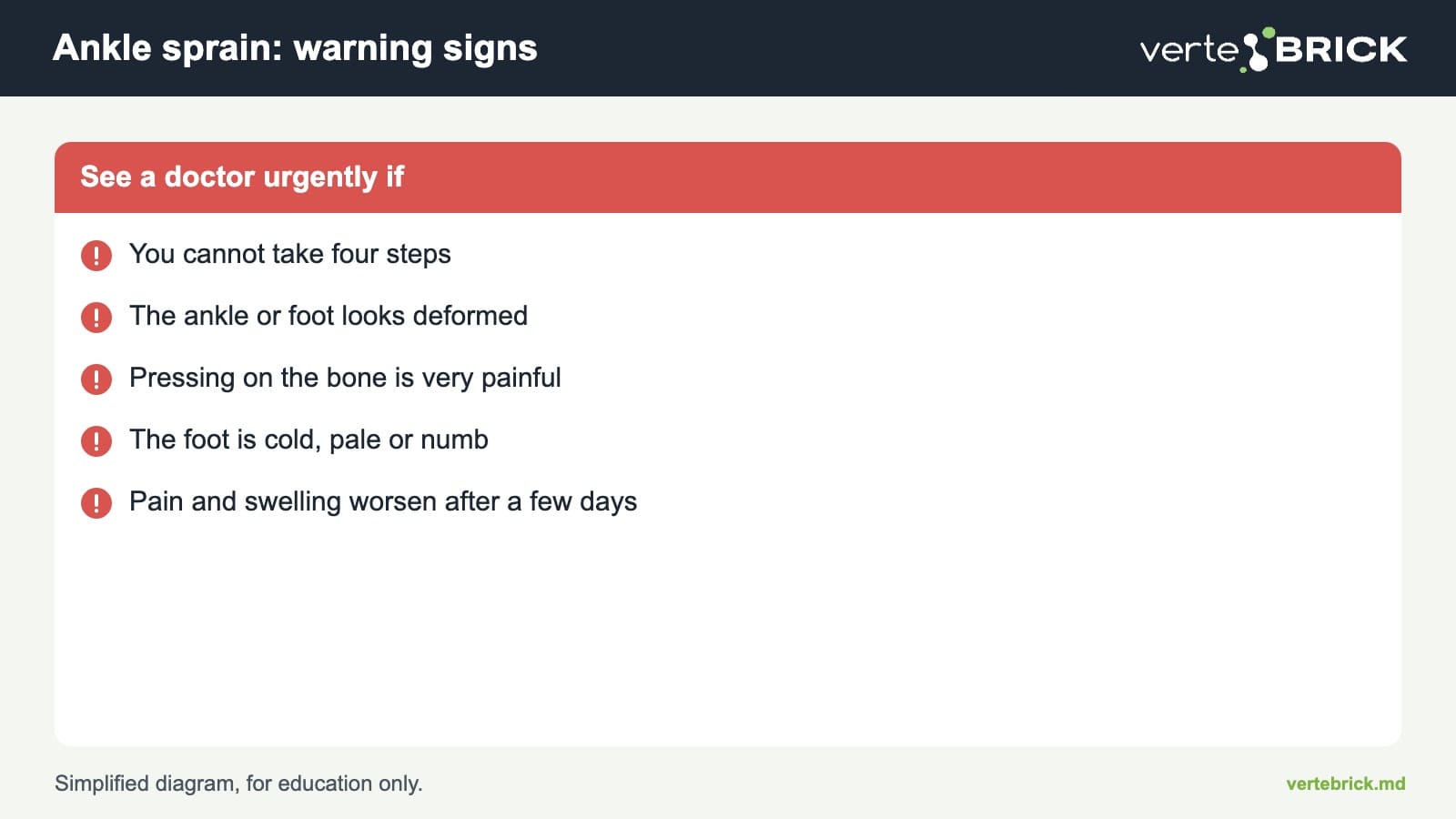
- you cannot take four steps on the injured foot;
- the ankle or foot looks deformed;
- pressing on the bone is very painful;
- the foot is cold, pale or numb;
- pain and swelling get worse instead of better after a few days.
How we work at Vertebrick
At the assessment, the physiotherapist checks the stability, mobility, strength and balance of your ankle and compares the injured side with the healthy one. You get a staged exercise programme, from the first days to returning to sport, plus clear tests that show when it is safe to go back.
Frequently asked questions
Do I need a cast after an ankle sprain?
Usually not. For mild and moderate sprains, early movement is better. Only in severe sprains can a short period of immobilisation help.
Why does my ankle keep rolling?
After a sprain that was not treated with exercise, the ankle stays weaker and balance stays poorer. Balance and strength exercises reduce this risk.
When can I go back to running or football?
When you can hop on the injured foot without pain and your balance and strength are similar to the other leg. A physiotherapist can check this with simple tests.
Where can I get ankle sprain rehabilitation in Chișinău?
At Vertebrick clinic, 12/2 Traian Blvd, Chișinău, Moldova. Bookings: +373 69 82 62 12.

Book an assessment
Come in for an assessment at Vertebrick, 12/2 Traian Blvd, Chișinău, Moldova. We are open Monday to Saturday, 08:00–20:00.
📞 +373 69 82 62 12 · WhatsApp: wa.me/37369826212 · Fill in the form
Author: the Vertebrick team, physiotherapy clinic in Chișinău. This article is for information only and does not replace a medical consultation.
Sources
- Gribble PA, Bleakley CM, Caulfield BM, et al. Evidence review for the 2016 International Ankle Consortium consensus statement on the prevalence, impact and long-term consequences of lateral ankle sprains. British Journal of Sports Medicine, 2016.
- Hupperets MDW, Verhagen EALM, van Mechelen W. Effect of unsupervised home based proprioceptive training on recurrences of ankle sprain: randomised controlled trial. BMJ, 2009.
- Lamb SE, Marsh JL, Hutton JL, et al. Mechanical supports for acute, severe ankle sprain: a pragmatic, multicentre, randomised controlled trial. The Lancet, 2009.
- Stiell IG, Greenberg GH, McKnight RD, et al. Decision rules for the use of radiography in acute ankle injuries. JAMA, 1993.
- Vuurberg G, Hoorntje A, Wink LM, et al. Diagnosis, treatment and prevention of ankle sprains: update of an evidence-based clinical guideline. British Journal of Sports Medicine, 2018.