
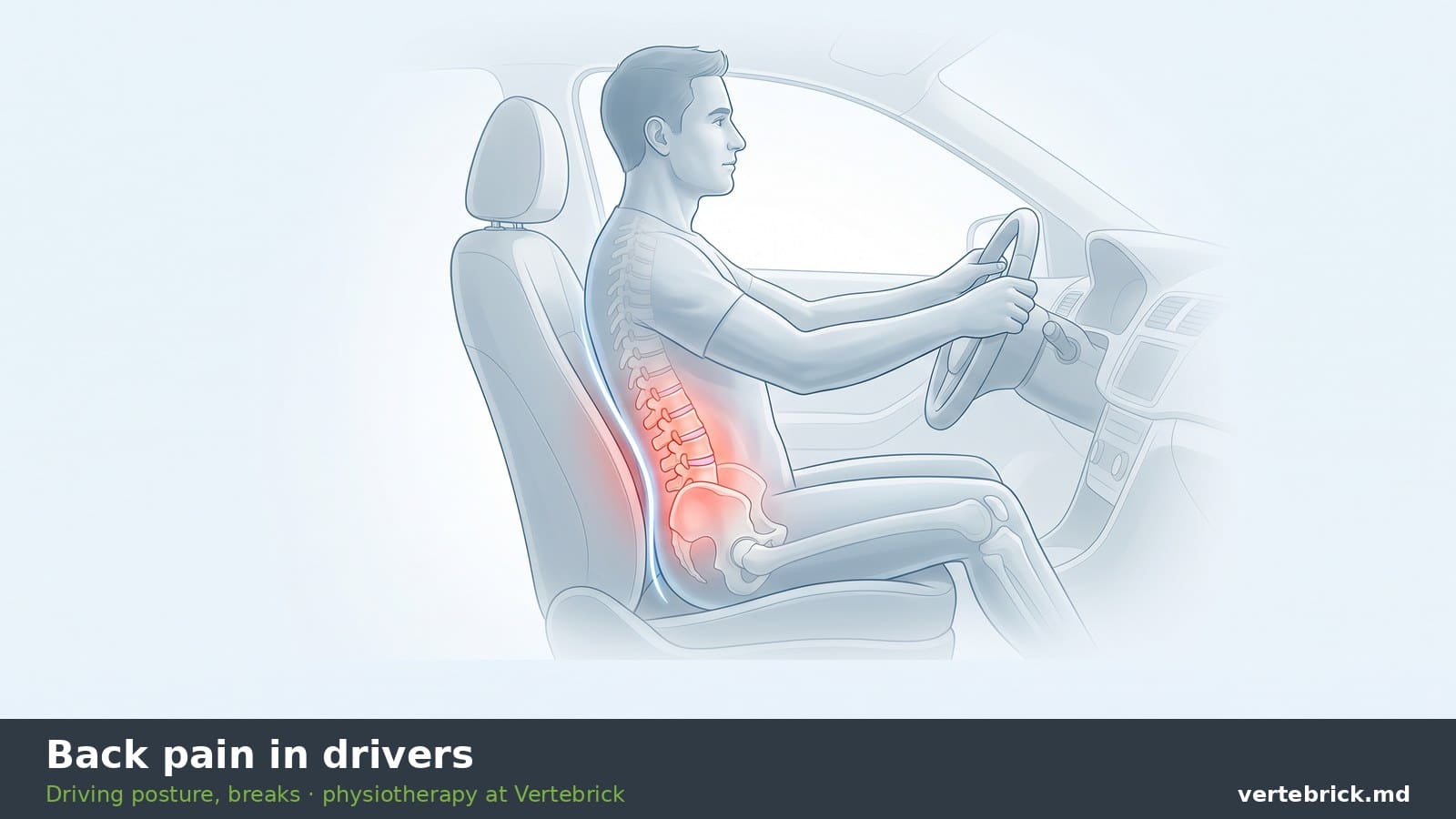
In short: back pain is common in people who drive a lot — taxi and truck drivers, couriers and anyone who spends hours behind the wheel. Long sitting, vehicle vibration and lifting loads straight after a drive all raise the risk. A well-adjusted seat, regular breaks and simple exercises help most. Most episodes settle within a few weeks.
Why your back hurts at the wheel
When driving you stay in one position for a long time, with the back and hip muscles barely working. Road vibration, especially in trucks and on rough roads, adds load to the spine. Many drivers unload goods or luggage right after hours of driving, while the back is still stiff. Fatigue, short sleep and stress make pain easier to feel.
Ordinary pain or something serious?
Most often it is mechanical pain: it comes on after long drives, eases when you move and has no serious cause. Less often the pain travels down the leg below the knee with numbness or tingling — a sign that a nerve is irritated. In that case an assessment is a good idea.
Typical signs
- low back pain or stiffness after long drives;
- difficulty getting out of the car and straightening up;
- pain in the buttock or the back of the thigh;
- discomfort that eases after a few minutes of walking;
- sometimes tension in the neck and shoulders.
What helps
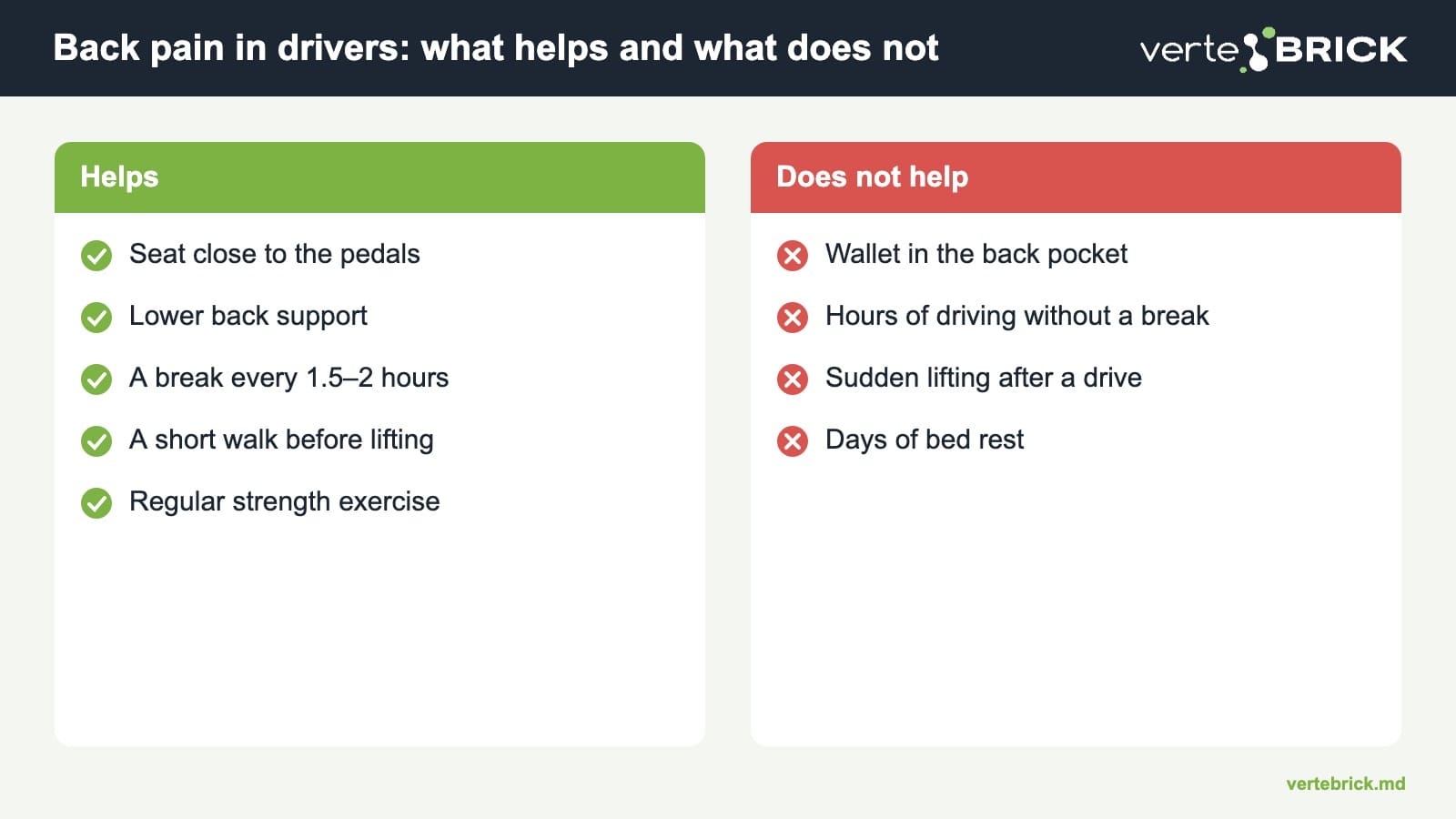
- the seat close to the pedals, with knees slightly bent;
- the backrest slightly reclined, with lower back support;
- a break every 1.5–2 hours, with a few minutes of walking;
- a few minutes of walking and movement before lifting after a drive;
- regular strength exercise for the back, trunk and hips.
What does not help
- a wallet or phone in your back pocket while driving;
- hours of driving without any break;
- sudden heavy lifting straight after a drive;
- days of bed rest when the pain starts.
How long it lasts
An episode of back pain usually settles within a few days to a few weeks. If the pain keeps coming back or lasts more than 6 weeks, an assessment and an exercise programme are worthwhile to lower the risk of new episodes.
When to see a doctor urgently
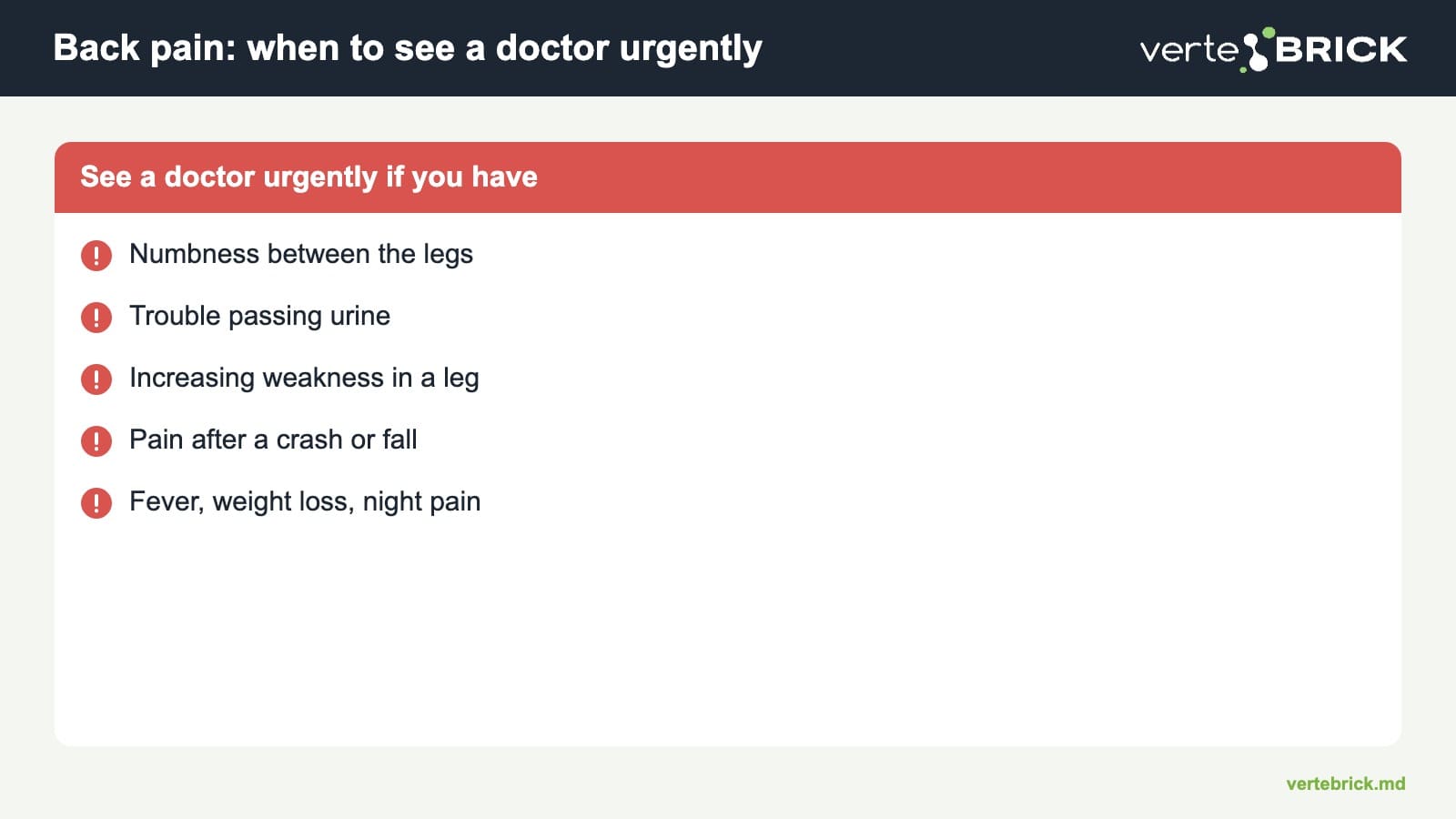
- numbness between the legs or around the back passage;
- difficulty passing urine or loss of control;
- increasing weakness in a leg;
- pain after a crash or a fall;
- fever, weight loss or severe pain at night.
How we work at Vertebrick
We assess the mobility and strength of your back and hips and talk about what your day at the wheel looks like. We build a short exercise programme for home and for your breaks, plus practical tips on seat set-up and lifting after a drive.
Frequently asked questions
Why does my back hurt after a long drive?
Long sitting in one position, road vibration and lifting loads straight after driving all put strain on the spine and back muscles.
How often should I take breaks on long drives?
A break every 1.5–2 hours, with a few minutes of walking and movement, helps the back relax.
What exercises help drivers with back pain?
Regular strength exercise for the back, trunk and hips, plus simple mobility movements during breaks.
Where can I get physiotherapy for back pain in Chisinau?
At the Vertebrick clinic in Chisinau, with an assessment and an exercise programme that fits your driving schedule.

Book an assessment
Come in for an assessment at Vertebrick, 12/2 Traian Blvd, Chișinău, Moldova. We are open Monday to Saturday, 08:00–20:00.
📞 +373 69 82 62 12 · WhatsApp: wa.me/37369826212 · Fill in the form
Author: the Vertebrick team, physiotherapy clinic in Chișinău. This article is for information only and does not replace a medical consultation.
Sources
- Foster NE et al. Prevention and treatment of low back pain: evidence, challenges, and promising directions. Lancet. 2018;391(10137):2368–2383.
- Burström L, Nilsson T, Wahlström J. Whole-body vibration and the risk of low back pain and sciatica: a systematic review and meta-analysis. Int Arch Occup Environ Health. 2015;88(4):403–418.
- NICE. Low back pain and sciatica in over 16s: assessment and management (NG59). 2016, updated 2020.