

In short: low back and pelvic pain is very common in pregnancy and, in most cases, does not mean that something is wrong with you or your baby. Studies show that movement and adapted exercise help, while long bed rest is not a solution. Below you will find why the pain appears, what you can do and when you need to see a doctor.
How common it is
More than two-thirds of pregnant women have low back pain at some point, and almost one in five has pain around the pelvis. The pain usually increases as pregnancy advances and can make sleeping, walking and working harder.
Why the back hurts in pregnancy
- Your weight goes up and your centre of gravity moves forward. The back muscles work harder to keep you upright.
- Hormones relax the ligaments of the pelvis. The joints become more mobile to prepare for birth, and they can become painful.
- The abdominal muscles stretch and support the spine less.
- Tiredness, poor sleep and staying in one position for a long time keep the pain going.
Pelvic pain is usually felt at the back, around the buttocks, or at the front, over the pubic bone. It often appears when walking, climbing stairs, turning in bed or standing on one leg.
What helps
An exercise programme followed for 8–12 weeks reduced the number of pregnant women with back and pelvic pain and cut the days of sick leave. The evidence is not perfect, but the direction is clear: adapted movement helps more than resting.
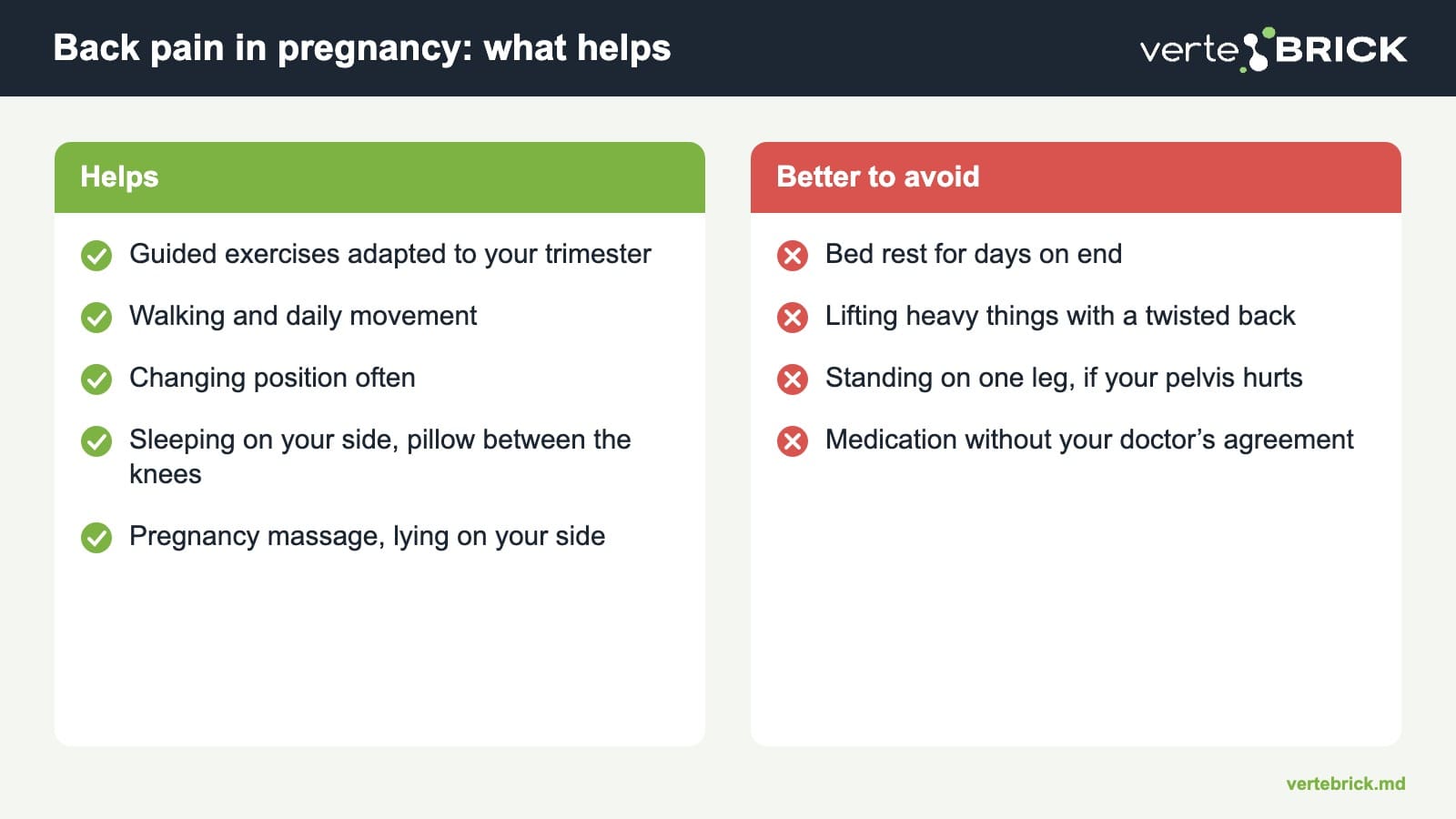
- Guided exercises for the trunk, the glutes and the pelvic floor, adapted to your trimester.
- Walking and daily movement. If there are no complications, physical activity in pregnancy is safe and recommended: about 150 minutes of moderate activity a week.
- Change position often. Avoid long periods of sitting or standing.
- Sleep on your side, with a pillow between your knees.
- Pregnancy-adapted massage, done lying on your side, can reduce back pain and tension.
What is better to avoid
- bed rest for days on end;
- lifting heavy things with a twisted back;
- standing on one leg and very long strides, if your pelvis hurts;
- medication without the agreement of the doctor who follows your pregnancy.
When to see a doctor urgently
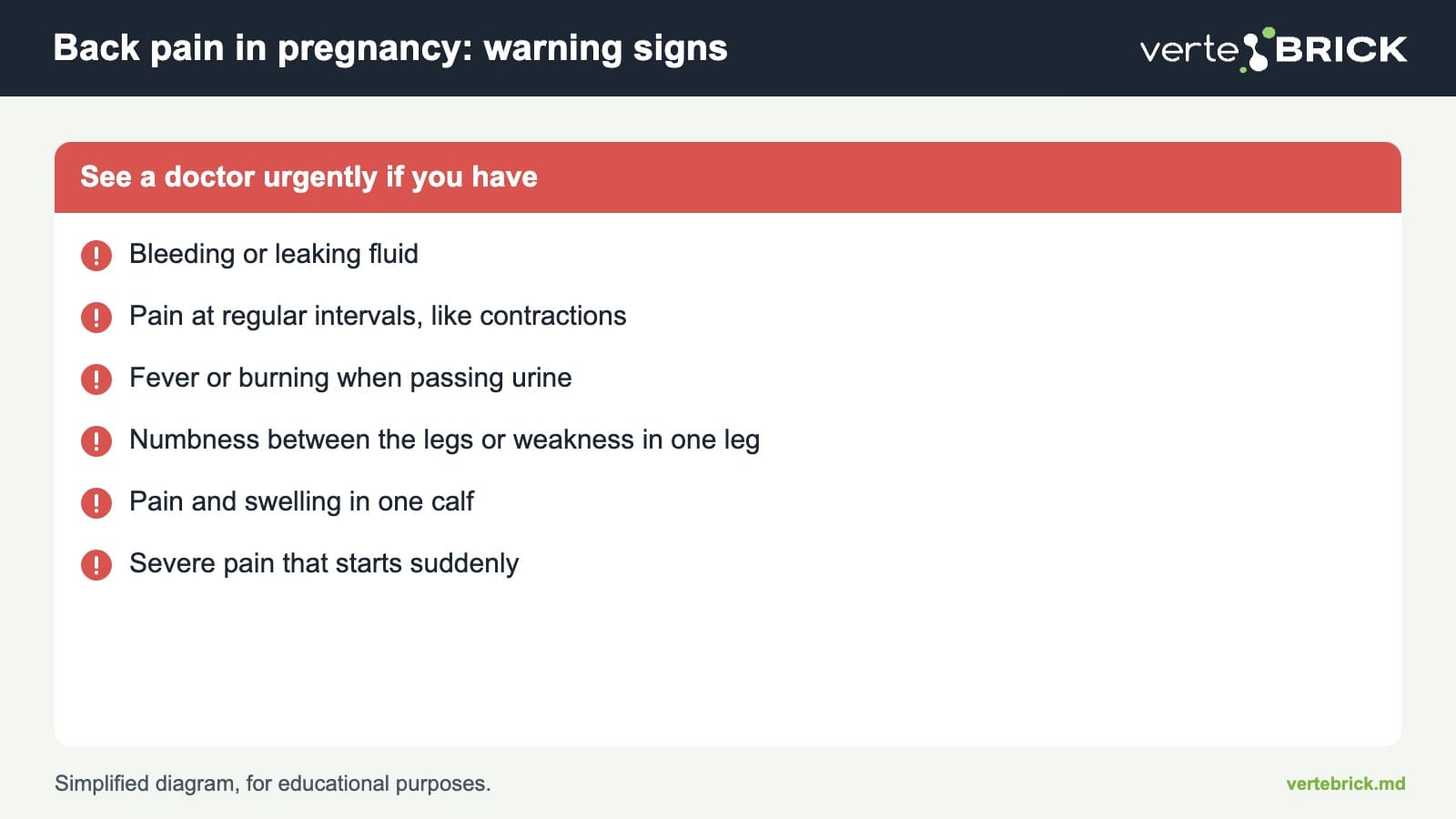
Call your doctor or go to the emergency department if back pain comes together with any of these:
- bleeding or leaking fluid;
- pain that comes and goes at regular intervals, like contractions;
- fever or burning when you pass urine;
- numbness between the legs, weakness in one leg or new bladder problems;
- pain and swelling in one calf only;
- severe pain that starts suddenly and is unlike what you had before.
How we work with pregnant women at Vertebrick
At the first visit the physiotherapist asks about your pregnancy, your pain and what your doctor has told you, then checks how your spine and pelvis move. You receive exercises that suit your trimester and advice for sleeping, working and lifting. If needed, we add pregnancy-adapted massage, done lying on your side.
If your pregnancy is high-risk or your doctor has advised you to limit effort, bring that recommendation with you: we adapt the programme or tell you honestly if it is better to wait.
Frequently asked questions
Is it dangerous to exercise in pregnancy?
In a pregnancy without complications, moderate movement is safe and recommended. Stop and call your doctor if you have bleeding, painful contractions, dizziness, chest pain or leaking fluid.
Does back pain go away after birth?
For many women it eases in the first months. If it persists, postnatal recovery exercises help rebuild the strength of the abdomen and back.
Can I have a massage in pregnancy?
Yes, in a pregnancy without complications, with a therapist who works with you lying on your side, without pressure on the abdomen and without deep massage of the legs. If you have complications, ask your doctor first.
Where can I get physiotherapy for pregnant women in Chișinău?
At Vertebrick clinic, 12/2 Traian Blvd, Chișinău. Bookings: +373 69 82 62 12.

Book an assessment
Come in for an assessment at Vertebrick, 12/2 Traian Blvd, Chișinău. We are open Monday to Saturday, 08:00–20:00.
📞 +373 69 82 62 12 · WhatsApp: wa.me/37369826212 · Fill in the form
Author: the Vertebrick team, physiotherapy clinic in Chișinău. This article is for information only and does not replace a medical consultation.
Sources
- Liddle SD, Pennick V. Interventions for preventing and treating low-back and pelvic pain during pregnancy. Cochrane Database of Systematic Reviews, 2015.
- American College of Obstetricians and Gynecologists. Physical Activity and Exercise During Pregnancy and the Postpartum Period. Committee Opinion No. 804, 2020.
- Mueller SM, Grunwald M. Effects, Side Effects and Contraindications of Relaxation Massage during Pregnancy: A Systematic Review of Randomized Controlled Trials. Journal of Clinical Medicine, 2021.