

In short: a distal radius fracture, or broken wrist, is one of the most common fractures, especially after a fall on an outstretched hand. While you are in a cast or after surgery, the fingers, elbow and shoulder need to move every day. After the cast comes off, mobility exercises and then strength exercises gradually restore hand function. Most progress comes in the first 3 months, and grip strength keeps improving for up to a year.
Why the wrist stays stiff
After a few weeks of immobilisation, the joint stiffens, the forearm muscles weaken and the hand may swell. That is why, after the cast is removed, turning the forearm, bending the wrist and making a fist are limited and painful. These come back with movement, not rest.
Stages of recovery
- In the cast: move your fingers, elbow and shoulder several times a day and keep the hand raised to reduce swelling.
- After the cast comes off: gentle exercises for bending and straightening the wrist and turning the forearm, several times a day.
- After 2–4 weeks of movement: strength exercises for grip, forearm and shoulder, progressed gradually.
- Return to usual activities and sport when strength and mobility allow.
What helps
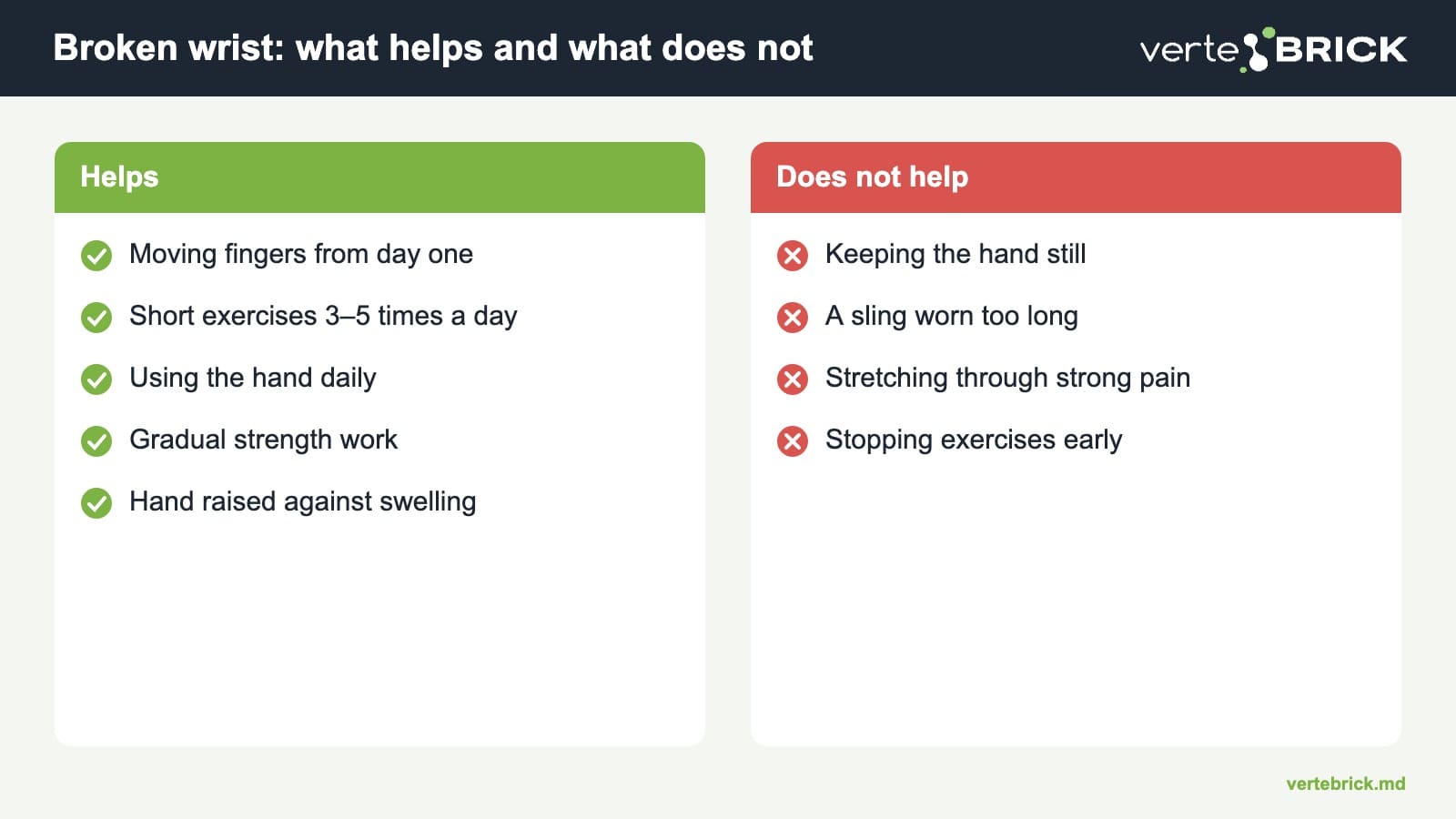
- Moving your fingers from day one, even in the cast.
- Short, frequent home exercises, 3–5 times a day.
- Using the hand in light daily tasks: dressing, eating, writing.
- Gradually progressed strength exercises for grip and forearm.
- Swelling control: hand raised and finger movements.
What does not help
- Keeping the hand still "so nothing breaks". Stiffness increases.
- Wearing a sling for too long, which stiffens the shoulder too.
- Forcing stretches through strong pain. Mobility comes back gradually.
- Stopping the exercises when the hand looks fine but strength has not returned.
How long it takes
The cast is usually worn for 4–6 weeks. After it comes off, most patients return to daily activities within 6–12 weeks. Grip strength and end-range movements can keep improving for up to a year. If the fracture happened after a simple fall over age 50, it is worth discussing osteoporosis with your doctor.
When to see a doctor urgently
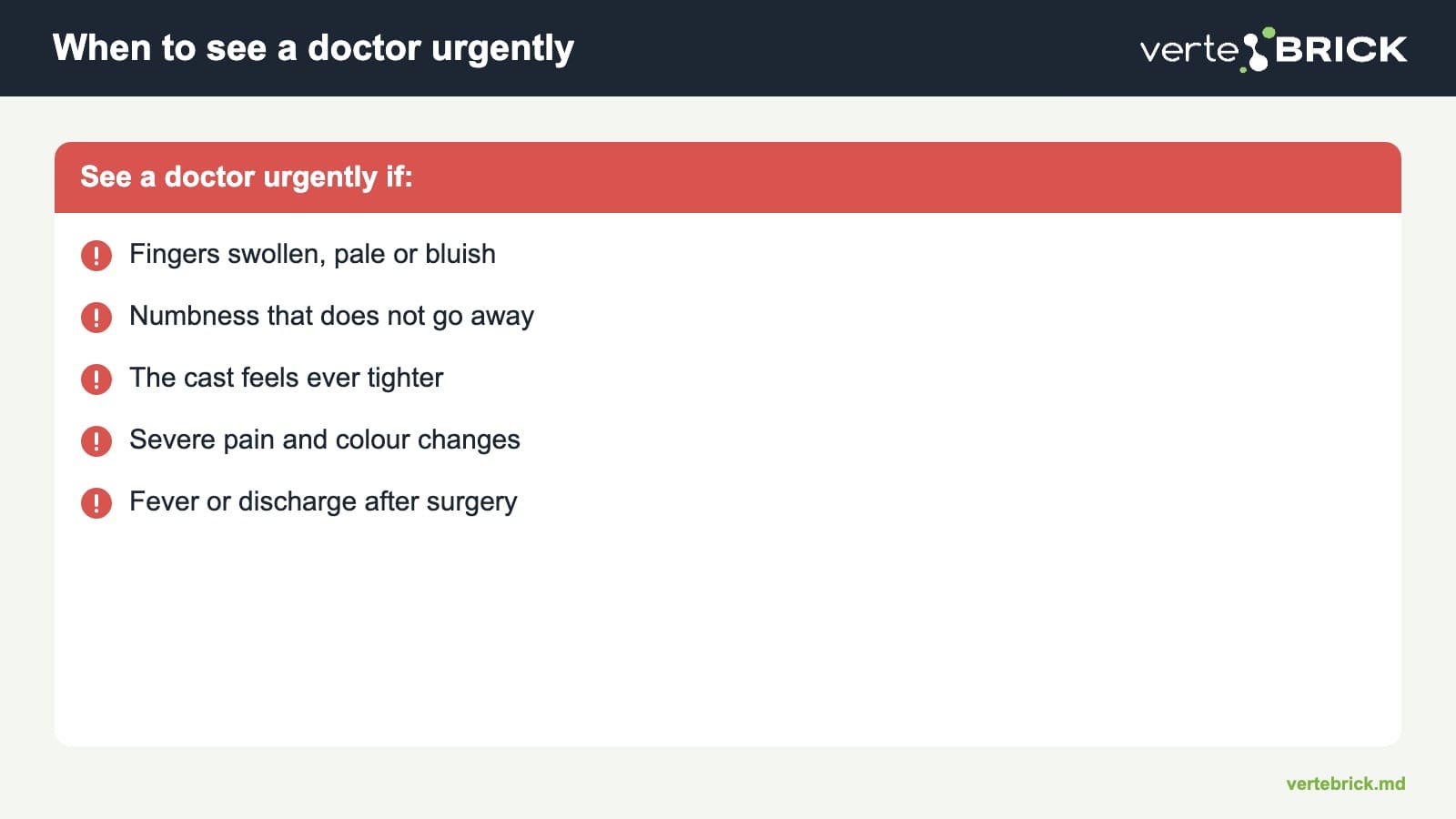
- fingers in the cast become very swollen, pale or bluish;
- numbness or tingling in the fingers that does not go away;
- the cast feels tighter and tighter or pain rises sharply;
- very severe pain, colour and temperature changes in the hand after the cast comes off;
- fever or discharge at the surgical site.
How we work at Vertebrick
At the first visit we measure wrist and forearm range of motion in degrees, grip strength and swelling. Based on these values we choose the exercises for each stage, show you what to do at home and check progress at every session, in line with your orthopaedic surgeon's advice.
Frequently asked questions
How long is recovery after a distal radius fracture?
Usually 6–12 weeks after the cast comes off for daily activities, and up to a year for full strength.
When do exercises start after a wrist fracture?
Fingers, elbow and shoulder move from day one. Wrist exercises start after the cast comes off or when your doctor allows.
Is it normal for the hand to be stiff after the cast?
Yes. Stiffness and mild swelling are normal after immobilisation and ease gradually with regular exercise.
Where can I get wrist fracture rehab in Chisinau?
At the Vertebrick clinic in Chisinau, with step-by-step exercises and mobility and strength measured at every session.

Book an assessment
Come in for an assessment at Vertebrick, 12/2 Traian Blvd, Chișinău, Moldova. We are open Monday to Saturday, 08:00–20:00.
📞 +373 69 82 62 12 · WhatsApp: wa.me/37369826212 · Fill in the form
Author: the Vertebrick team, physiotherapy clinic in Chișinău. This article is for information only and does not replace a medical consultation.
Sources
- Handoll HHG, Elliott J. Rehabilitation for distal radial fractures in adults. Cochrane Database Syst Rev. 2015;(9):CD003324.
- American Academy of Orthopaedic Surgeons. Management of Distal Radius Fractures: Evidence-Based Clinical Practice Guideline. 2020.
- Mauck BM, Swigler CW. Evidence-based review of distal radius fractures. Orthop Clin North Am. 2018;49(2):211–222.
- Kanis JA et al. European guidance for the diagnosis and management of osteoporosis in postmenopausal women. Osteoporos Int. 2019;30(1):3–44.