
In short: many headaches that start at the back of the head are tension-type headaches or cervicogenic headaches, meaning they come from the neck. They are not dangerous, but they can come back often. Exercises for the deep neck and shoulder muscles, manual therapy and regular screen breaks reduce how often they happen and how strong they are. There are, however, warning signs that need a doctor straight away.
Two common types
A tension-type headache presses like a band around the head, on both sides, and does not get worse with light activity. A cervicogenic headache starts at the back of the neck, usually on one side, spreads towards the temple or eye and appears or increases with certain neck positions or movements. Both are often linked to long hours at a desk, stress and poor sleep.
Typical signs
- pain that starts at the back of the neck or the base of the skull;
- a stiff neck, especially after a day at the computer;
- tender spots in the neck and shoulder muscles;
- pain that increases with certain head positions;
- no strong nausea and no vision problems.
What helps
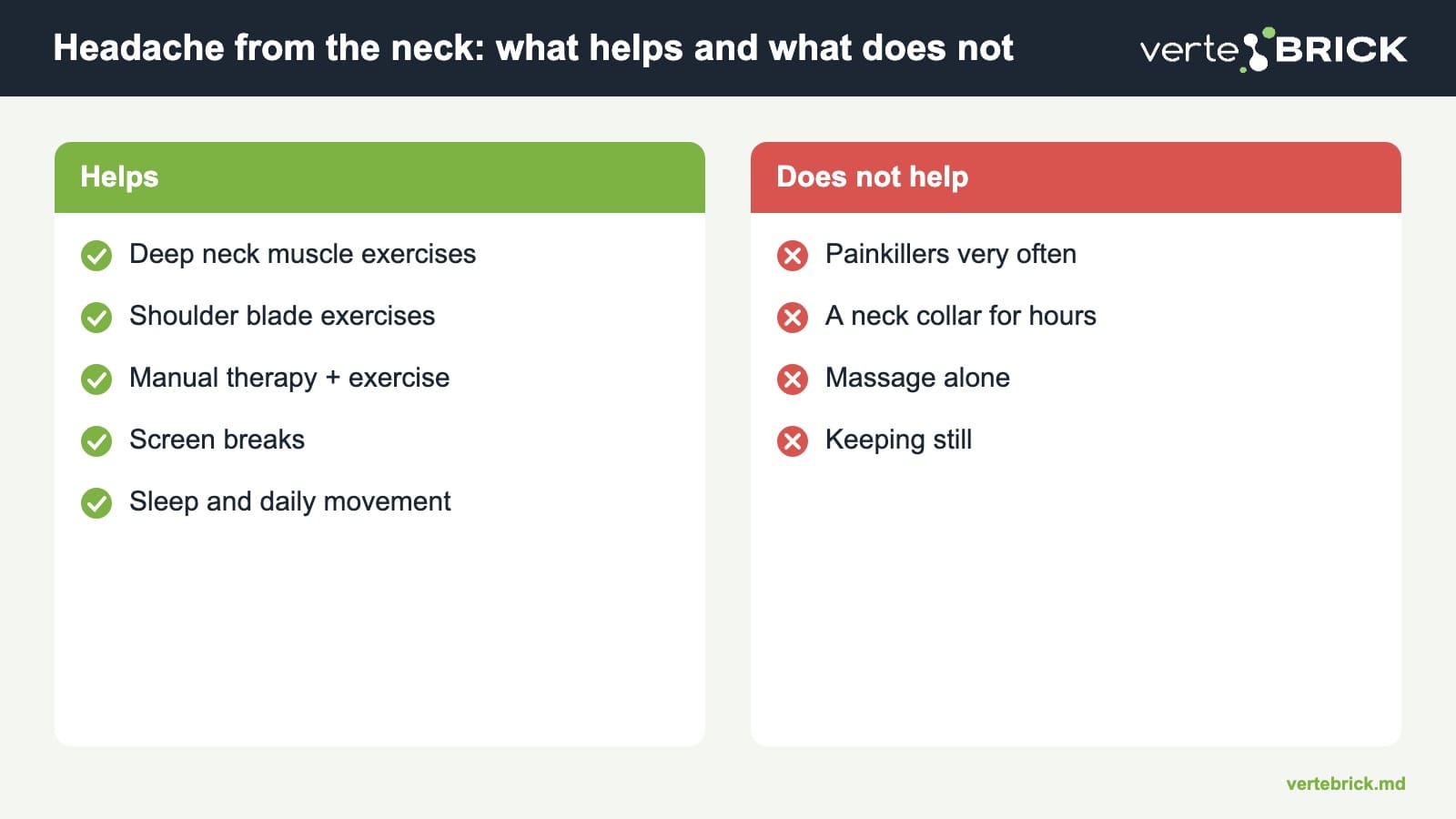
- Exercises for the deep neck muscles, for example a gentle chin nod held for a few seconds, progressed gradually.
- Shoulder blade and shoulder exercises that take load off the neck muscles.
- Manual therapy for the neck, combined with exercise, not instead of it.
- Short screen breaks every 30–45 minutes and a monitor at eye level.
- Regular sleep, daily movement and stress management.
What does not help
- Taking painkillers very often. Used on more than 10–15 days a month, they can keep the headache going.
- Wearing a neck collar for hours. Muscles weaken and stiffness increases.
- Massage alone, without exercise. It brings short-term relief, but the pain comes back.
- Keeping still for fear that moving the neck will cause harm.
How long it lasts
A tension-type headache episode usually lasts from a few hours to a few days. With a regular exercise programme, many patients notice fewer and milder headaches after 4–6 weeks. The effect lasts if the exercises become part of your routine.
When to see a doctor urgently
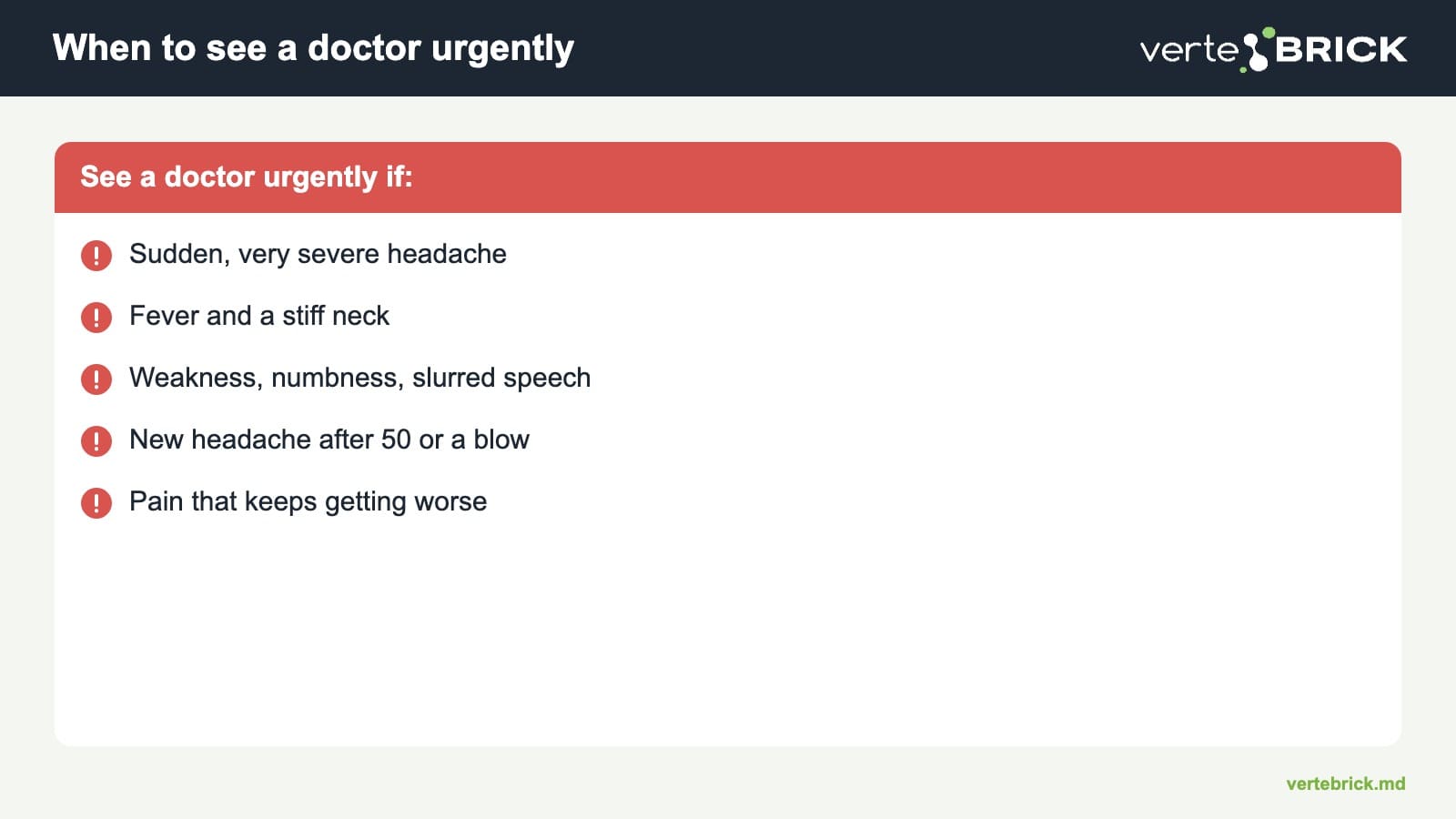
- a very severe headache that starts suddenly, "like a thunderclap";
- fever and a stiff neck, especially with nausea or confusion;
- weakness, numbness, slurred speech or vision problems;
- a new headache after age 50 or after a blow to the head;
- pain that keeps getting worse from week to week.
How we work at Vertebrick
At the first visit we ask how and when the pain appears, check for warning signs, and test neck mobility, deep muscle strength and your desk posture. Then we build a step-by-step exercise programme and track how often the headache appears from week to week. If a neurology consultation is needed, we tell you from the start.
Frequently asked questions
Can a headache come from the neck?
Yes. A cervicogenic headache starts from the joints and muscles of the neck and spreads to the head, usually on one side.
Which exercises help a headache from the neck?
Exercises for the deep neck muscles and the shoulder blades, done daily and progressed gradually, give the best results.
How quickly will I see an effect?
Many patients notice fewer headaches after 4–6 weeks of regular exercise.
Where can I get treatment for neck-related headaches in Chisinau?
At the Vertebrick clinic in Chisinau, after an assessment of your neck and posture, with an exercise programme checked at every session.
Book an assessment
Come in for an assessment at Vertebrick, 12/2 Traian Blvd, Chișinău, Moldova. We are open Monday to Saturday, 08:00–20:00.
📞 +373 69 82 62 12 · WhatsApp: wa.me/37369826212 · Fill in the form
Author: the Vertebrick team, physiotherapy clinic in Chișinău. This article is for information only and does not replace a medical consultation.
Sources
- Jull G et al. A randomized controlled trial of exercise and manipulative therapy for cervicogenic headache. Spine. 2002;27(17):1835–1843.
- Fernández-de-las-Peñas C, Cuadrado ML. Physical therapy for headaches. Cephalalgia. 2016;36(12):1134–1142.
- Headache Classification Committee of the International Headache Society. The International Classification of Headache Disorders, 3rd edition. Cephalalgia. 2018;38(1):1–211.
- Do TP et al. Red and orange flags for secondary headaches in clinical practice: SNNOOP10 list. Neurology. 2019;92(3):134–144.
- Gross A et al. Exercises for mechanical neck disorders. Cochrane Database Syst Rev. 2015;(1):CD004250.