
In short: a frozen shoulder (adhesive capsulitis) makes the shoulder painful and increasingly stiff, without any clear injury. It is more common between 40 and 60, in women and in people with diabetes or thyroid problems. It usually gets better with time, but it can last one to three years. Gentle exercises suited to the phase of the condition, and sometimes an injection early on, help you get through this period more easily.
What a frozen shoulder is
The shoulder joint is wrapped in a capsule. In a frozen shoulder, the capsule becomes inflamed, thickens and tightens, so the arm cannot be lifted or turned, either by you or by someone else. This is the difference from other shoulder pain: movement is limited even when the physiotherapist moves your arm.
The three phases
- The painful phase (several months): severe pain, especially at night, and movement starts to be lost.
- The stiff phase: pain eases, but the shoulder stays “stuck”; it is hard to put your hand behind your back or lift your arm.
- The thawing phase: movement gradually returns. Some people are left with a small limitation.
What helps
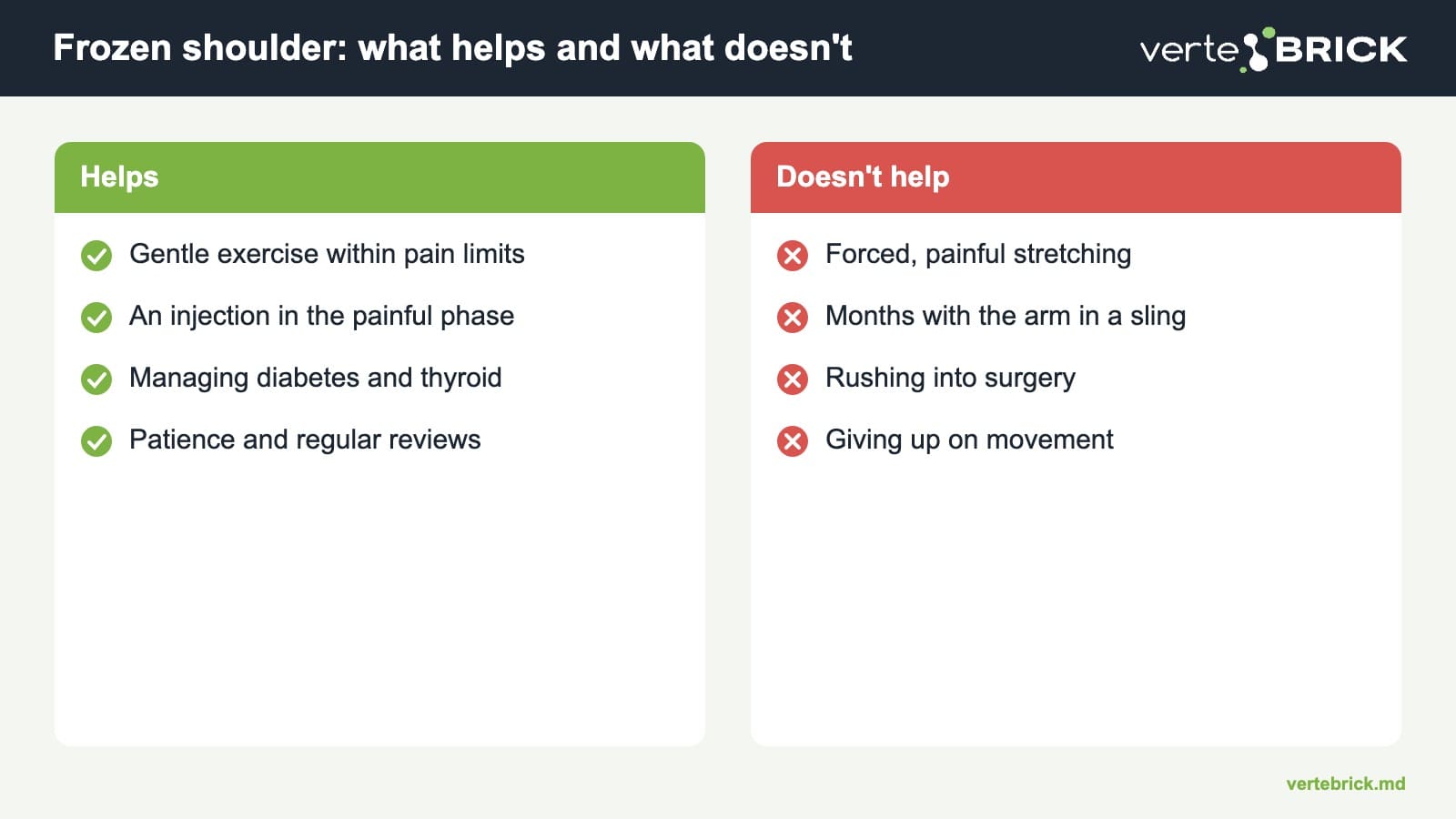
- Gentle exercise within the limits of pain, suited to the phase. In the painful phase, gentle exercise gave better results than forced stretching.
- A corticosteroid injection in the painful phase, given by a doctor. It reduces pain faster in the first weeks and makes exercise easier.
- Clear explanations: knowing that the condition lasts a long time but usually ends well.
- Managing diabetes and thyroid problems with your doctor.
- Pain medication for a short time and agreed with your doctor, so you can sleep and do your exercises.
What does not help or needs caution
- Forced, painful stretching in the painful phase. It can increase pain and slow recovery.
- Keeping the arm in a sling for a long time. The shoulder gets even stiffer.
- Rushing into surgery. A large study compared physiotherapy with an injection, manipulation under anaesthetic and surgery. After a year the results were similar, and the non-surgical option was the simplest.
How long it lasts
Usually one to three years from the first signs until movement returns. Exercise does not always “shorten” the condition, but it helps you have less pain and use your arm better throughout it.
When to see a doctor urgently
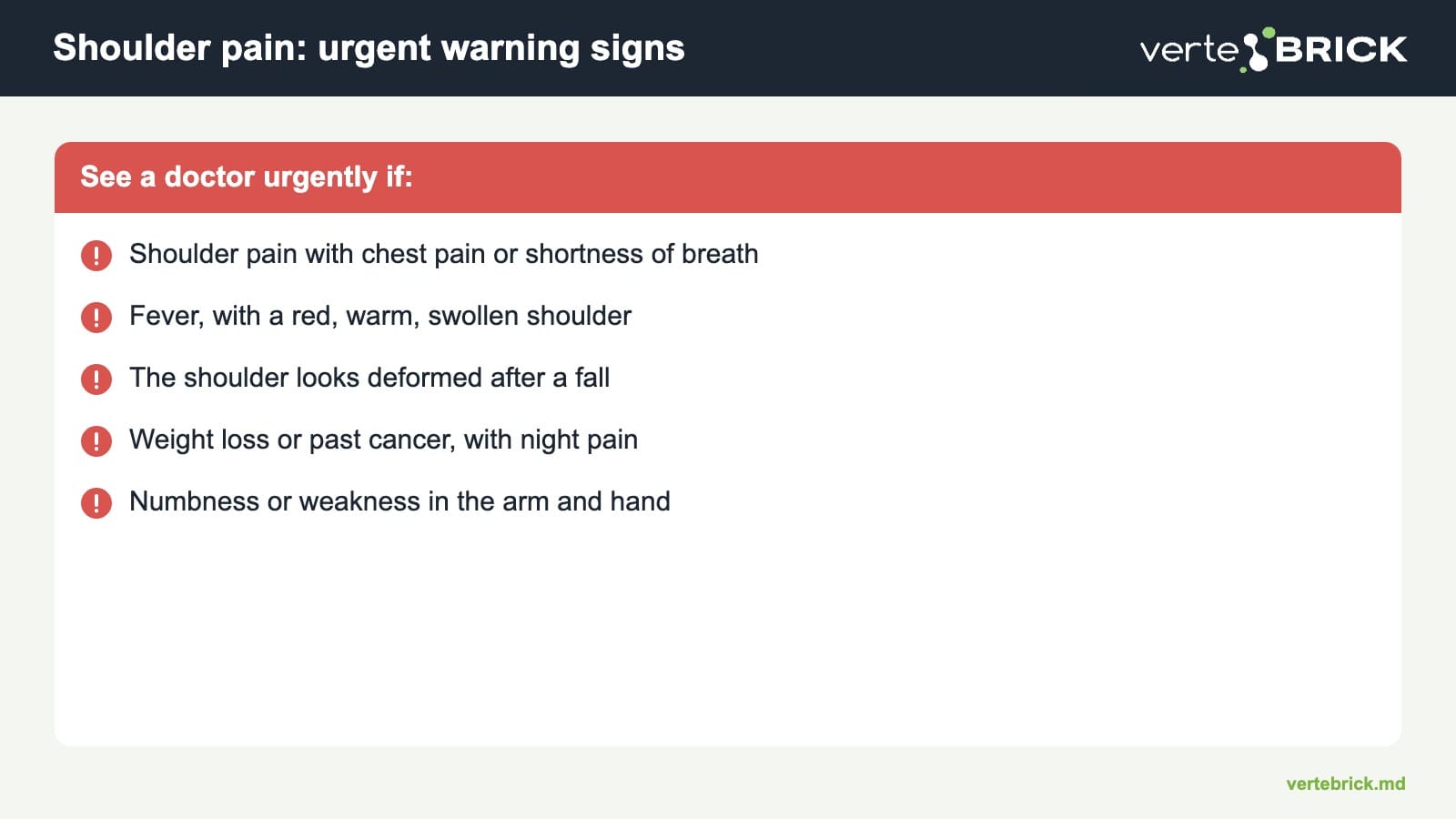
- shoulder pain together with chest pain, shortness of breath or sweating (it may be your heart);
- fever, with a red, warm and swollen shoulder;
- pain after a fall, with the shoulder looking deformed or the arm impossible to move;
- unexplained weight loss or a history of cancer, with severe pain at night;
- numbness or weakness in the arm and hand.
How we work at Vertebrick
At the assessment we check shoulder movement, both your own and when the physiotherapist moves your arm, as well as strength and your neck, to tell a frozen shoulder apart from other causes of pain. We explain which phase you are in, and you get an exercise programme for that phase, advice for sleep and daily activities, and regular re-assessments so you can see your movement coming back.
Frequently asked questions
Does a frozen shoulder go away on its own?
Most of the time, yes, but it can take one to three years. The right exercises reduce pain and help you use your arm better in the meantime.
Why does my shoulder hurt more at night?
In the painful phase the shoulder capsule is inflamed, and pain increases when you lie on that shoulder. A pillow under the arm and medication agreed with your doctor can help.
Does an injection help a frozen shoulder?
In the painful phase, a corticosteroid injection can reduce pain faster in the first weeks. It is combined with gentle exercise.
Where can I get physiotherapy for a frozen shoulder in Chișinău?
At the Vertebrick clinic, 12/2 Traian Blvd, Chișinău. Book on +373 69 82 62 12.

Book an assessment
Come in for an assessment at Vertebrick, 12/2 Traian Blvd, Chișinău, Moldova. We are open Monday to Saturday, 08:00–20:00.
📞 +373 69 82 62 12 · WhatsApp: wa.me/37369826212 · Fill in the form
Author: the Vertebrick team, physiotherapy clinic in Chișinău. This article is for information only and does not replace a medical consultation.
Sources
- Rangan A, Brealey SD, Keding A, et al. Management of adults with primary frozen shoulder in secondary care (UK FROST): a multicentre, pragmatic, three-arm, superiority randomised clinical trial. The Lancet, 2020.
- Carette S, Moffet H, Tardif J, et al. Intraarticular corticosteroids, supervised physiotherapy, or a combination of the two in the treatment of adhesive capsulitis of the shoulder: a placebo-controlled trial. Arthritis & Rheumatism, 2003.
- Diercks RL, Stevens M. Gentle thawing of the frozen shoulder: a prospective study of supervised neglect versus intensive physical therapy in seventy-seven patients with frozen shoulder syndrome followed up for two years. Journal of Shoulder and Elbow Surgery, 2004.
- Kelley MJ, Shaffer MA, Kuhn JE, et al. Shoulder pain and mobility deficits: adhesive capsulitis. Clinical practice guidelines. Journal of Orthopaedic & Sports Physical Therapy, 2013.
- Zreik NH, Malik RA, Charalambous CP. Adhesive capsulitis of the shoulder and diabetes: a meta-analysis of prevalence. Muscles, Ligaments and Tendons Journal, 2016.