
In short: “Sit up straight or your back will hurt” is one of the most common pieces of advice, but research has not found a single “correct” posture that prevents pain. People with very different postures get back pain just as often. What matters more is changing position often, moving and having strong muscles. The best posture is, in fact, your next one.
The myth of perfect posture
For years we have been told to keep the back straight and the shoulders pulled back, and that sitting “crooked” damages the spine. Large reviews of the research have found no clear link between the shape of the back and the onset of pain. In teenagers, for example, those who sat hunched over their phones did not have more neck pain than those who sat upright.
This does not mean position does not matter at all. It means no position is good if you hold it for hours without moving, and no position is dangerous if you change it often.
So why does it hurt after a day at the desk?
Muscles and joints are loaded when you stay still for a long time, however “correctly” you sit. Tiredness, sleep, stress and how little you move the rest of the day also play a part. Pain is a signal that you want to change position, not a sign that you have damaged your spine.
Fear of “bad posture” can make things worse: people tense their back to sit perfectly straight and tire even faster.
What really helps
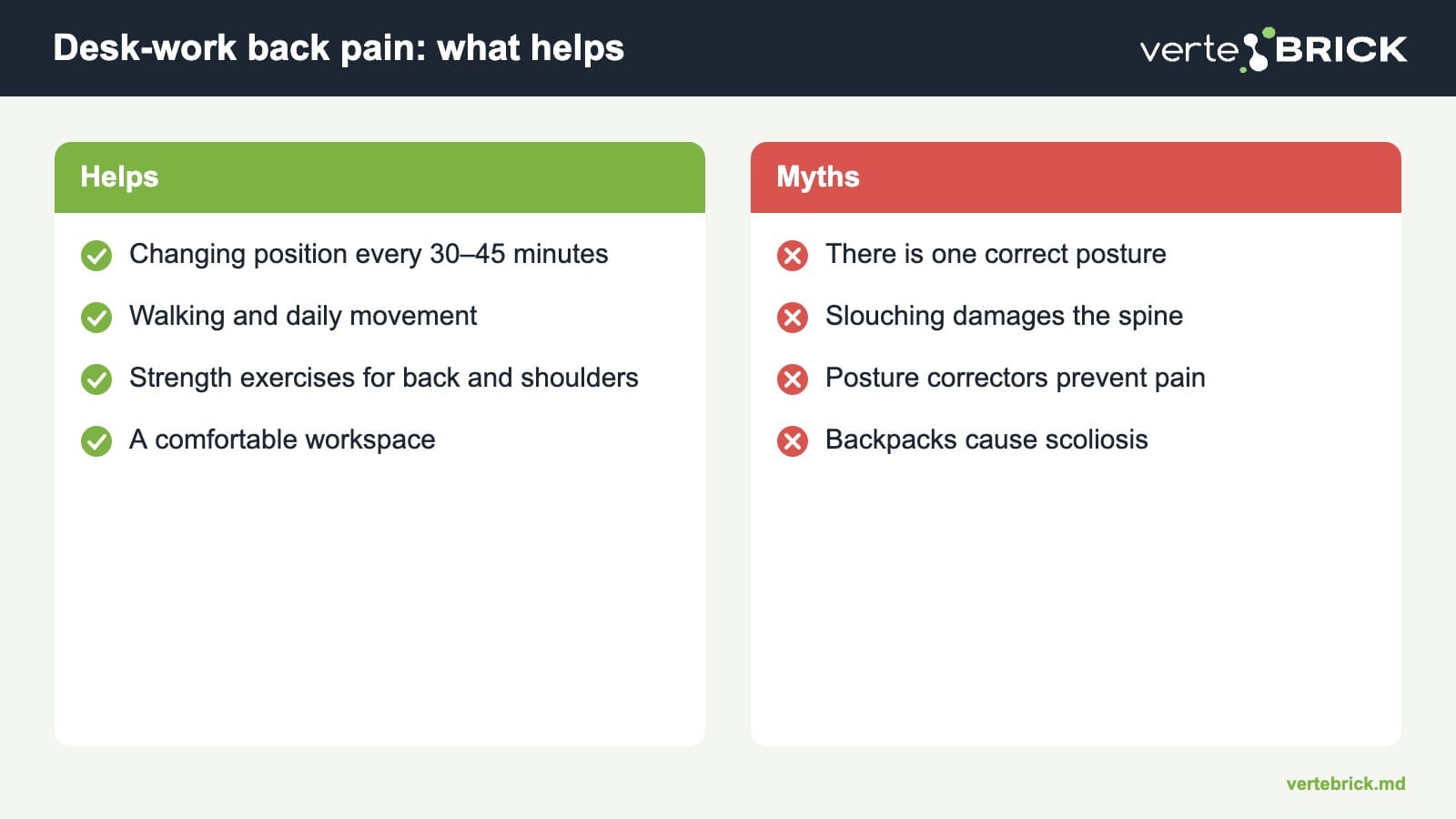
- Changing position often: stand up, take a few steps, change how you sit every 30–45 minutes.
- Daily movement: walking and physical activity outside working hours.
- Strength exercises for the back, shoulders and hips, so you can sit longer without tiring.
- A comfortable workspace: the screen close to eye level, the chair at a height where your feet reach the floor. Aim for comfort, not perfection.
- Enough sleep and regular breaks lower sensitivity to pain.
What does not help
- Sitting “perfectly straight” for hours. Constant tension tires the muscles.
- Posture correctors worn all day. There is no good evidence that they prevent pain.
- Fear of certain positions: bending or slouching on the sofa does not “break” your back.
- A standing desk without breaks. Standing still for hours is tiring too.
Posture and scoliosis in children
Many parents worry that slouching at a school desk or a heavy backpack causes scoliosis. Idiopathic scoliosis, the most common form in children and teenagers, is not caused by posture or by a backpack. That is why it matters to recognise the signs and get an assessment, rather than just telling your child to sit up straight.
When to get an assessment
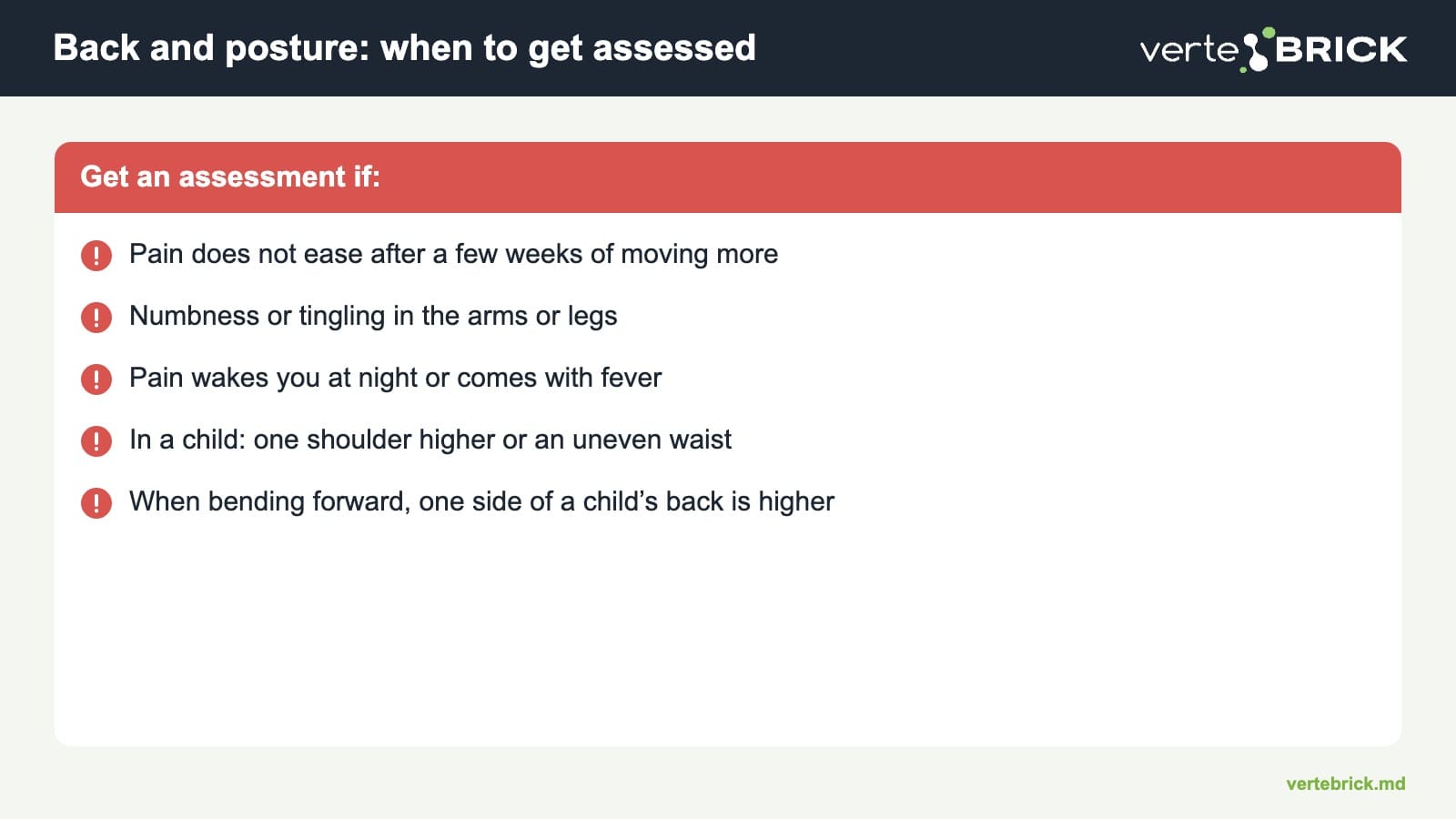
- back or neck pain does not improve after a few weeks, even though you move more;
- numbness or tingling appears in the arms or legs;
- the pain wakes you at night or comes with fever or weight loss;
- in a child, one shoulder is higher, a shoulder blade sticks out or the waist is uneven;
- when the child bends forward, one side of the back looks higher than the other.
How we work at Vertebrick
At the assessment we do not look for “perfect posture”: we ask how you work, how much you move and what triggers your pain, then check mobility and strength. You get a simple plan of active breaks and strength exercises that fits your schedule. For children, we check for signs of scoliosis and explain to parents what they mean.
Frequently asked questions
Is there a correct posture at the desk?
There is no single correct posture. The best one is the one you change often. Breaks, movement and muscle strength matter most.
Does looking down at your phone damage your neck?
There is no evidence that it damages the neck. Staying still for a long time can tire the muscles, so breaks and changing position help.
Does a heavy backpack cause scoliosis?
No. Idiopathic scoliosis is not caused by a backpack or by posture. A very heavy backpack can be uncomfortable, though, so it is worth lightening.
Where can I get physiotherapy for back pain from desk work in Chișinău?
At the Vertebrick clinic, 12/2 Traian Blvd, Chișinău. Book on +373 69 82 62 12.
Book an assessment
Come in for an assessment at Vertebrick, 12/2 Traian Blvd, Chișinău, Moldova. We are open Monday to Saturday, 08:00–20:00.
📞 +373 69 82 62 12 · WhatsApp: wa.me/37369826212 · Fill in the form
Author: the Vertebrick team, physiotherapy clinic in Chișinău. This article is for information only and does not replace a medical consultation.
Sources
- Slater D, Korakakis V, O'Sullivan P, Nolan D, O'Sullivan K. “Sit up straight”: time to re-evaluate. Journal of Orthopaedic & Sports Physical Therapy, 2019.
- Swain CTV, Pan F, Owen PJ, Schmidt H, Belavy DL. No consensus on causality of spine postures or physical exposure and low back pain: a systematic review of systematic reviews. Journal of Biomechanics, 2020.
- Richards KV, Beales DJ, Smith AJ, O'Sullivan PB, Straker LM. Neck posture clusters and their association with biopsychosocial factors and neck pain in Australian adolescents. Physical Therapy, 2016.
- Shrestha N, Kukkonen-Harjula KT, Verbeek JH, et al. Workplace interventions for reducing sitting at work. Cochrane Database of Systematic Reviews, 2018.
- Maher C, Underwood M, Buchbinder R. Non-specific low back pain. The Lancet, 2017.