
In short: a strain or partial tear of the muscles at the back of the thigh is one of the most common injuries in football, running and sprinting sports. Active rehabilitation, with strength exercises started early, brings a faster return than rest. The main problem is re-injury, and a simple exercise, the Nordic hamstring, halves the risk of injury.
What happens in the muscle
There are three muscles at the back of the thigh (the hamstrings). They work very hard when sprinting, braking the leg before it hits the ground, and during strong stretching movements, such as kicking a ball or lunging. That is when small or larger tears can occur in the muscle fibres.
Typical signs
- sudden, sharp pain at the back of the thigh during a sprint or a stretch;
- pain when walking, climbing stairs or trying to straighten the leg;
- sometimes a bruise that appears a few days later;
- weakness when you try to bend the knee against resistance.
What helps
- The first days: protect the area, walk as far as pain allows and avoid sprinting and forced stretching.
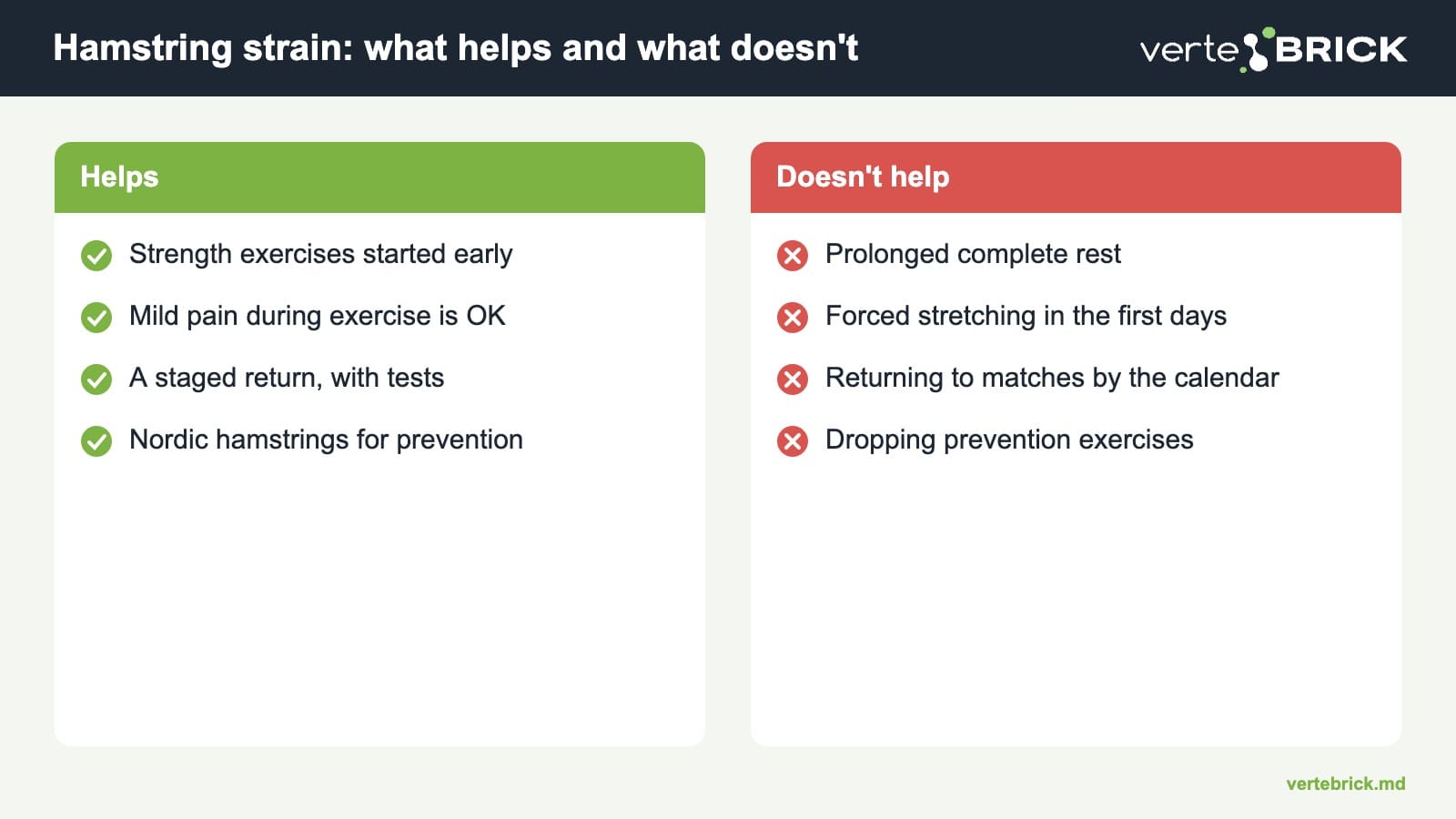
- Strength exercises started early, progressed gradually. A programme based on exercises in lengthened positions led to a return to sport almost twice as fast as a conventional programme.
- Mild pain during exercise is acceptable. In one study, exercising up to mild pain did not slow recovery.
- A staged return: walking, easy running, accelerations, then sprinting, with strength tests before matches.
- The Nordic hamstring exercise for prevention, continued after you return.
What does not help or needs caution
- Prolonged complete rest. The muscle heals weaker and the risk of re-injury goes up.
- Forced, painful stretching in the first days. It can make the injury bigger.
- Returning to sprinting and matches by the calendar alone. Returning too soon is the most common cause of re-injury.
- Dropping the prevention exercises after you return. Their effect fades if you stop them.
How long it takes
It depends on the size of the injury. Mild strains can recover in 1–3 weeks, while larger ones may need 1–3 months. The decision to return is based on strength, mobility and sprint tests, not just the number of days.
When to see a doctor without delay
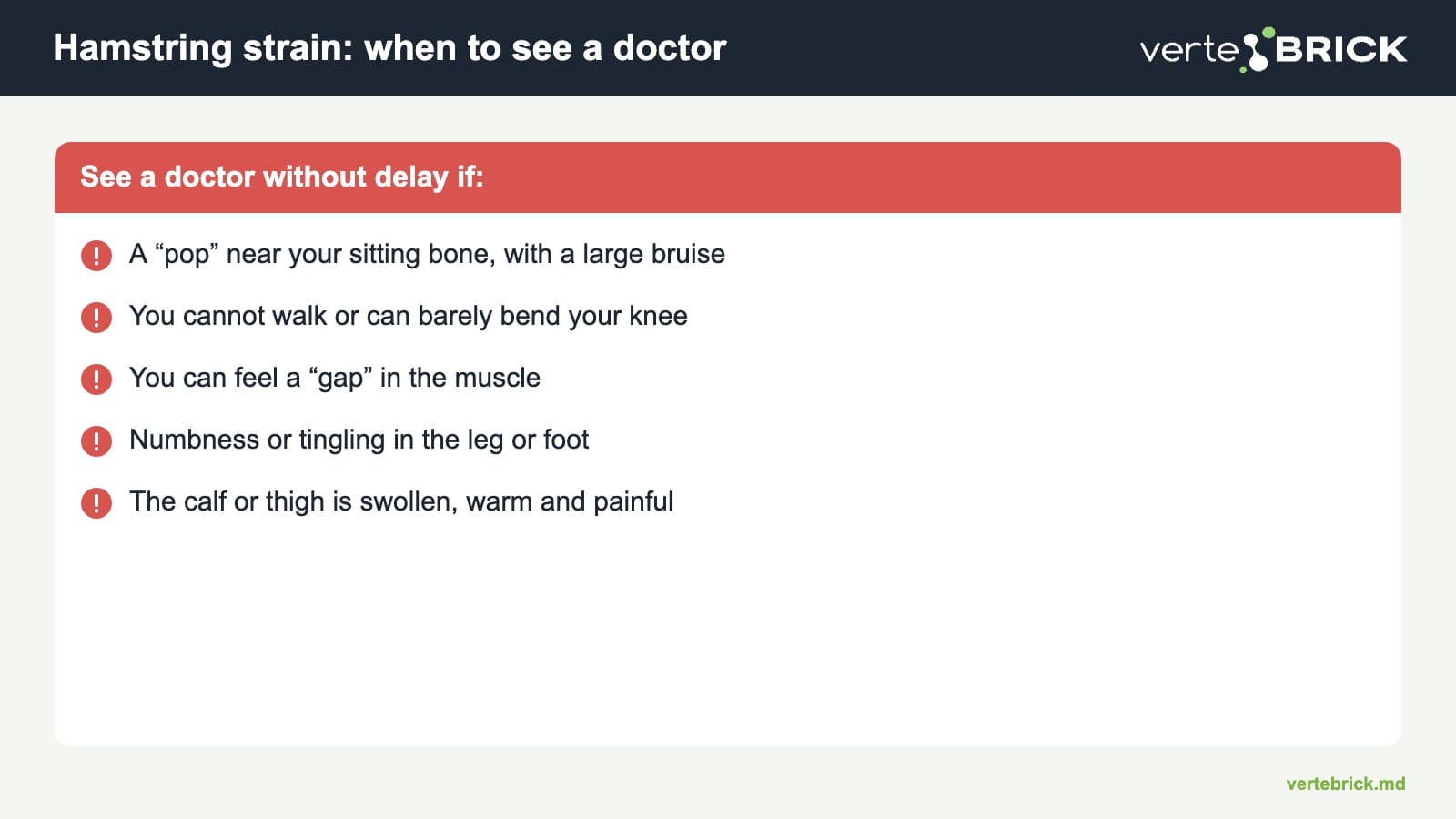
- you felt a “pop” high up, near your sitting bone, followed by a large bruise;
- you cannot walk or can barely bend your knee;
- you can feel a “gap” in the muscle, or the muscle looks bunched up;
- numbness or tingling in the leg or foot;
- the calf or thigh is swollen, warm and painful.
A tear high up, where the muscle attaches to the bone, should be assessed by an orthopaedic surgeon within days, because it sometimes needs surgery.
How we work at Vertebrick
At the assessment we check where the injury is and how big it is, test strength and mobility, and find out which sport you play. You get a staged plan with strength exercises started early, tests before returning to sprinting and matches, and a prevention programme you can also do with your team.
Frequently asked questions
How long does recovery from a hamstring strain take?
Usually one to three weeks for mild strains and one to three months for larger ones. Return is decided by tests, not just by the calendar.
Do I need complete rest?
No. After the first days, gradually progressed strength exercises speed up recovery and lower the risk of re-injury.
What is the Nordic hamstring exercise?
A strength exercise where you kneel with your ankles held and slowly lower your body forward. Done regularly, it halves the risk of hamstring injury.
Where can I get rehabilitation after a muscle injury in Chișinău?
At the Vertebrick clinic, 12/2 Traian Blvd, Chișinău. Book on +373 69 82 62 12.

Book an assessment
Come in for an assessment at Vertebrick, 12/2 Traian Blvd, Chișinău, Moldova. We are open Monday to Saturday, 08:00–20:00.
📞 +373 69 82 62 12 · WhatsApp: wa.me/37369826212 · Fill in the form
Author: the Vertebrick team, physiotherapy clinic in Chișinău. This article is for information only and does not replace a medical consultation.
Sources
- van Dyk N, Behan FP, Whiteley R. Including the Nordic hamstring exercise in injury prevention programmes halves the rate of hamstring injuries: a systematic review and meta-analysis of 8459 athletes. British Journal of Sports Medicine, 2019.
- Askling CM, Tengvar M, Thorstensson A. Acute hamstring injuries in Swedish elite football: a prospective randomised controlled clinical trial comparing two rehabilitation protocols. British Journal of Sports Medicine, 2013.
- Hickey JT, Timmins RG, Maniar N, et al. Pain-free versus pain-threshold rehabilitation following acute hamstring strain injury: a randomized controlled trial. Journal of Orthopaedic & Sports Physical Therapy, 2020.
- Petersen J, Thorborg K, Nielsen MB, Budtz-Jørgensen E, Hölmich P. Preventive effect of eccentric training on acute hamstring injuries in men's soccer: a cluster-randomized controlled trial. American Journal of Sports Medicine, 2011.
- Ekstrand J, Hägglund M, Waldén M. Epidemiology of muscle injuries in professional football (soccer). American Journal of Sports Medicine, 2011.