

In short: hip osteoarthritis is the most common cause of hip pain after the age of 50. The first treatment recommended by international guidelines is not a pill or an injection but well-dosed, regular exercise, together with a clear explanation of what is happening in the joint. Hip replacement remains a very good option when pain and limitation no longer respond to treatment.
Where does it hurt: the hip or something else?
Not every “hip pain” comes from the hip joint. Where it hurts tells us a lot:
- In the groin (at the front, in the crease between the thigh and the belly): most often the source is the hip joint itself, for example osteoarthritis.
- On the outside of the hip, especially when lying on that side: usually the tendons of the gluteal muscles (gluteal tendinopathy), not arthritis.
- In the buttock, with pain spreading down the leg: the source is often the lower back or the sciatic nerve.
That is why the physiotherapist also checks your back, not only your hip.
What hip osteoarthritis is
Hip osteoarthritis means wear of the cartilage in the hip joint, together with changes in the bone and the surrounding tissues. Typical signs are groin pain when walking and climbing stairs, morning stiffness that eases within an hour, difficulty putting on socks or shoes, and an ever shorter step.
The X-ray does not always match the pain. Some people with “advanced arthritis” on the X-ray have little pain, while others have a lot of pain with mild changes. That is why treatment is chosen by your symptoms and how well you move, not by the X-ray alone.
What helps
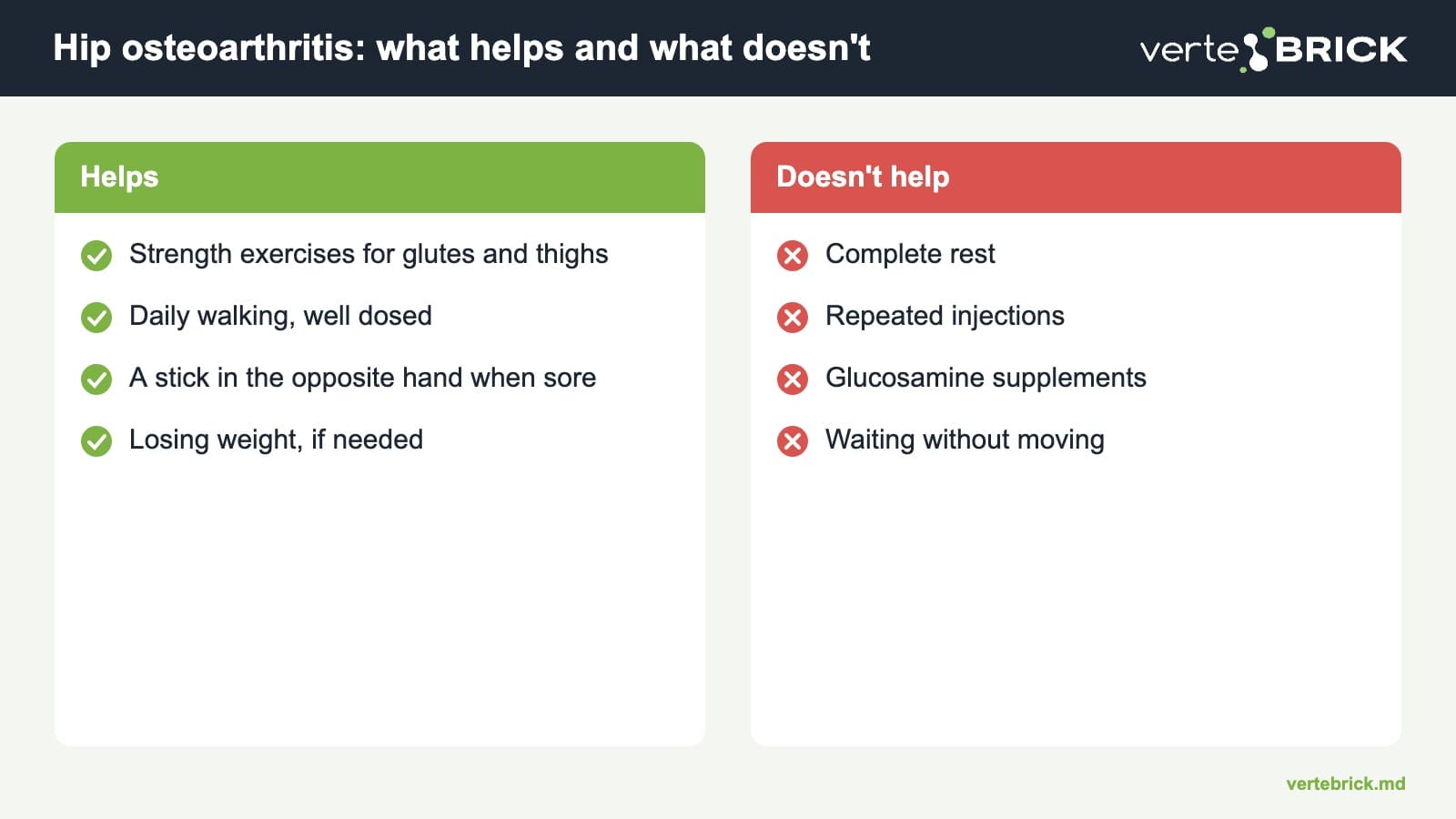
- Strength exercises for the gluteal and thigh muscles, 2–3 times a week. All major guidelines recommend them as first-line treatment.
- Mobility and balance exercises, which keep the hip moving and lower the risk of falls.
- Daily walking, well dosed: little and often is better than rarely and a lot.
- A walking stick in the hand opposite the painful hip during flare-ups. It takes part of the load.
- Losing weight, if you carry extra kilograms. It reduces the load on the joint.
- Understanding that movement does not “wear out” the joint; it helps it.
Mild pain during exercise is acceptable if it settles within 24 hours and does not increase from day to day.
What does not help or needs caution
- Complete rest. Muscles weaken quickly and the hip stiffens.
- Glucosamine and chondroitin supplements. International guidelines do not recommend them for hip osteoarthritis.
- Repeated corticosteroid injections. They may ease pain in the short term but do not change the course of the disease.
- Anti-inflammatory tablets for months without supervision. They are used in short courses, agreed with your doctor.
Pain on the outside of the hip
If it hurts on the outside when you lie on that side, climb stairs or stand on one leg, the most common cause is gluteal tendinopathy. In a large study, an exercise programme combined with advice on which positions to avoid (such as crossing your legs) gave better results at two months than a corticosteroid injection or simply waiting.
When surgery is needed
Hip replacement is one of the most successful operations in orthopaedics. It is considered when pain is severe, including at night, and limits your daily life despite several months of proper non-surgical treatment. Exercise before surgery can make recovery easier, and physiotherapy afterwards is essential to get back to normal walking.
When to see a doctor urgently
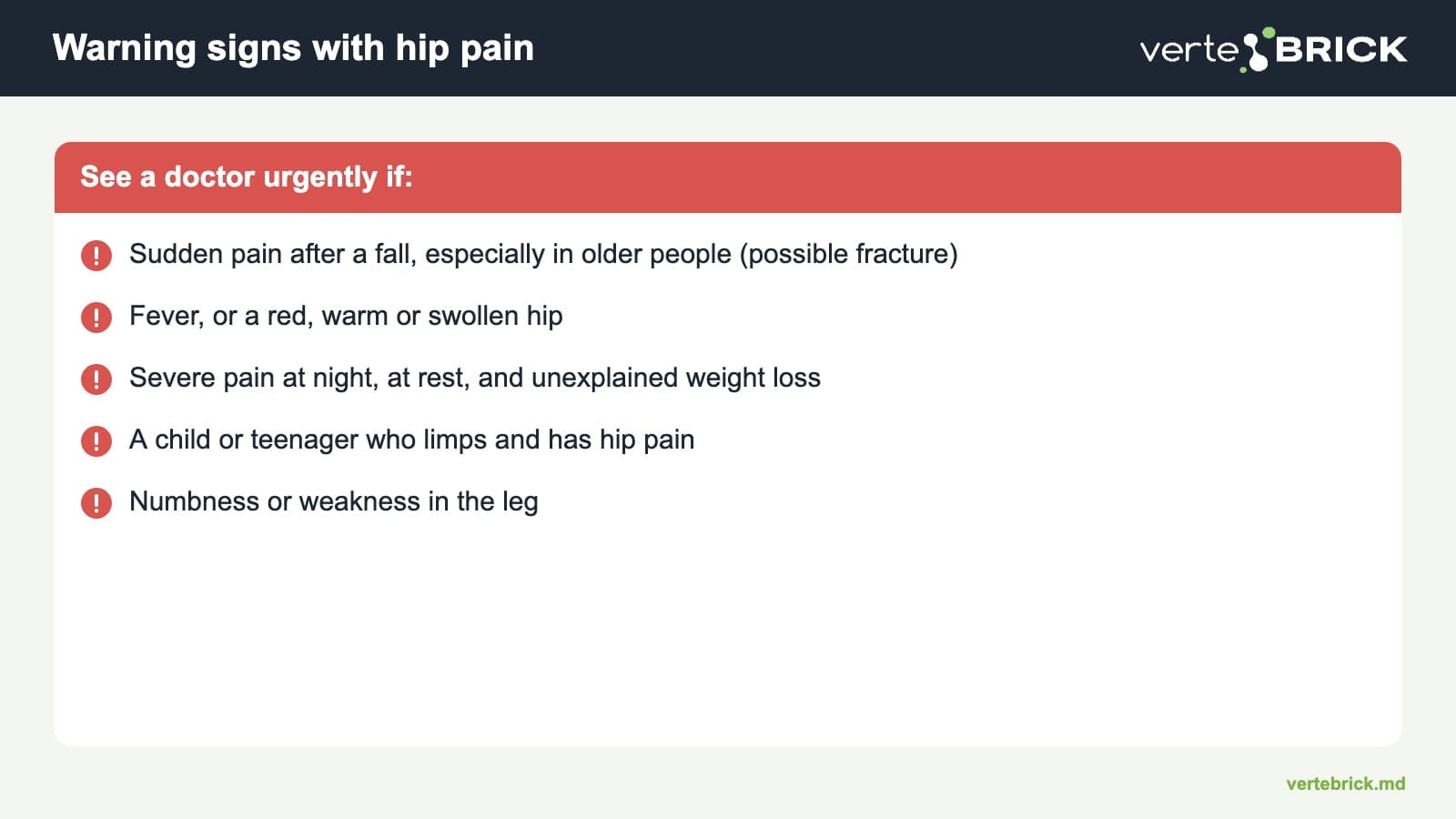
- sudden pain after a fall, especially in older people: it may be a fracture;
- fever, or a red, warm or swollen hip;
- severe pain at night, at rest, and unexplained weight loss;
- a child or teenager who limps and has hip or knee pain;
- numbness or weakness in the leg.
How we work at Vertebrick
At the assessment, the physiotherapist finds out where and when it hurts and checks hip movement, muscle strength, walking and the lower back. You get an exercise programme tailored to you, with clear progression, advice for daily activities and a plan to get back to walking longer distances. If your hip replacement is already scheduled, we prepare you for surgery and help you recover afterwards.
Frequently asked questions
Can I walk if I have hip osteoarthritis?
Yes. Well-dosed walking is recommended. If the pain increases, shorten the distance and take breaks, but do not give up walking.
Do exercises damage the joint further?
No. Well-dosed exercise reduces pain and improves walking. Complete rest does more harm.
When do I need a hip replacement?
When pain and limitation remain severe after several months of proper non-surgical treatment. The decision is made together with an orthopaedic surgeon.
Where can I get physiotherapy for hip pain in Chișinău?
At the Vertebrick clinic, 12/2 Traian Blvd, Chișinău. Book on +373 69 82 62 12.

Book an assessment
Come in for an assessment at Vertebrick, 12/2 Traian Blvd, Chișinău, Moldova. We are open Monday to Saturday, 08:00–20:00.
📞 +373 69 82 62 12 · WhatsApp: wa.me/37369826212 · Fill in the form
Author: the Vertebrick team, physiotherapy clinic in Chișinău. This article is for information only and does not replace a medical consultation.
Sources
- Bannuru RR, Osani MC, Vaysbrot EE, et al. OARSI guidelines for the non-surgical management of knee, hip, and polyarticular osteoarthritis. Osteoarthritis and Cartilage, 2019.
- Fransen M, McConnell S, Hernandez-Molina G, Reichenbach S. Exercise for osteoarthritis of the hip. Cochrane Database of Systematic Reviews, 2014.
- Kolasinski SL, Neogi T, Hochberg MC, et al. 2019 American College of Rheumatology/Arthritis Foundation Guideline for the Management of Osteoarthritis of the Hand, Hip, and Knee. Arthritis & Rheumatology, 2020.
- Mellor R, Bennell K, Grimaldi A, et al. Education plus exercise versus corticosteroid injection use versus a wait and see approach on global outcome and pain from gluteal tendinopathy: prospective, single blinded, randomised clinical trial. BMJ, 2018.
- National Institute for Health and Care Excellence. Osteoarthritis in over 16s: diagnosis and management (NG226), 2022.
- Skou ST, Roos EM. Good Life with osteoArthritis in Denmark (GLA:D): evidence-based education and supervised neuromuscular exercise delivered by certified physiotherapists nationwide. BMC Musculoskeletal Disorders, 2017.