

In short: iliotibial band syndrome causes pain on the outside of the knee that starts during a run after a certain time or distance, especially downhill. It is not a serious injury. What helps is a temporary cut in running volume, strength exercises for the hip and a gradual return. Stretching and foam rolling alone rarely fix it.
What the iliotibial band is
The iliotibial band (IT band) is a thick strip of connective tissue along the outside of the thigh, from the hip to just below the knee. It does not “shorten” and it barely stretches. In runners, bending the knee over and over compresses the sensitive tissue under the band, just above the outer side of the knee, and that is where the pain comes from.
Why it happens
Most often after a sudden jump in mileage, a lot of downhill running or always running the same direction on a track. Weak glute muscles, overstriding with the foot landing far in front of the body, and a badly set bike saddle in people who cycle a lot also play a part.
Typical signs
- sharp or burning pain on the outside of the knee;
- the pain starts after some time running and gets worse if you keep going;
- it is worse downhill and going down stairs;
- sometimes the pain spreads up the outside of the thigh;
- the knee does not swell or lock.
What helps
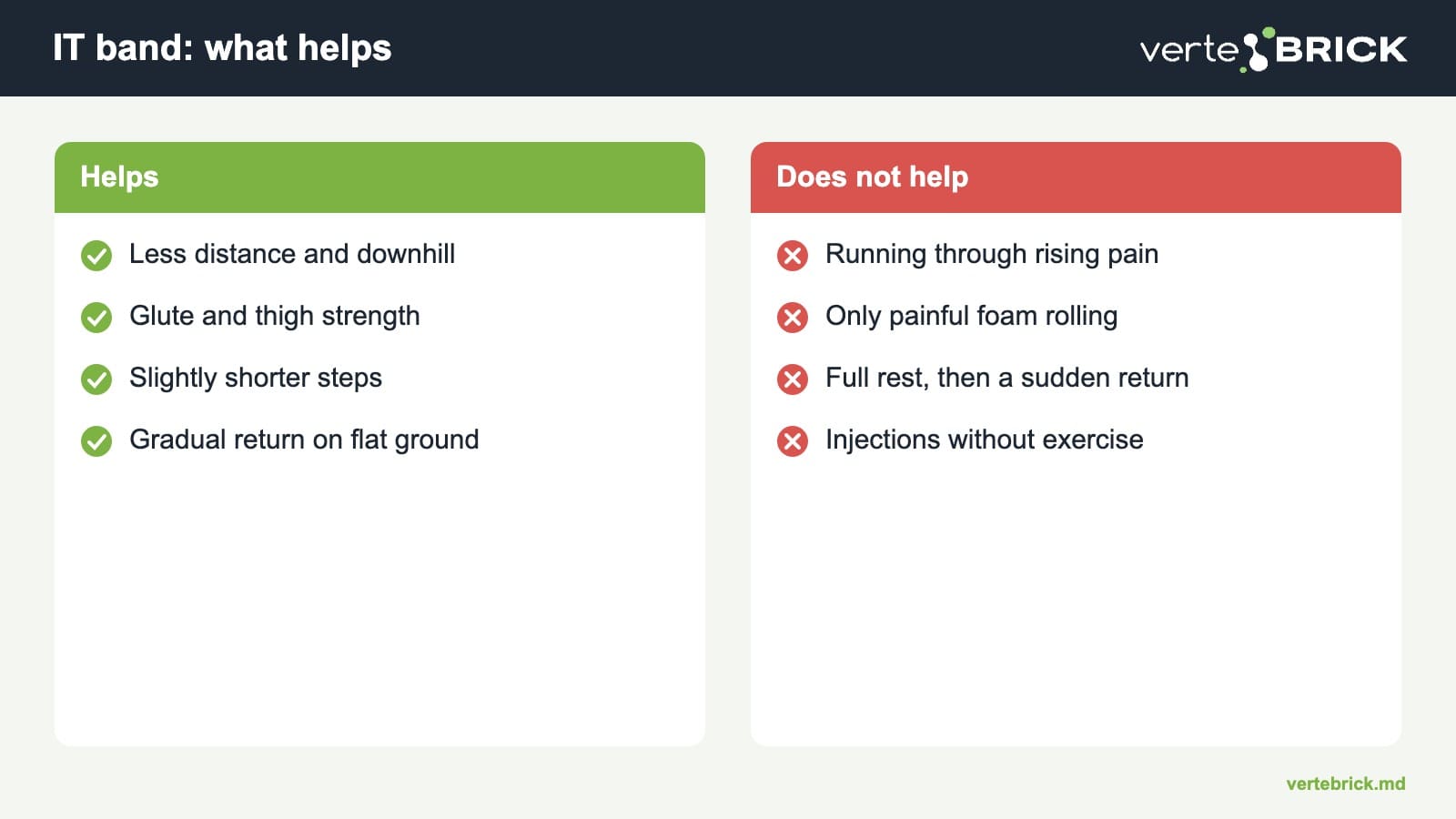
- cutting distance and downhills for a while, without stopping movement completely;
- strength exercises for the glutes and thigh: single-leg bridge, side-lying leg raises, controlled single-leg squats;
- slightly shorter steps and a slightly higher running cadence;
- a gradual return to running, on flat ground first;
- checking your bike fit if you cycle a lot.
What doesn't help
- running through pain that gets worse from day to day;
- only painful foam rolling of the band: it does not “lengthen” it;
- complete rest with no exercise, then a sudden return to the same volume;
- repeated injections without an exercise programme.
How long it takes
In most cases the pain eases within 4–8 weeks with exercise and training changes. Long-standing cases can take 2–3 months. Surgery is rare and only discussed after months of proper treatment without results.
When to see a doctor
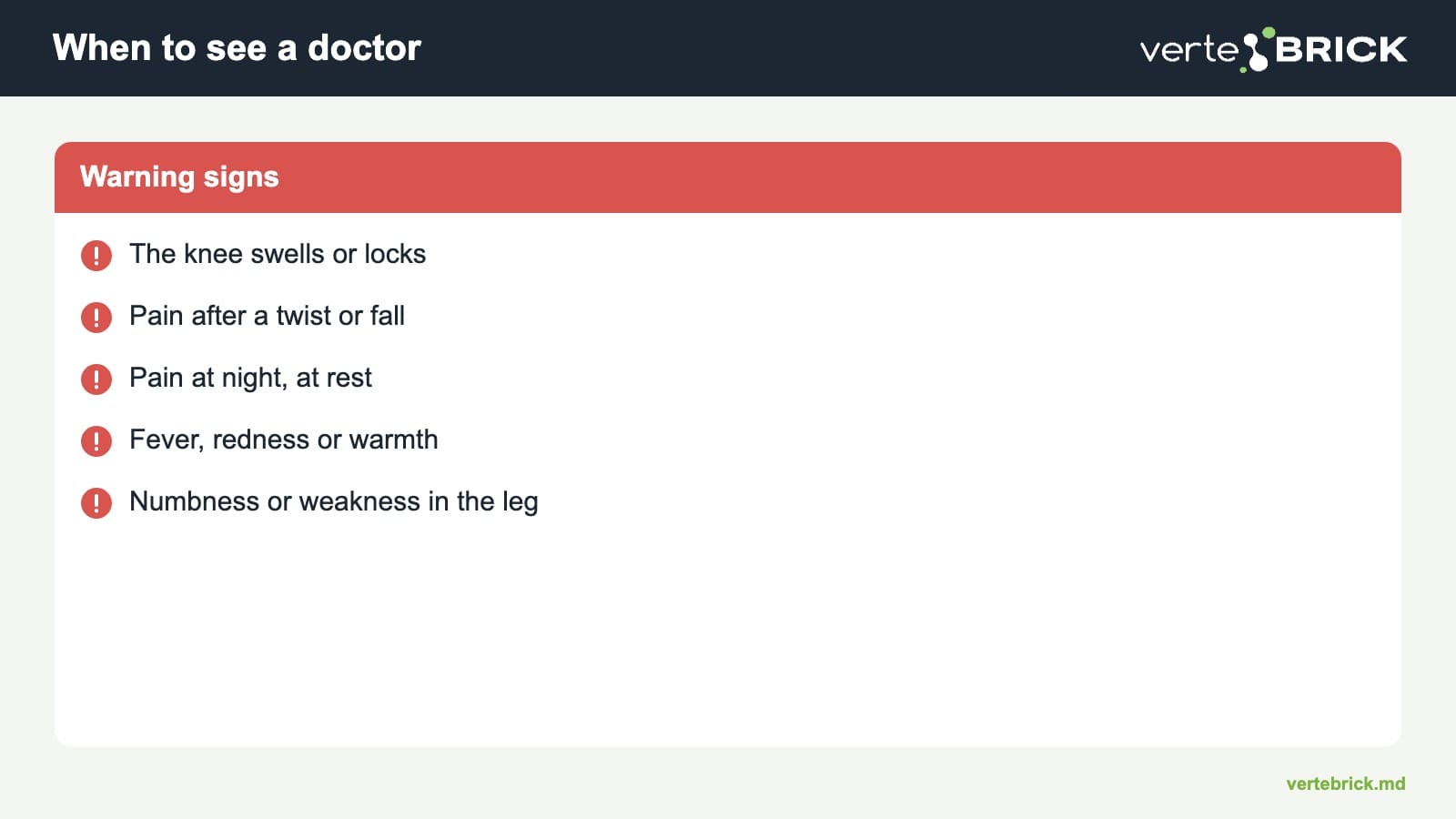
- the knee swells or locks;
- the pain started after a twist or a fall;
- the pain also comes at night, at rest;
- fever, redness or warmth around the knee;
- numbness or weakness in the leg.
How we work at Vertebrick
At the first visit we check exactly where it hurts, your hip and thigh strength, and how you control the knee in a single-leg squat. If you run, we look at your training and running technique. You get a staged exercise programme and a clear plan for returning to running.
Frequently asked questions
Is it the IT band or the meniscus?
IT band pain sits on the outside of the knee during repeated activity, without swelling or locking. A meniscus problem more often causes swelling, locking or pain when twisting. An assessment tells them apart.
Can I keep running?
Yes, if the pain stays low, up to 3 out of 10, and is not worse the next day. Cut distance and downhills, then build up gradually.
Does foam rolling help?
It can give short-term relief, but it does not treat the cause. Hip strength exercises matter more.
Where can I get IT band syndrome treatment in Chișinău?
At the Vertebrick clinic in Chișinău, with an assessment, strength exercises and a return-to-running plan.

Book an assessment
Come in for an assessment at Vertebrick, 12/2 Traian Blvd, Chișinău, Moldova. We are open Monday to Saturday, 08:00–20:00.
📞 +373 69 82 62 12 · WhatsApp: wa.me/37369826212 · Fill in the form
Author: the Vertebrick team, physiotherapy clinic in Chișinău. This article is for information only and does not replace a medical consultation.
Sources
- van der Worp MP et al. Iliotibial band syndrome in runners: a systematic review. Sports Med. 2012;42(11):969–992.
- Fredericson M, Wolf C. Iliotibial band syndrome in runners: innovations in treatment. Sports Med. 2005;35(5):451–459.
- Baker RL, Fredericson M. Iliotibial band syndrome in runners: biomechanical implications and exercise interventions. Phys Med Rehabil Clin N Am. 2016;27(1):53–77.