

In short: jumper's knee (patellar tendinopathy) causes pain just below the kneecap when jumping, landing, squatting or climbing stairs. It is common in basketball, volleyball, football and running. The most effective treatment is an exercise programme that loads the tendon gradually, together with managing how much you jump. Complete rest alone rarely fixes it.
What patellar tendinopathy is
The patellar tendon connects the kneecap to the shin bone and takes high forces during jumping and landing. When load rises too quickly, the tendon cannot adapt in time, becomes painful and tolerates effort less well. It is not classic inflammation but a problem of tendon capacity.
How it differs from pain at the front of the knee
Patellofemoral pain is more diffuse, around or behind the kneecap, and gets worse with long sitting with bent knees. Patellar tendinopathy hurts at one precise point just below the kneecap and is linked mainly to jumping and fast efforts.
Typical signs
- pain right below the kneecap;
- pain at the start of activity that may “warm up” and return afterwards;
- pain with jumping, landing and deep squats;
- stiffness in the morning or after sitting for a long time;
- tenderness when pressing on the tendon.
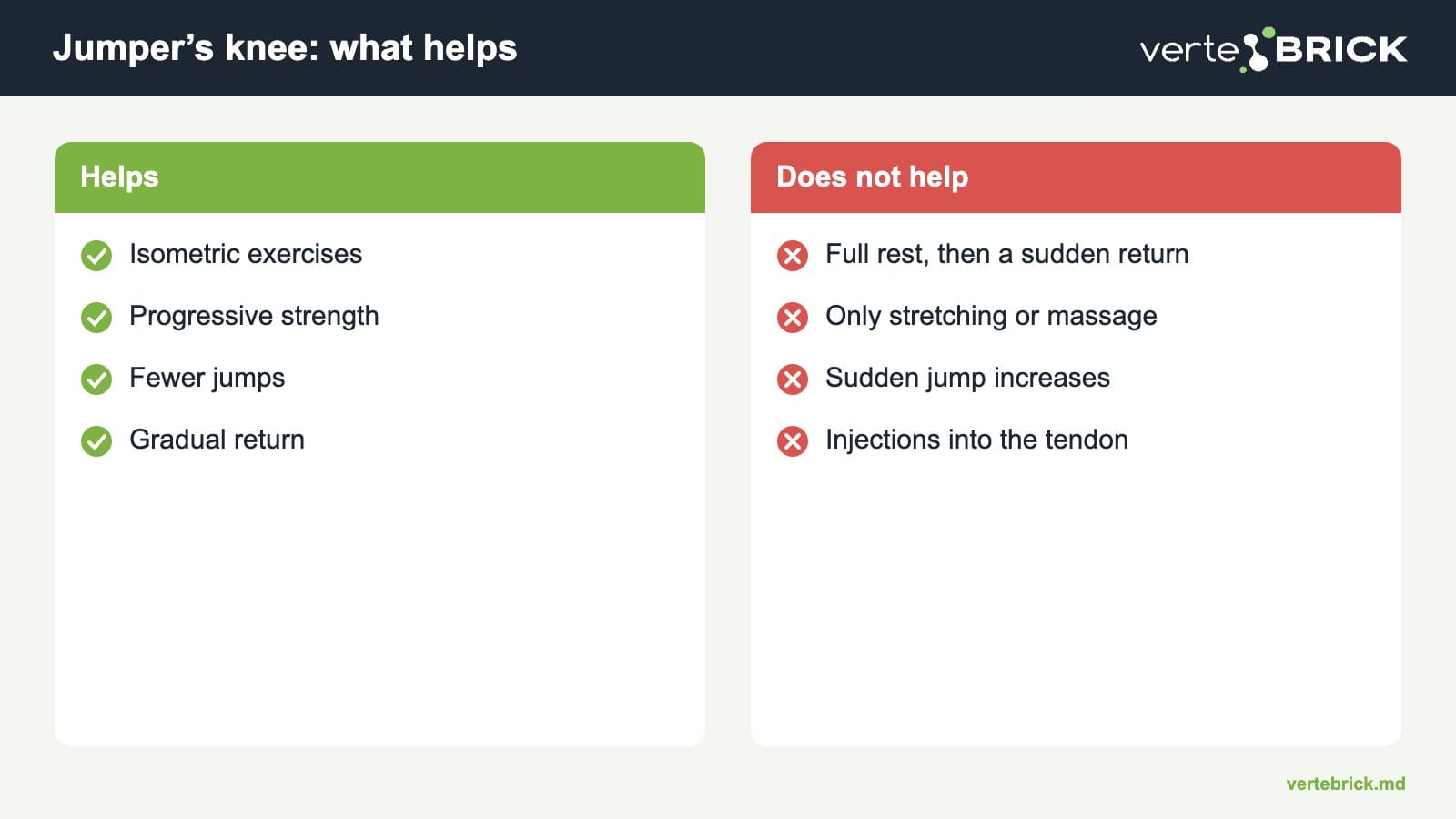
What helps
- isometric (static hold) exercises to ease pain;
- progressive thigh strength exercises, then faster loading exercises;
- cutting down on jumping for a while, without stopping sport completely;
- using next-day pain as a guide to load;
- a gradual return to jumping and games.
What doesn't help
- complete rest with no exercise, then a sudden return;
- only stretching or only massage;
- suddenly increasing jump training;
- repeated corticosteroid injections into the tendon.
How long it takes
Tendons adapt slowly. Clear improvement usually comes after 6–12 weeks of exercise, and full recovery for jumping sports can take 3–6 months.
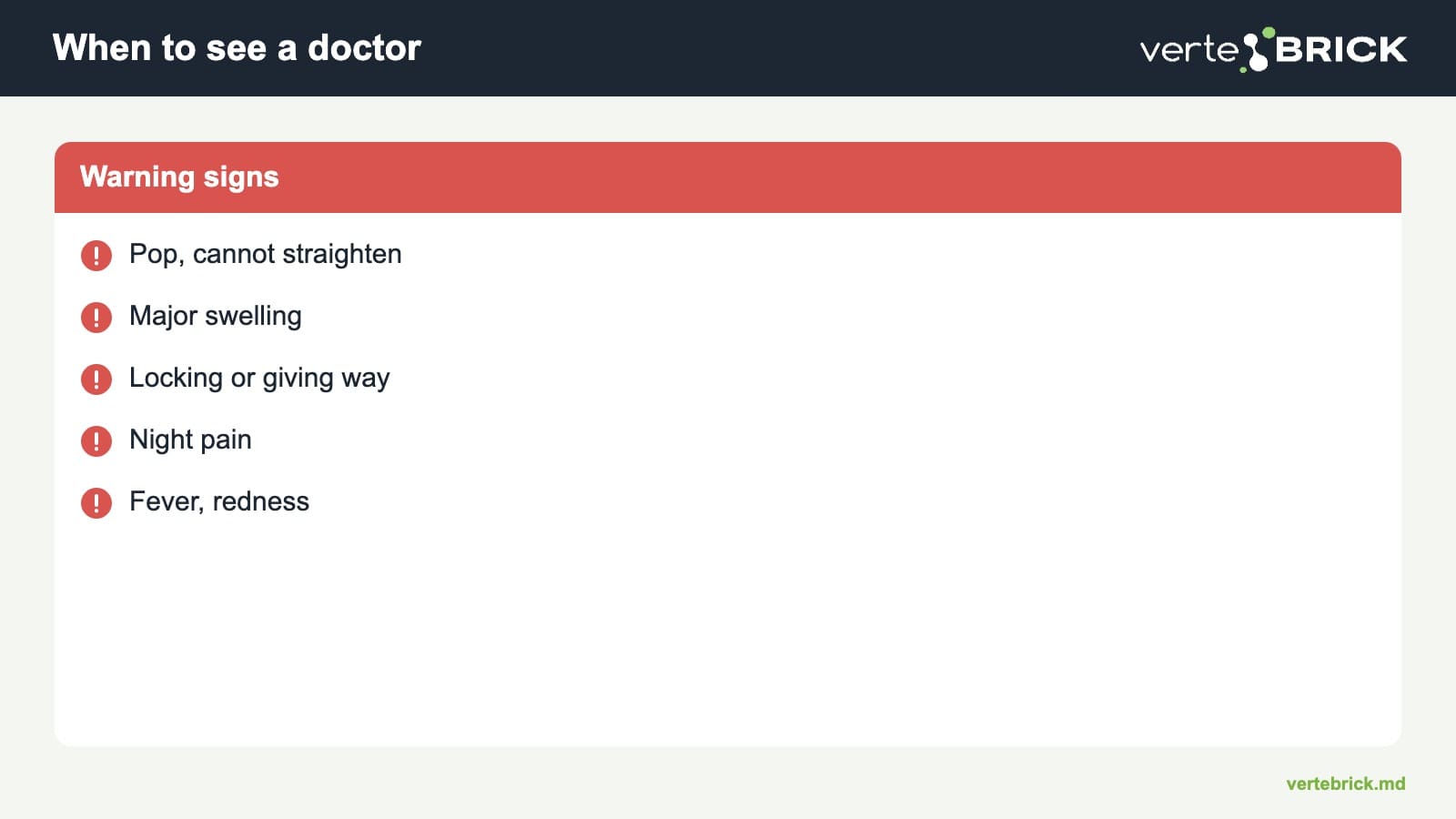
When to see a doctor
- a “pop” and being unable to straighten the knee;
- major knee swelling;
- the knee locks or gives way;
- pain also at night, at rest;
- fever, redness or warmth around the knee.
How we work at Vertebrick
We assess the tendon, thigh and hip strength, your landing technique and training volume. We build a staged loading programme and a plan to return to jumping and games that fits your season.
Frequently asked questions
What is jumper's knee?
It is the common name for patellar tendinopathy: overload of the tendon below the kneecap, frequent in jumping sports.
Can I keep training with jumper's knee?
Usually yes, with fewer jumps and an exercise programme. Pain up to 3 out of 10 that is not worse the next day is usually acceptable.
Does a patellar strap help?
It can ease pain for some athletes in the short term, but it does not replace tendon loading exercises.
Where can I get jumper's knee rehab in Chișinău?
At the Vertebrick clinic in Chișinău, with a progressive loading programme and a return-to-sport plan.

Book an assessment
Come in for an assessment at Vertebrick, 12/2 Traian Blvd, Chișinău, Moldova. We are open Monday to Saturday, 08:00–20:00.
📞 +373 69 82 62 12 · WhatsApp: wa.me/37369826212 · Fill in the form
Author: the Vertebrick team, physiotherapy clinic in Chișinău. This article is for information only and does not replace a medical consultation.
Sources
- Malliaras P et al. Patellar tendinopathy: clinical diagnosis, load management, and advice for challenging case presentations. J Orthop Sports Phys Ther. 2015;45(11):887–898.
- Rio E et al. Isometric exercise induces analgesia and reduces inhibition in patellar tendinopathy. Br J Sports Med. 2015;49(19):1277–1283.
- Breda SJ et al. Effectiveness of progressive tendon-loading exercise therapy in patients with patellar tendinopathy: a randomised clinical trial. Br J Sports Med. 2021;55(9):501–509.