

In short: the most common cause of knee pain after the age of 45–50 is osteoarthritis of the knee. It is not “wear and tear” that forces you to rest: studies show that exercise reduces pain and improves walking, while keyhole surgery (arthroscopy) does not help in osteoarthritis. Below you will find why the knee hurts, what works and when you need to see a doctor.
Why the knee hurts
The knee carries your body weight with every step. Pain can come from the cartilage, the meniscus, ligaments, tendons or the surrounding muscles. In young people and athletes it appears more often after overload or injury. In adults over 45–50, the most common cause is osteoarthritis.
In knee osteoarthritis the cartilage becomes thinner and the joint more sensitive. Typical signs are pain going up and down stairs, morning stiffness that eases within a few minutes, and pain after a long walk.
An MRI does not tell the whole story
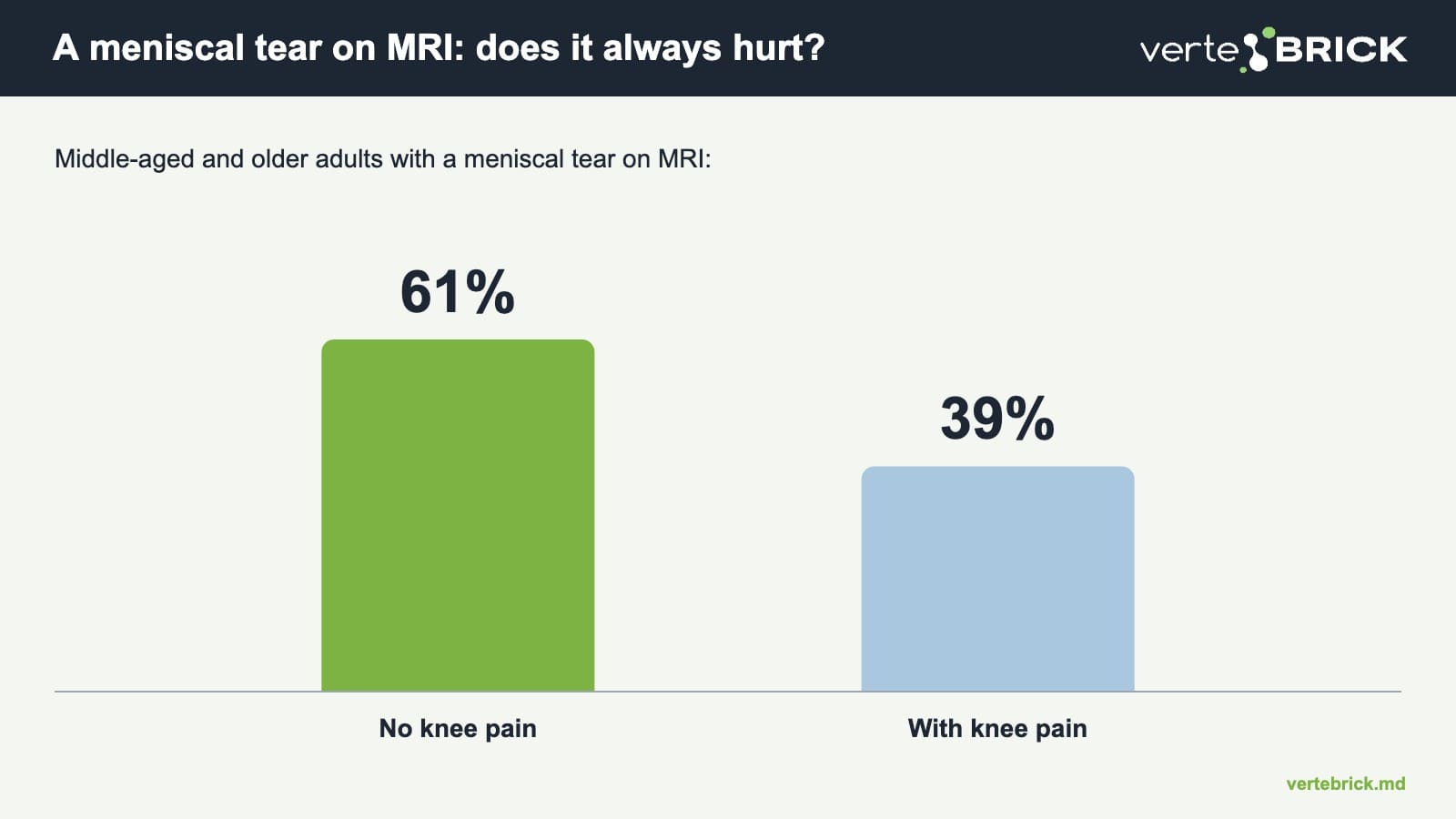
Many people are frightened when they read “meniscal tear” on an MRI report. In a study of middle-aged and older adults, 61% of those with a meniscal tear on MRI had no knee pain at all. A degenerative meniscal tear is often an age-related change, not necessarily the cause of the pain, and it does not automatically mean surgery.
What helps
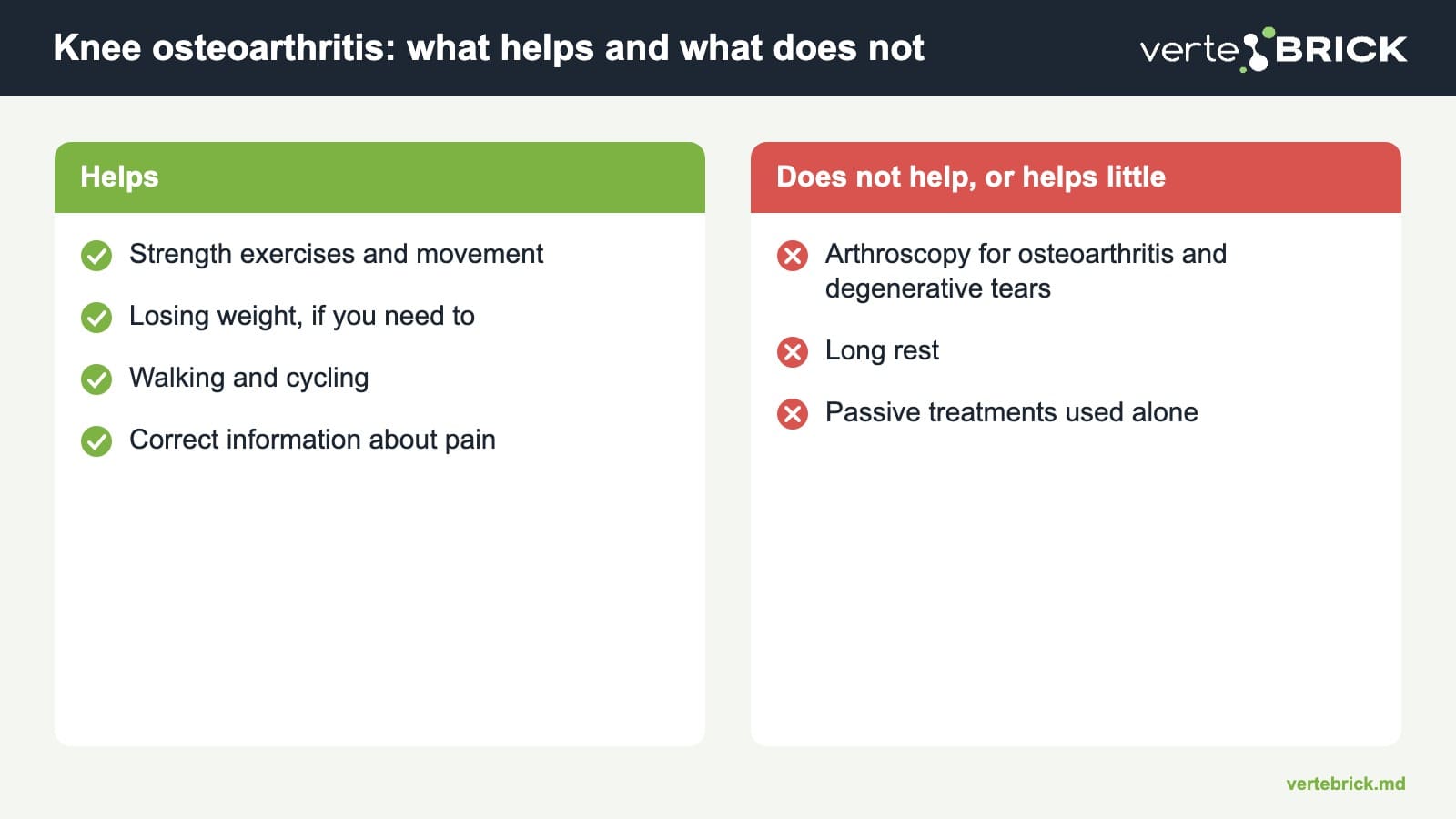
- Strength exercises and movement. In studies, exercise reduced pain by 12 points on average on a 0–100 scale and improved knee function.
- Losing weight, if you need to. Every kilogram lost takes about four times that load off the knee with each step.
- Walking and cycling, in amounts your knee tolerates, built up gradually.
- Correct information. Pain during effort does not mean you are damaging the joint. Movement feeds the cartilage.
What does not help, or helps little
- Arthroscopy for knee osteoarthritis and degenerative meniscal tears. International guidelines strongly recommend against it, because it brings no lasting benefit compared with exercise.
- Long rest. The muscles weaken and the knee becomes more painful.
- Passive treatments used alone. They can ease pain for a while, but they do not replace exercise.
When surgery is needed
A knee replacement is a good option when osteoarthritis is advanced, pain seriously limits your life and a proper exercise programme followed for several months has not helped enough. The decision is made together with an orthopaedic surgeon. Physiotherapy is needed both before and after the operation.
When to see a doctor urgently
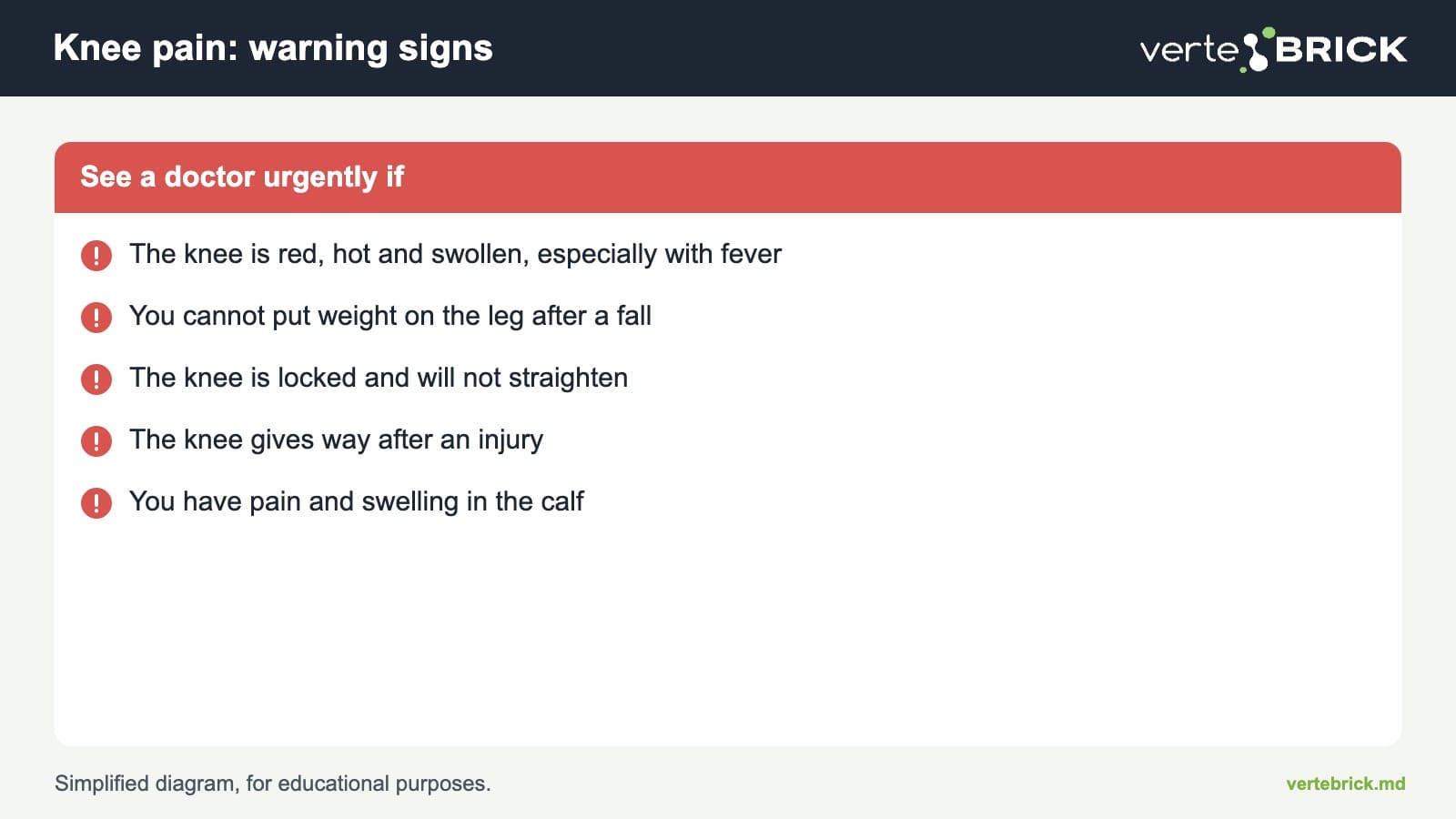
- a red, hot and swollen knee, especially with fever;
- you cannot put weight on the leg after a fall or a blow;
- the knee is locked and you cannot straighten it;
- the knee gives way after an injury;
- pain and swelling in the calf.
How we work at Vertebrick
At the assessment the physiotherapist checks the movement and strength of your knee, hip and ankle, and the way you walk and climb stairs. You receive an exercise programme adapted to your pain, which we progress gradually, and advice for daily activities. If we suspect a problem that needs an orthopaedic doctor, we tell you directly.
Frequently asked questions
Can I exercise if I have knee osteoarthritis?
Yes. Exercise is the core treatment for knee osteoarthritis. Mild pain during effort that settles quickly is acceptable.
My MRI shows a meniscal tear. Do I need surgery?
Not necessarily. Many degenerative tears cause no symptoms. Treatment usually starts with exercise, and surgery is discussed only if the knee locks or recovery does not help.
Do stairs damage the knee?
No. The knee needs movement. If stairs hurt, you dose them and strengthen the thigh and hip muscles.
Where can I get knee physiotherapy in Chișinău?
At Vertebrick clinic, 12/2 Traian Blvd, Chișinău. Bookings: +373 69 82 62 12.

Book an assessment
Come in for an assessment at Vertebrick, 12/2 Traian Blvd, Chișinău. We are open Monday to Saturday, 08:00–20:00.
📞 +373 69 82 62 12 · WhatsApp: wa.me/37369826212 · Fill in the form
Author: Vasile Cebotaru, physiotherapist, founder of Vertebrick clinic. This article is for information only and does not replace a medical consultation.
Sources
- Fransen M, McConnell S, Harmer AR, et al. Exercise for osteoarthritis of the knee. Cochrane Database of Systematic Reviews, 2015.
- Siemieniuk RAC, Harris IA, Agoritsas T, et al. Arthroscopic surgery for degenerative knee arthritis and meniscal tears: a clinical practice guideline. BMJ, 2017.
- Englund M, Guermazi A, Gale D, et al. Incidental meniscal findings on knee MRI in middle-aged and elderly persons. New England Journal of Medicine, 2008.
- Messier SP, Gutekunst DJ, Davis C, DeVita P. Weight loss reduces knee-joint loads in overweight and obese older adults with knee osteoarthritis. Arthritis & Rheumatism, 2005.