
In short: after a total knee replacement, the result depends a lot on rehabilitation. The first six weeks are decisive: the goal is a knee that straightens fully, bends to at least 90° and lets you walk with growing confidence. Strength exercises started early and progressed gradually work better than rest. Most of the progress comes in the first three months, but the knee keeps improving for up to a year.
What changes after surgery
The surgeon replaces the worn joint surfaces with artificial components. Arthritis pain usually goes away, but the muscles around the knee, especially the quadriceps, weaken a lot in the first weeks. Swelling, stiffness and fear of loading the leg also appear. All of this is worked on in rehab.
Goals for the first 6 weeks
- Full extension: the knee should straighten completely. A knee that stays slightly bent makes walking tiring and painful.
- Flexion to at least 90° in the first weeks, then towards 110–120°, so you can climb stairs and get up from a chair easily.
- Swelling control: leg raised, ice after exercise and frequent ankle movements.
- Walking: from a frame or crutches to a cane, then without support once your gait is symmetrical.
What helps
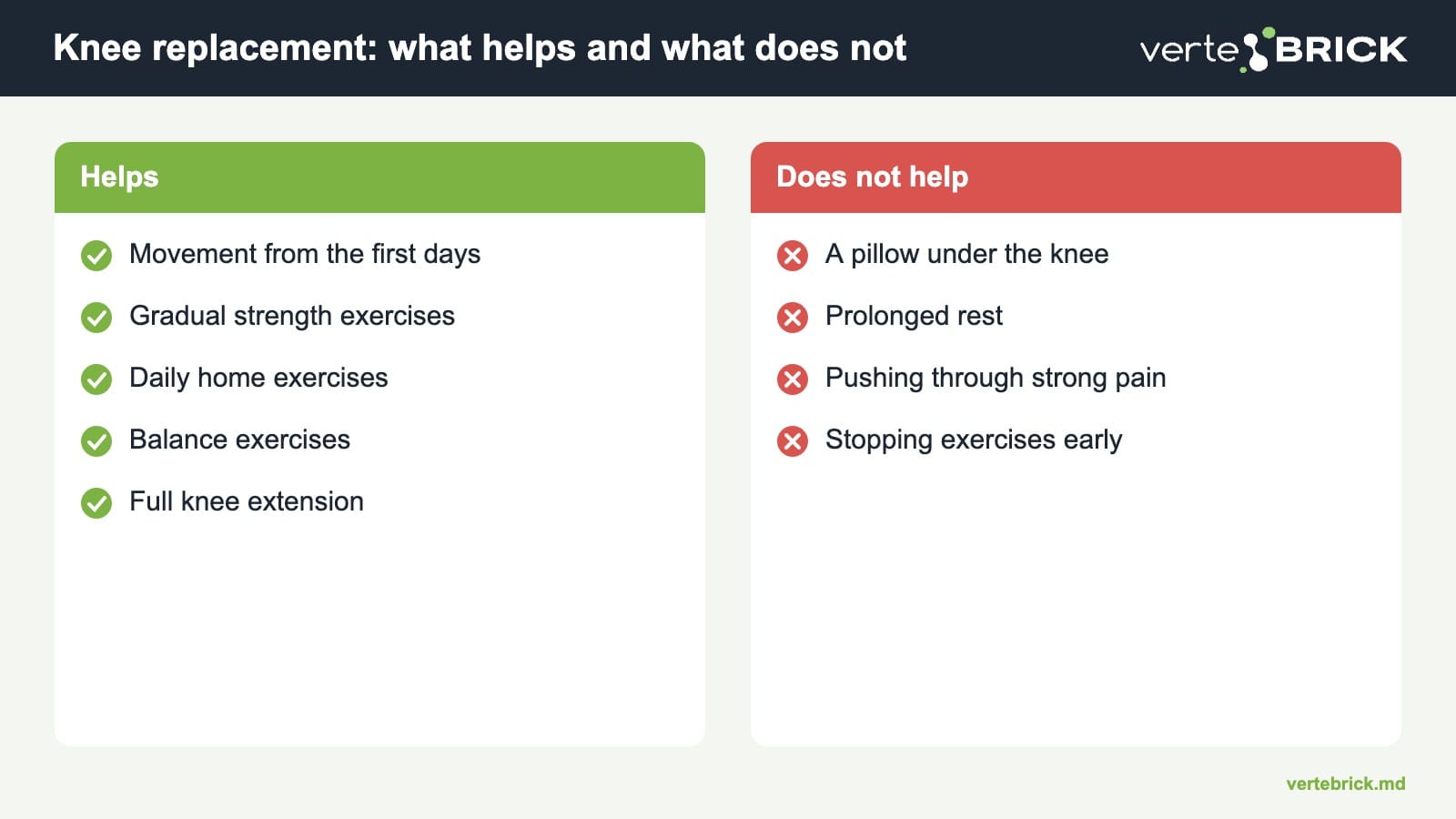
- Movement from the first days, as your surgeon advises: ankle pumps, quadriceps sets, straight-leg raises.
- Gradually progressed strength exercises: sit-to-stands, step-ups, partial squats, a stationary bike once flexion allows.
- Daily home exercises — several short sets a day rather than one long session.
- Balance exercises to reduce the risk of falls.
- Preparing before surgery: a stronger knee before the operation usually recovers more easily.
What does not help
- A pillow under the knee when lying down. It feels comfortable, but it keeps the knee bent and makes full extension harder.
- Prolonged rest. Muscles weaken and stiffness increases.
- Pushing through strong pain. Moderate discomfort is normal, but pain that rises day after day and marked swelling mean you overdid it.
- Stopping exercises after the first weeks. Strength returns over months, not days.
How long recovery takes
Most patients stop using crutches within 2–6 weeks and return to light daily activities within 6–12 weeks. Driving and going back to work are decided with your doctor, usually after 4–8 weeks, depending on which leg was operated on and the type of work. Strength and confidence when walking keep improving for up to a year. About one in five patients has pain that lasts longer, and a well-guided exercise programme helps in these cases too.
When to see a doctor urgently
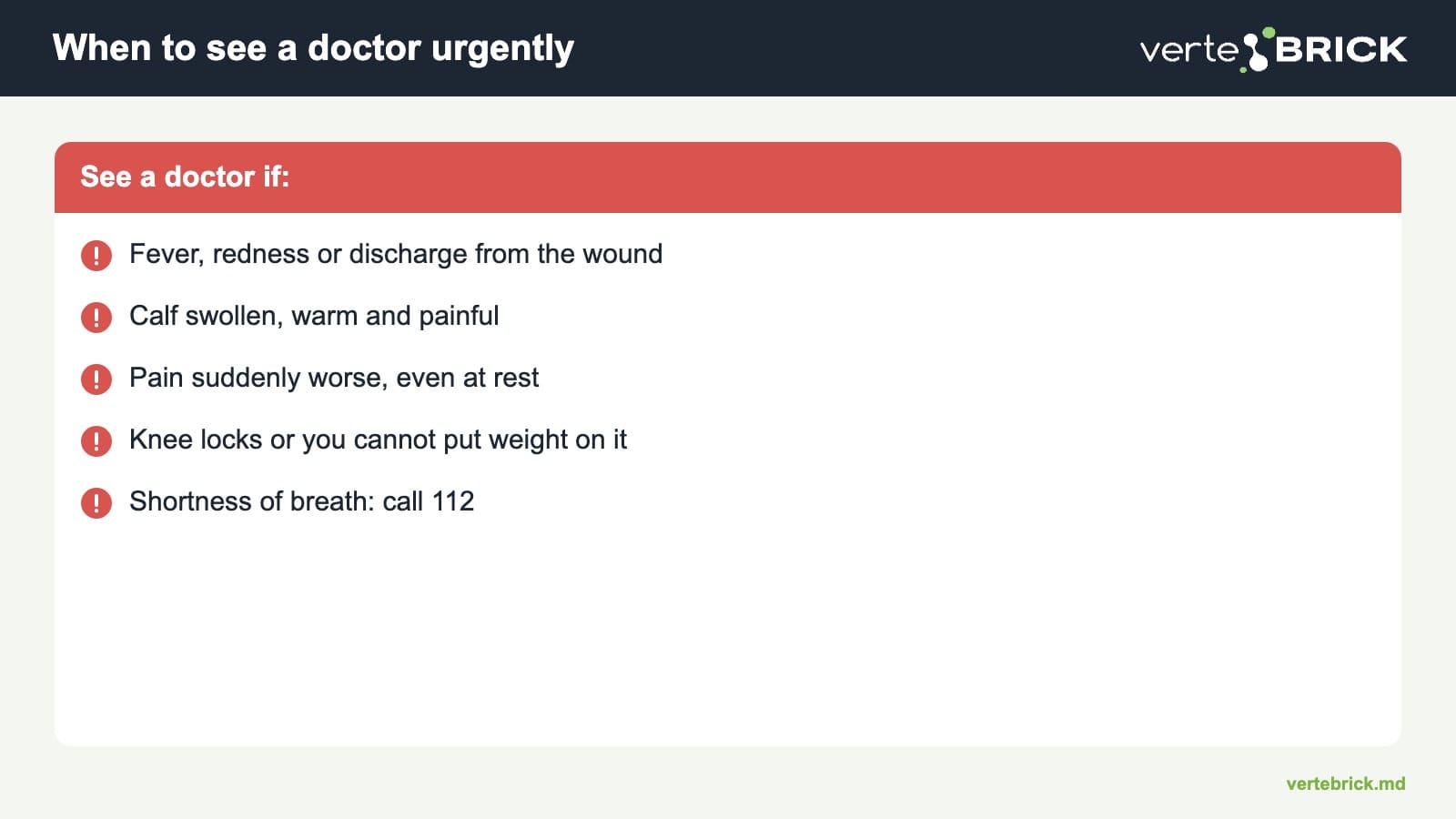
- fever, redness or discharge from the wound;
- the calf becomes swollen, warm and painful;
- pain suddenly gets worse, even at rest;
- the knee locks or you cannot put weight on the leg;
- shortness of breath or chest pain (call 112).
How we work at Vertebrick
At the first visit we measure your knee's range of motion in degrees, muscle strength and the way you walk, then set out a clear step-by-step programme. We show you the home exercises and check at every session how extension, flexion and strength are progressing. We work together with your surgeon's recommendations.
Frequently asked questions
How long is rehab after a knee replacement?
Usually 6–12 weeks for daily activities and up to a year for full recovery of strength.
When can I start physiotherapy?
Gentle exercises start in the first days after surgery. Outpatient rehab usually begins after discharge, as your surgeon advises.
Is it normal for the knee to be swollen after several weeks?
Yes, moderate swelling can last a few months, especially in the evening. Marked swelling, redness or fever should be checked by a doctor.
Where can I do knee replacement rehab in Chisinau?
At the Vertebrick clinic in Chisinau, with an exercise programme matched to your stage and checked at every session.

Book an assessment
Come in for an assessment at Vertebrick, 12/2 Traian Blvd, Chișinău, Moldova. We are open Monday to Saturday, 08:00–20:00.
📞 +373 69 82 62 12 · WhatsApp: wa.me/37369826212 · Fill in the form
Author: the Vertebrick team, physiotherapy clinic in Chișinău. This article is for information only and does not replace a medical consultation.
Sources
- Jette DU et al. Physical Therapist Management of Total Knee Arthroplasty. Phys Ther. 2020;100(9):1603–1631.
- Bade MJ, Stevens-Lapsley JE. Early high-intensity rehabilitation following total knee arthroplasty improves outcomes. J Orthop Sports Phys Ther. 2011;41(12):932–941.
- Pozzi F, Snyder-Mackler L, Zeni J. Physical exercise after knee arthroplasty: a systematic review of controlled trials. Eur J Phys Rehabil Med. 2013;49(6):877–892.
- Beswick AD et al. What proportion of patients report long-term pain after total hip or knee replacement for osteoarthritis? BMJ Open. 2012;2:e000435.
- NICE. Joint replacement (primary): hip, knee and shoulder (NG157). 2020.