

In short: low back pain is very common and, in most cases, is not caused by a serious disease. International clinical guidelines recommend movement, supervised exercise and clear information first, not bed rest, back belts or routine scans. Below you will find why your back hurts, when to see a doctor urgently and which treatment works.
How common is low back pain?
About 619 million people worldwide had low back pain in 2020, roughly 1 in 13 people. It is the leading cause of disability in the world. So if your back hurts, you are not an exception: this is a very common problem that can usually be treated without surgery.
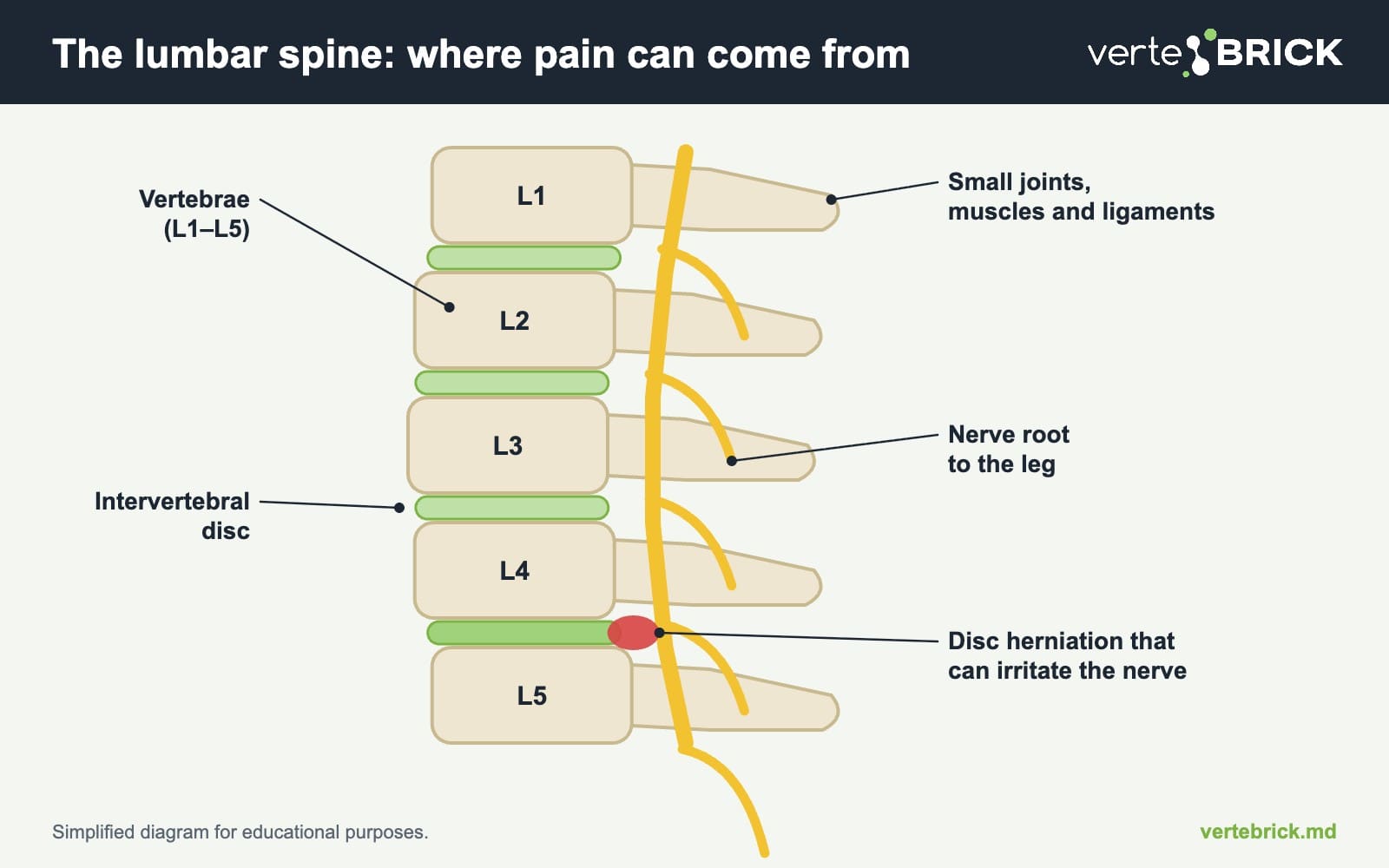
Why does the lower back hurt?
The lumbar spine has five large vertebrae. Between them sit the discs, which act like shock absorbers, and next to them run the nerves to the legs. Around them are muscles, ligaments and small joints. Pain can come from any of these structures.
In more than 90% of chronic back pain cases seen in primary care, no specific disease explains the pain. Doctors call this "non-specific low back pain". It does not mean the pain is not real. It means it is not dangerous, and treatment is based on movement and gradually rebuilding strength.
Things that raise the risk or keep the pain going:
- long hours of sitting and little movement;
- sudden lifting, especially with a twist;
- weak trunk and glute muscles;
- poor sleep, stress and fatigue;
- fear of movement, which makes you avoid activity and weakens the back even more.
An MRI does not tell the whole story
Many patients get scared when their MRI report says "protrusion", "bulge" or "disc degeneration". A review of 33 studies with more than 3,000 people looked at MRIs of people with no back pain at all. The results:
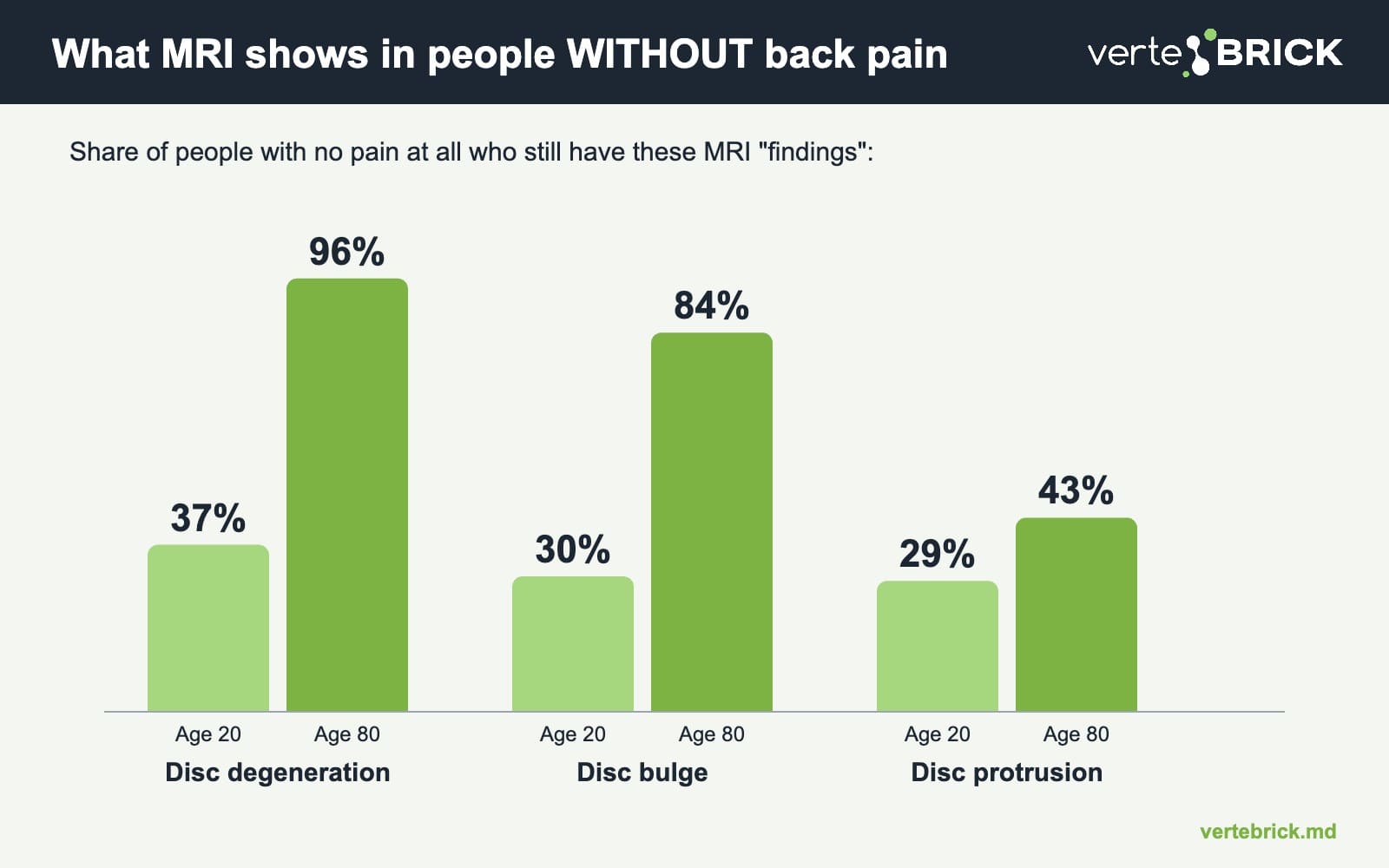
- disc degeneration: 37% at age 20 and 96% at age 80;
- disc bulge: 30% at age 20 and 84% at age 80;
- disc protrusion: 29% at age 20 and 43% at age 80.
In other words, many of these "findings" are normal age-related changes, like grey hair. That is why clinical guidelines advise against routine imaging for back pain, and recommends it only when the result would change treatment.
When to see a doctor URGENTLY
See a doctor or go to the emergency department straight away if, along with back pain, you have:
- loss of bladder or bowel control;
- numbness between the legs ("saddle area");
- leg weakness that is getting worse;
- fever, unexplained weight loss or a history of cancer;
- pain after a fall or an accident;
- severe night pain that does not ease in any position.
These signs are rare, but a doctor should check them before you start any exercise.
What clinical guidelines recommend
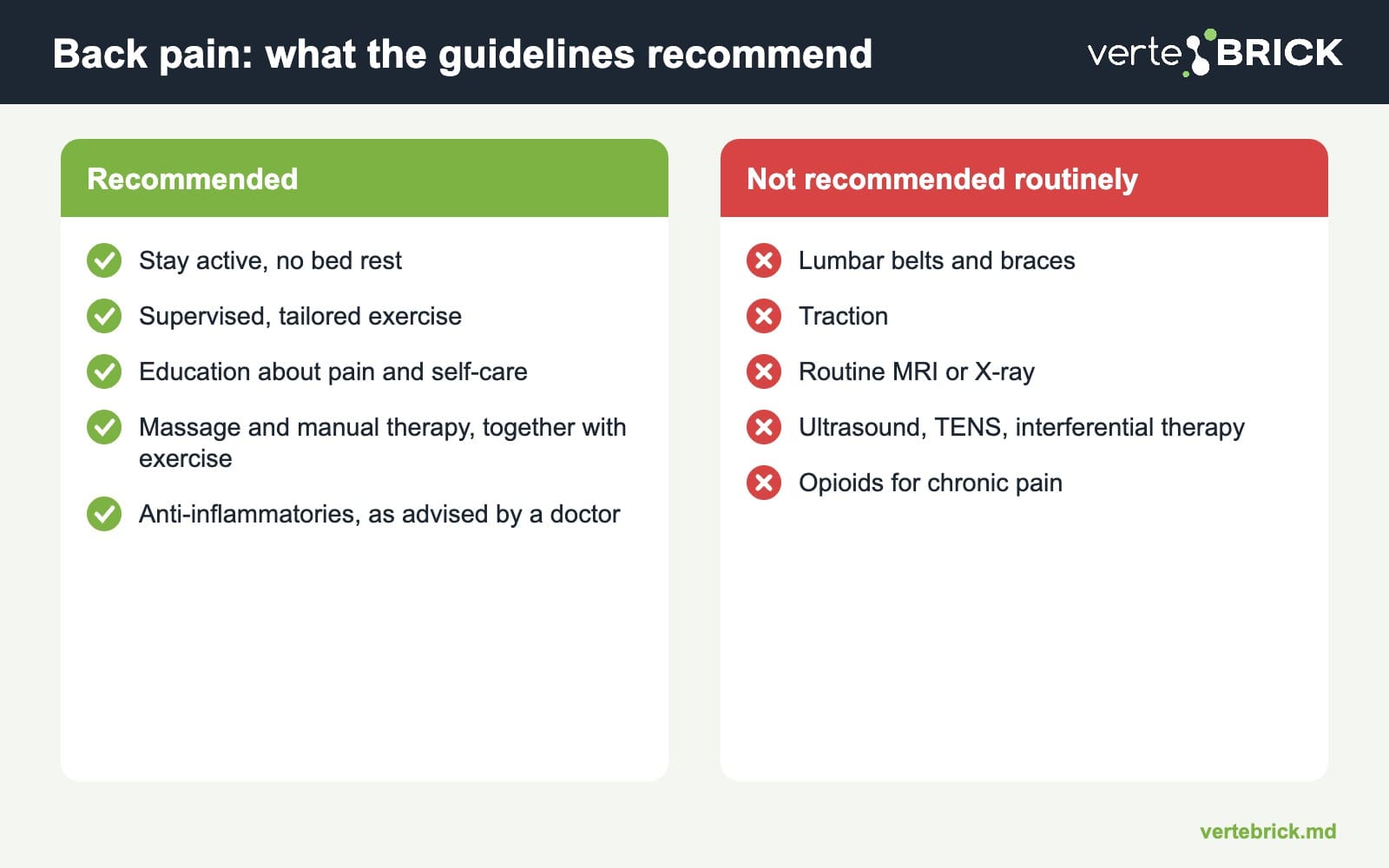
For chronic low back pain, international guidelines recommend: education about pain and self-care, exercise programmes, physical therapies (such as spinal manipulation and massage), psychological therapies (such as cognitive behavioural therapy) and some medicines, such as anti-inflammatories, as advised by a doctor.
The guidelines also list what is not recommended routinely: lumbar belts and braces, traction, ultrasound, TENS, interferential therapy and acupuncture. Opioids are not recommended because of the risk of dependence.
One important detail: the guidelines recommend massage and manual therapy only together with exercise, not as a stand-alone treatment.
How much does exercise help?
A review of 249 trials with more than 24,000 patients found that exercise reduces chronic low back pain by an average of 15 points on a 0–100 scale compared with no treatment. That difference matters to patients. There is no single "magic" exercise: what counts is a programme that suits you and that you do regularly.
How we work at Vertebrick
At Vertebrick, back pain treatment starts with an assessment by a physiotherapist: which movements hurt, what eases the pain, how strong your muscles are, and how you sit and move at work and at home. You then get a plan that may include:
- supervised exercise for mobility and trunk and glute strength;
- therapeutic massage and manual techniques combined with exercise, as the guidelines recommend;
- advice on desk work, driving, sleep and lifting;
- a short home exercise programme;
- a gradual return to sport and the activities you enjoy.
The goal is not only to ease the pain now, but to know what to do so it does not come back.
What you can do today
- Stay active. Walking 2–3 times a day usually helps more than lying in bed.
- Change position every 30–40 minutes if you sit a lot.
- Do not buy a back belt "for prevention": guidelines do not recommend it.
- Do not panic over MRI wording before you discuss it with a specialist.
Frequently asked questions
How long does low back pain last?
Many episodes improve within days or weeks. If the pain lasts more than 6 weeks, keeps coming back or stops you from working, it is worth getting a physiotherapy assessment.
Do I need an MRI for back pain?
Usually not at first. Guidelines recommend imaging only when the result would change treatment or when there are warning signs. Your doctor makes that decision.
Does massage help back pain?
Massage can reduce pain in the short term, but the effect is better and lasts longer when combined with exercise. That is why at Vertebrick massage is part of a plan, not the only treatment.
Can I exercise with back pain?
In most cases, yes, with adjustments. The right kind of movement helps recovery. Your physiotherapist will tell you what you can do now and how to build up gradually.
Where can I get physiotherapy for back pain in Chișinău?
At Vertebrick clinic, 12/2 Traian Blvd, Chișinău. Bookings: +373 69 82 62 12.

Book an assessment
Come in for an assessment at Vertebrick, 12/2 Traian Blvd, Chișinău. We are open Monday to Saturday, 08:00–20:00.
📞 +373 69 82 62 12 · WhatsApp: wa.me/37369826212 · Fill in the form
Author: Vasile Cebotaru, physiotherapist, founder of Vertebrick clinic. This article is for information only and does not replace a medical consultation.
Sources
- World Health Organization (2023). WHO guideline for non-surgical management of chronic primary low back pain in adults. who.int
- NICE (2016, updated). Low back pain and sciatica in over 16s: assessment and management (NG59). nice.org.uk
- Brinjikji W. et al. (2015). Systematic literature review of imaging features of spinal degeneration in asymptomatic populations. AJNR, 36(4):811–816.
- Hayden J.A. et al. (2021). Exercise therapy for chronic low back pain. Cochrane Database of Systematic Reviews.
- Furlan A.D. et al. (2015). Massage for low-back pain. Cochrane Database of Systematic Reviews.