
In short: a lumbar disc herniation sounds serious, but for most people the pain eases within a few weeks or months without surgery. Studies show that herniations often shrink on their own, and large fragments that have come out of the disc shrink even more often than small ones. Well-dosed movement and guided exercise help. Surgery is needed in only a small number of cases.
What a disc herniation is
Between the vertebrae sit the discs, “cushions” that take the load. Sometimes the outer layer of a disc gives way and part of its inner material comes out. If it presses on or irritates a nerve, you get pain that travels down the leg (sciatica), sometimes with numbness or tingling.
On an MRI report, a herniation is described as a protrusion (the disc only bulges), an extrusion (part of the disc has come out) or a sequestration (a fragment has broken off).
The MRI does not tell the whole story
Herniations and “bulging discs” are very common in people with no back pain at all, and they become more common with age. So a herniation on the MRI does not automatically mean it is the cause of your pain, or that you need surgery. What matters is what you feel, what the examination shows and how the pain changes.
A herniation can shrink on its own
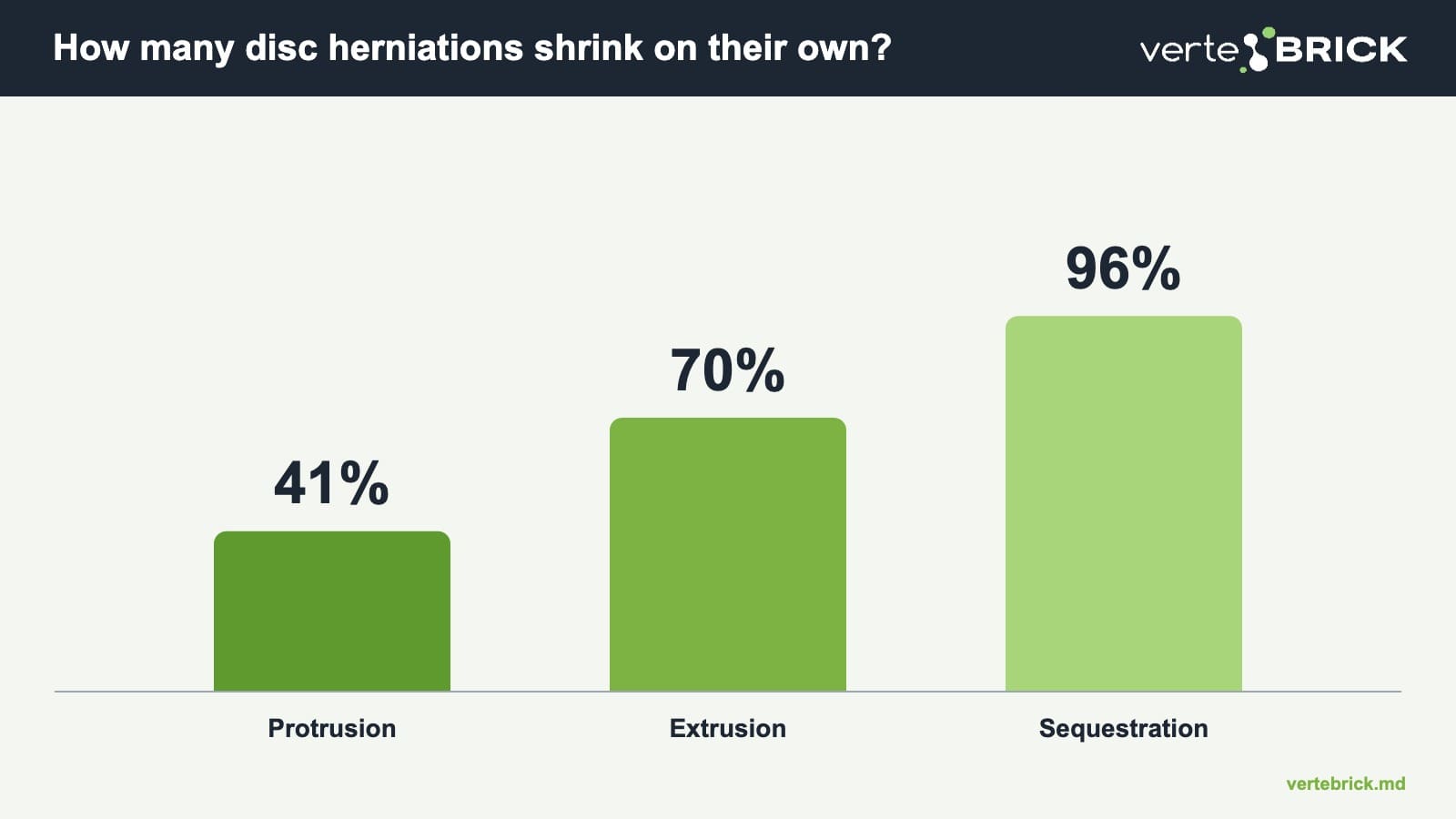
The body gradually “clears away” the material that has come out of the disc. In an analysis of several studies, the herniation shrank or disappeared in about 4 in 10 people with a protrusion, 7 in 10 with an extrusion and more than 9 in 10 with a sequestration. Surprisingly, the larger the fragment, the more often it shrinks.
What helps
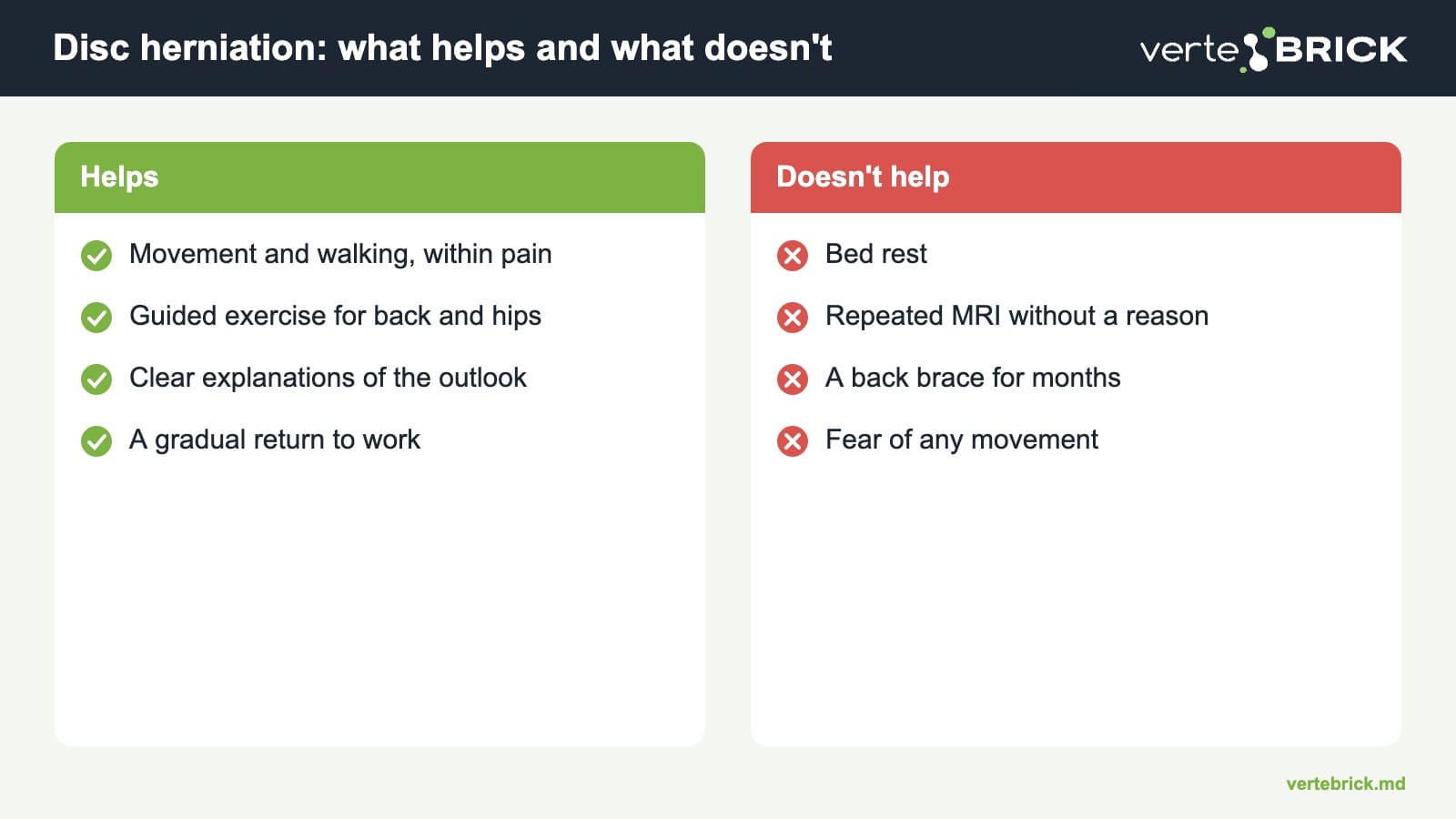
- Movement and walking, within the limits of pain. Bed rest does not speed up recovery.
- Guided exercise for the back, hips and abdomen, adapted to how irritated the nerve is.
- Clear explanations: knowing that pain does not mean your spine is “breaking” and that the outlook is usually good.
- A gradual return to work and normal activities, even if it still hurts a little.
- Pain medication for a short time and agreed with your doctor, so that you can keep moving.
What does not help or needs caution
- Bed rest for more than a day or two. Muscles weaken and the pain tends to last longer.
- Repeated MRI scans without a clear reason. They do not change treatment and can cause needless worry.
- Wearing a back brace for months. It may help for a few days when the pain is acute, but in the long run it weakens the muscles.
- Fear of any movement. Avoiding all bending and lifting makes recovery harder.
When surgery is needed
Surgery is considered when leg pain stays very severe after 6–12 weeks of proper treatment, or when significant weakness appears and gets worse. Large studies show that surgery brings faster relief, but after a year the results are similar to those of people treated without surgery. The decision is made together with a neurosurgeon, after weighing the benefits and risks.
When to go to hospital urgently
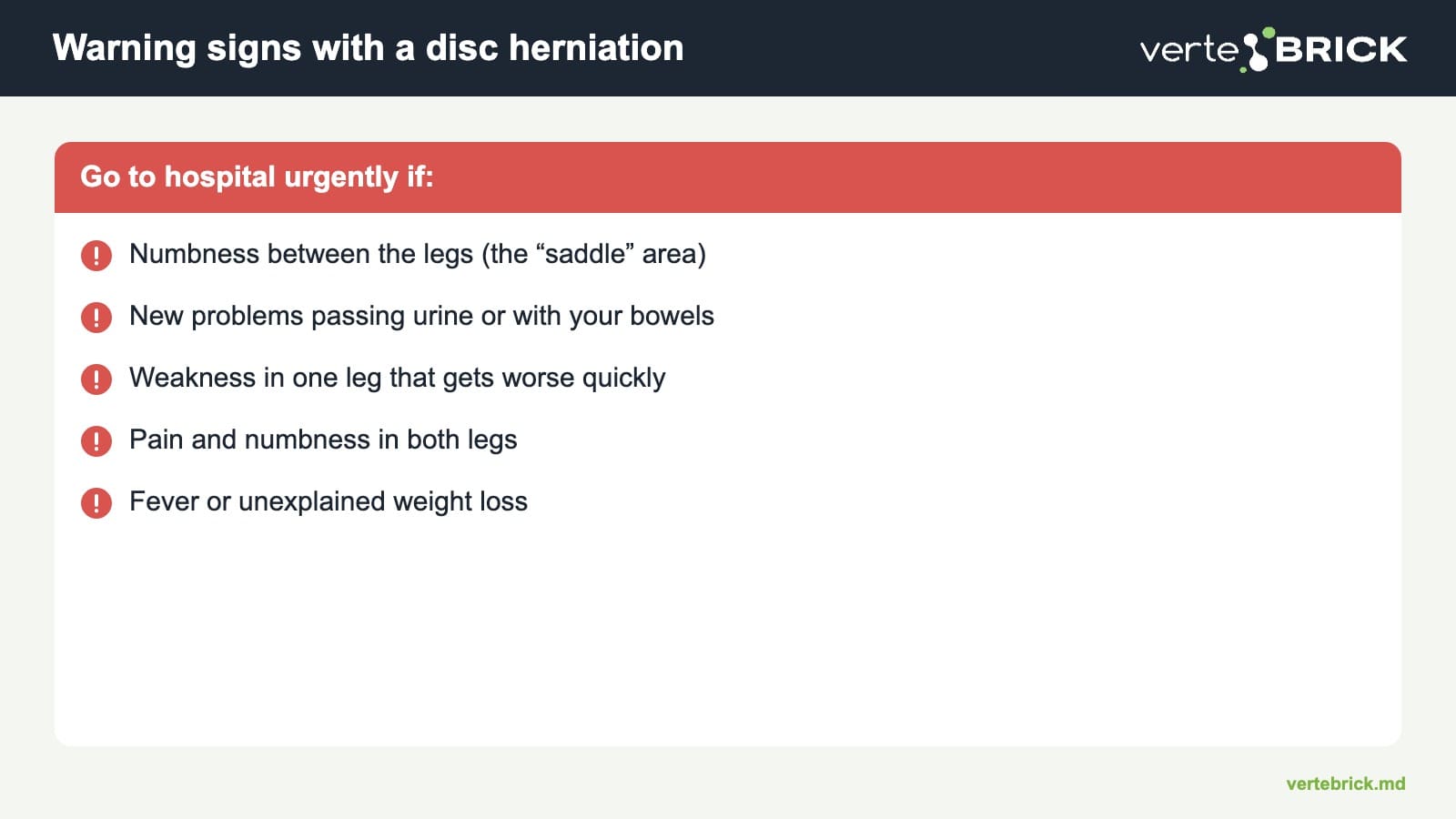
- numbness between the legs and around the back passage (the “saddle” area);
- new problems passing urine or controlling your bowels;
- weakness in one leg that gets worse quickly, for example you cannot lift your foot;
- pain and numbness in both legs;
- fever or unexplained weight loss together with back pain.
The first three signs can mean serious compression of the nerves (cauda equina syndrome), which needs urgent surgery.
How we work at Vertebrick
At the assessment, the physiotherapist finds out how the pain started, checks spinal movement, strength, sensation and reflexes, and looks for warning signs. We explain in plain words what the MRI shows and what it does not. You get an exercise programme with clear progression, advice on sleep, work and lifting, and a re-assessment so you can see your progress.
Frequently asked questions
Does a disc herniation heal without surgery?
For most people, yes. The pain eases within a few weeks or months, and the herniation often shrinks on its own.
Can I exercise with a disc herniation?
Yes. Adapted exercise and walking are recommended. They are chosen according to how irritated the nerve is and increased gradually.
Do I need to repeat the MRI?
Usually not. An MRI is repeated only if new signs appear, for example weakness that gets worse, or before surgery.
Where can I get physiotherapy for a disc herniation in Chișinău?
At the Vertebrick clinic, 12/2 Traian Blvd, Chișinău. Book on +373 69 82 62 12.

Book an assessment
Come in for an assessment at Vertebrick, 12/2 Traian Blvd, Chișinău, Moldova. We are open Monday to Saturday, 08:00–20:00.
📞 +373 69 82 62 12 · WhatsApp: wa.me/37369826212 · Fill in the form
Author: the Vertebrick team, physiotherapy clinic in Chișinău. This article is for information only and does not replace a medical consultation.
Sources
- Chiu CC, Chuang TY, Chang KH, Wu CH, Lin PW, Hsu WY. The probability of spontaneous regression of lumbar herniated disc: a systematic review. Clinical Rehabilitation, 2015.
- Brinjikji W, Luetmer PH, Comstock B, et al. Systematic literature review of imaging features of spinal degeneration in asymptomatic populations. American Journal of Neuroradiology, 2015.
- Peul WC, van Houwelingen HC, van den Hout WB, et al. Surgery versus prolonged conservative treatment for sciatica. New England Journal of Medicine, 2007.
- Weinstein JN, Tosteson TD, Lurie JD, et al. Surgical vs nonoperative treatment for lumbar disk herniation: the Spine Patient Outcomes Research Trial (SPORT): a randomized trial. JAMA, 2006.
- National Institute for Health and Care Excellence. Low back pain and sciatica in over 16s: assessment and management (NG59), 2016, updated 2020.