
In short: a medial collateral ligament (MCL) sprain happens when the knee is pushed inwards, for example by a blow from the side or a slip. It hurts on the inner side of the knee. Most injuries heal without surgery, with protection at first and then staged exercise. Return to sport depends on the grade of injury and on testing, not just on the number of weeks.
What the MCL is
The medial collateral ligament connects the thigh bone to the shin bone on the inner side of the knee and stops the knee “opening” inwards. Unlike the ACL, it has a good blood supply and usually heals by itself if it is protected properly.
Grades of injury
Grade 1 is a stretch with pain but a stable knee. Grade 2 is a partial tear with mild instability. Grade 3 is a complete tear and sometimes comes with ACL or meniscus injuries. A doctor sets the grade by examination and, if needed, an MRI.
Typical signs
- pain on the inner side of the knee after a blow or a twist;
- tenderness when pressing on the inner edge of the knee;
- local swelling, sometimes bruising;
- pain when fully bending the knee or stepping sideways;
- a feeling that the knee “opens” inwards with bigger injuries.
What helps
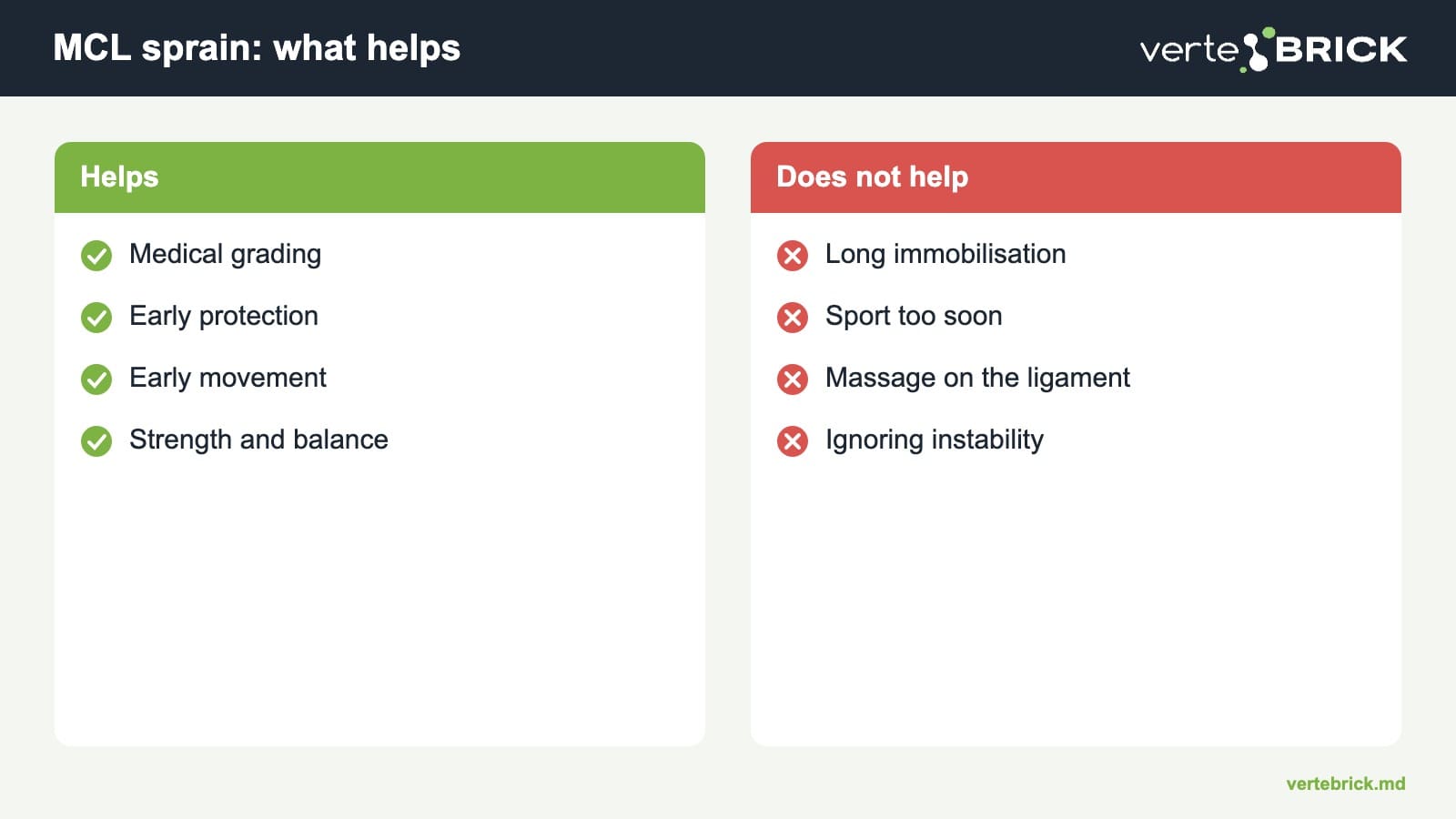
- a medical assessment to set the grade;
- protection at first: ice and, if needed, a hinged brace and crutches for a few days;
- early movement within pain limits, so you do not lose mobility;
- strength exercises for the quadriceps, hamstrings and hip;
- balance work and a gradual return to running and changes of direction.
What doesn't help
- long, complete immobilisation without exercise;
- returning to sport before the knee is stable and pain-free;
- strong massage directly over the ligament in the first days;
- ignoring instability or locking.
How long it takes
Grade 1 usually recovers in 1–3 weeks, grade 2 in 3–6 weeks and grade 3 in about 6–12 weeks. Return to sport comes after strength and control tests.
When to see a doctor urgently
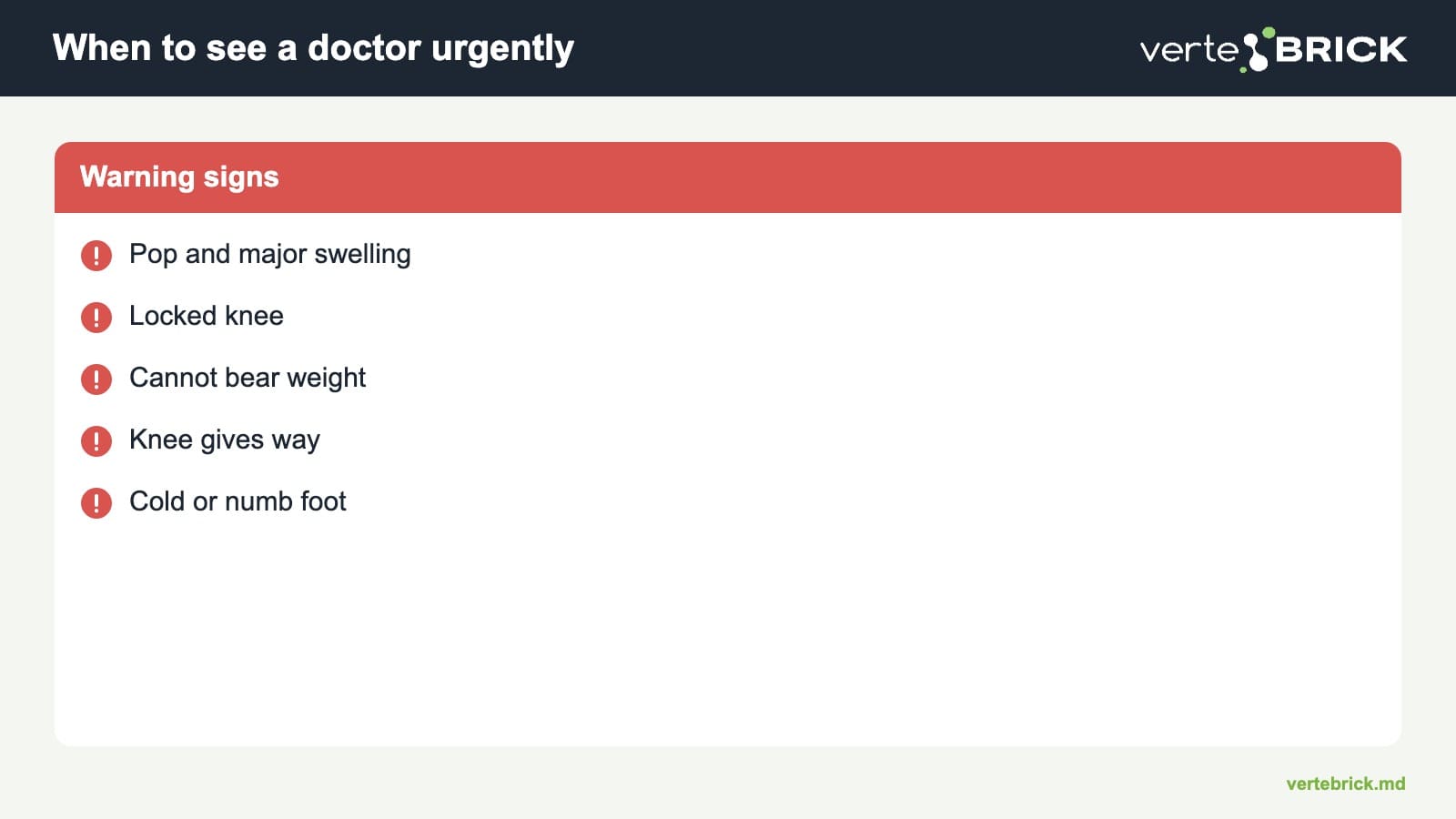
- a “pop” and a lot of swelling within hours;
- the knee locks or will not straighten;
- you cannot put weight on the leg;
- the knee gives way when walking;
- numbness or a cold foot.
How we work at Vertebrick
We follow your doctor's guidance. We track knee mobility, strength and stability and build a staged programme, from simple exercises to jumps and changes of direction, with testing before you return to sport.
Frequently asked questions
Does the MCL heal without surgery?
Yes, in most cases. The ligament has a good blood supply and with protection and exercise it usually heals without surgery.
Do I need a brace after a knee sprain?
For grade 2 and 3 injuries, doctors often recommend a hinged brace for a few weeks. For grade 1 it is usually not needed.
When can I return to football after an MCL sprain?
When the knee is stable and pain-free and you have passed strength and change-of-direction tests. Usually 2–12 weeks, depending on the grade.
Where can I get knee sprain rehab in Chișinău?
At the Vertebrick clinic in Chișinău, with a staged programme and testing before return to sport.
Book an assessment
Come in for an assessment at Vertebrick, 12/2 Traian Blvd, Chișinău, Moldova. We are open Monday to Saturday, 08:00–20:00.
📞 +373 69 82 62 12 · WhatsApp: wa.me/37369826212 · Fill in the form
Author: the Vertebrick team, physiotherapy clinic in Chișinău. This article is for information only and does not replace a medical consultation.
Sources
- Andrews K et al. Review: medial collateral ligament injuries. J Orthop. 2017;14(4):550–554.
- Kim C, Chasse PM, Taylor DC. Return to play after medial collateral ligament injury. Clin Sports Med. 2016;35(4):679–696.
- Logerstedt DS et al. Knee stability and movement coordination impairments: knee ligament sprain revision 2017. J Orthop Sports Phys Ther. 2017;47(11):A1–A47.