

In short: a meniscus tear seen on MRI does not automatically mean surgery. In adults over 35–40, most tears are degenerative, and an exercise programme of about 12 weeks gives results as good as arthroscopy. Surgery remains an option when the knee locks or when the tear follows an injury in a young person.
What the meniscus is
The menisci are two crescent-shaped cartilage "cushions" between the thigh bone and the shin bone. They spread the load and stabilise the knee. With age the tissue becomes more fragile, and tears can appear even without a clear injury. In young people, a tear usually happens with a sudden twist of the knee while the foot is planted.
Typical signs
- pain on the inner or outer side of the knee;
- swelling that appears the same day or the next;
- pain when squatting, twisting or climbing stairs;
- a feeling that the knee "catches" or "clicks";
- sometimes the knee cannot straighten fully.
What helps
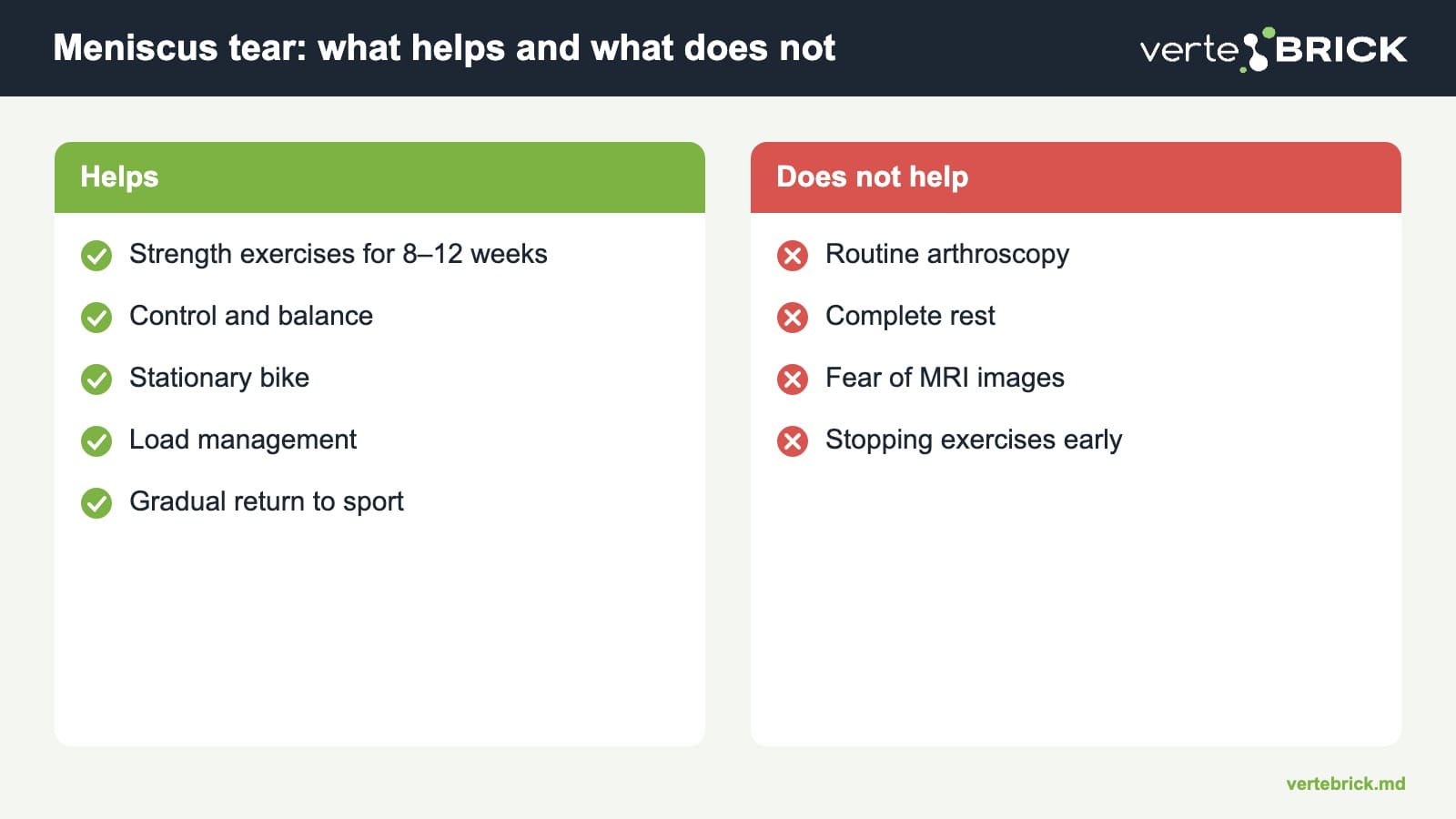
- Strength exercises for the thigh and hip, progressed gradually for at least 8–12 weeks.
- Control and balance exercises, so the knee does not drop inwards during squats and steps.
- A stationary bike for mobility and fitness without heavy impact.
- Load management: you temporarily reduce the movements that cause strong pain, not all activity.
- A gradual return to running and sport after strength and control tests.
What does not help
- "Routine" arthroscopy for a degenerative tear without locking. It does not give better results than exercise.
- Complete rest and avoiding any knee bending.
- Fear of MRI images. Many people with no pain at all also have meniscus changes on MRI.
- Stopping the exercises after a few weeks, when pain has eased but strength has not yet returned.
When surgery is discussed
Surgery makes sense mainly when the knee locks and will not straighten, when the tear is large and follows an injury in a young person, or when mechanical symptoms continue after a well-done exercise programme. The decision is made together with an orthopaedic surgeon. After surgery, recovery is also based on exercise.
When to see a doctor
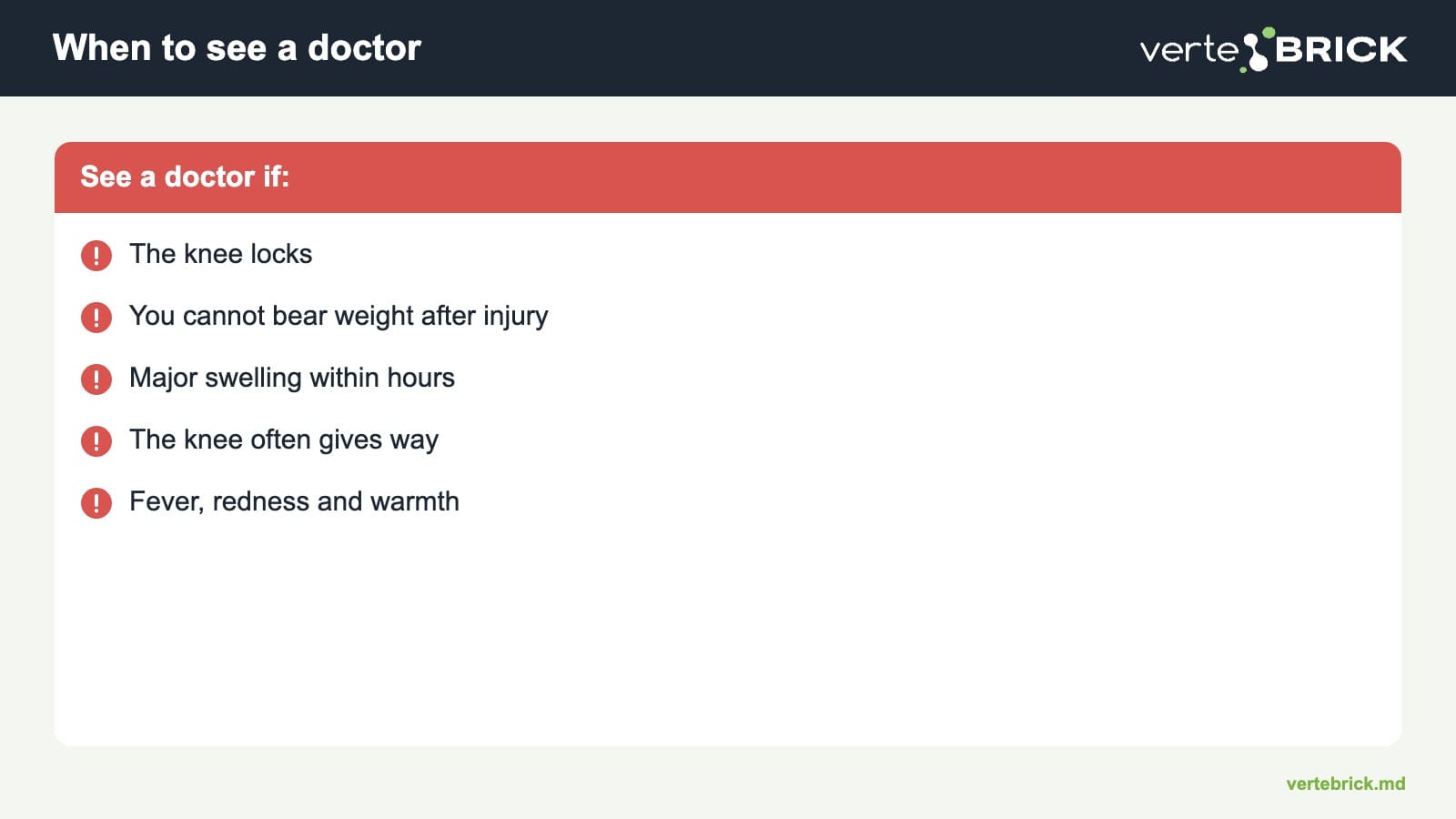
- the knee is locked and will not straighten;
- you cannot put weight on the leg after an injury;
- the knee swells a lot within hours of a twist;
- the knee often gives way;
- fever, redness and warmth in the joint.
How we work at Vertebrick
At the first visit we check the mobility and stability of the knee, thigh and hip strength, and the way you squat and step. Based on these tests we build a step-by-step programme and measure progress at every session. If there are signs that need an orthopaedic assessment, we tell you from the start.
Frequently asked questions
Does a meniscus tear heal without surgery?
The inner part of the meniscus heals poorly, but pain and knee function improve in most patients with a well-guided exercise programme.
How long does recovery without surgery take?
Usually 8–12 weeks of regular exercise, followed by a gradual return to sport.
Can I squat with a torn meniscus?
Yes, usually partial squats, to a depth without strong pain, progressed gradually. We choose them based on your assessment tests.
Where can I get meniscus rehab in Chisinau?
At the Vertebrick clinic in Chisinau, with a step-by-step exercise programme and progress measured at every session.

Book an assessment
Come in for an assessment at Vertebrick, 12/2 Traian Blvd, Chișinău, Moldova. We are open Monday to Saturday, 08:00–20:00.
📞 +373 69 82 62 12 · WhatsApp: wa.me/37369826212 · Fill in the form
Author: the Vertebrick team, physiotherapy clinic in Chișinău. This article is for information only and does not replace a medical consultation.
Sources
- Kise NJ et al. Exercise therapy versus arthroscopic partial meniscectomy for degenerative meniscal tear in middle aged patients: randomised controlled trial with two year follow-up. BMJ. 2016;354:i3740.
- van de Graaf VA et al. Effect of early surgery vs physical therapy on knee function among patients with nonobstructive meniscal tears: the ESCAPE randomized clinical trial. JAMA. 2018;320(13):1328–1337.
- Sihvonen R et al. Arthroscopic partial meniscectomy versus sham surgery for a degenerative meniscal tear. N Engl J Med. 2013;369(26):2515–2524.
- Siemieniuk RAC et al. Arthroscopic surgery for degenerative knee arthritis and meniscal tears: a clinical practice guideline. BMJ. 2017;357:j1982.
- Logerstedt DS et al. Knee pain and mobility impairments: meniscal and articular cartilage lesions. Revision 2018. J Orthop Sports Phys Ther. 2018;48(2):A1–A50.