
In short: neck pain is very common in people who spend a lot of time at a computer or on their phone. In most cases it is not dangerous and improves within a few weeks. What works best is movement and strength exercises for the neck and shoulders, not rest or the search for a “perfect posture”.
Why the neck hurts
Your neck carries the weight of your head all day. When you sit in the same position for hours, the neck and shoulder muscles get tired and sensitive. Stress, too little sleep and lack of movement increase the tension even more.
Typical signs: pain and stiffness at the back of the neck, sometimes spreading to the shoulders or between the shoulder blades, getting worse towards the evening or after many hours at the desk. In some people the pain spreads up into the head and causes headaches.
Posture is not everything
Many people believe that “text neck”, bending the head towards a screen, causes the pain on its own. Studies in young adults found no clear link between this posture and neck pain. More important than a “correct” position is not staying in one position for too long and having strong muscles.
An MRI does not tell the whole story
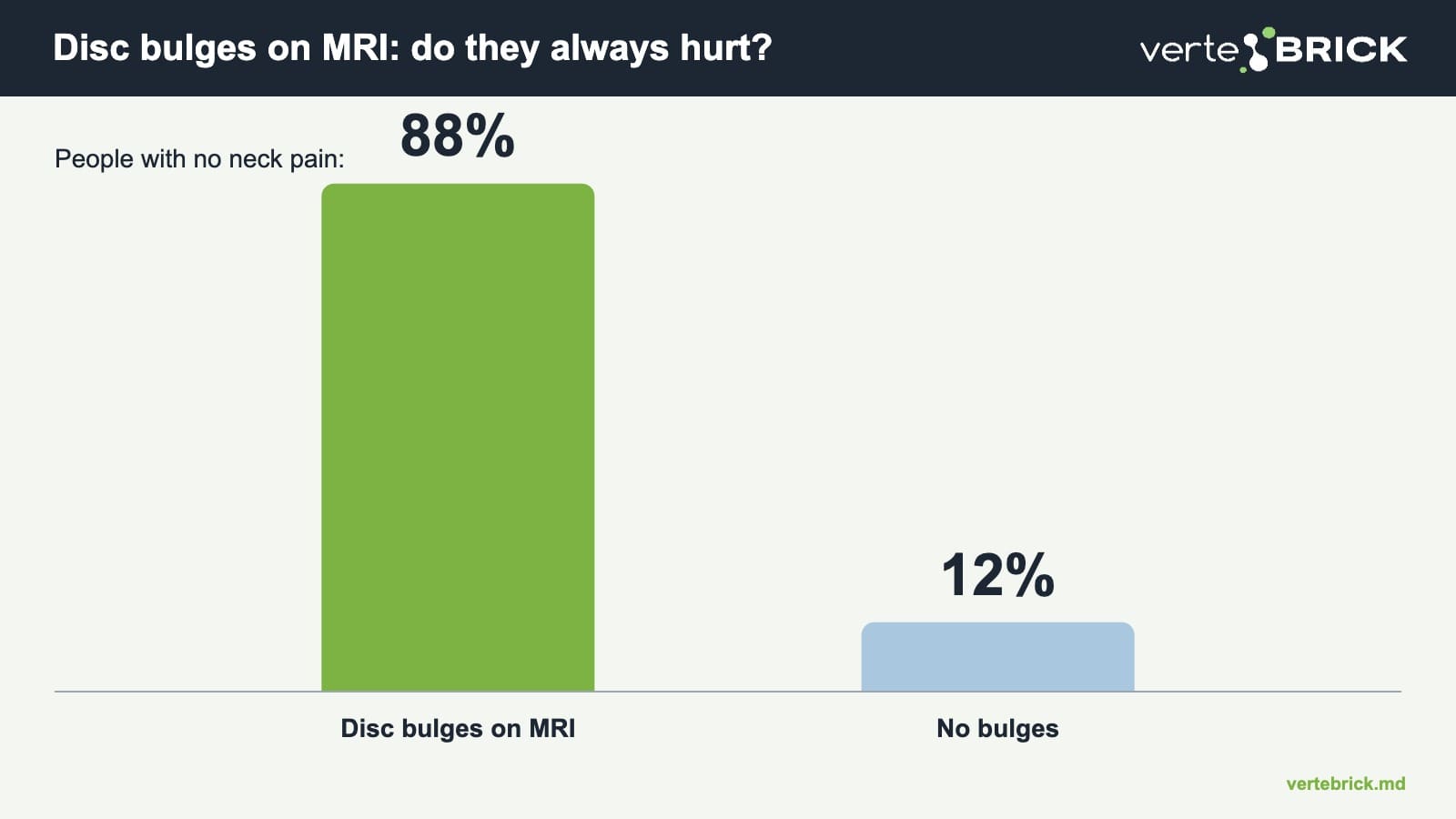
Neck MRI scans often show disc “bulges” or “herniations”. In a large study of people with no neck pain at all, almost 9 in 10 had disc bulges on MRI. These changes come with age and in most cases are not the cause of the pain.
What helps
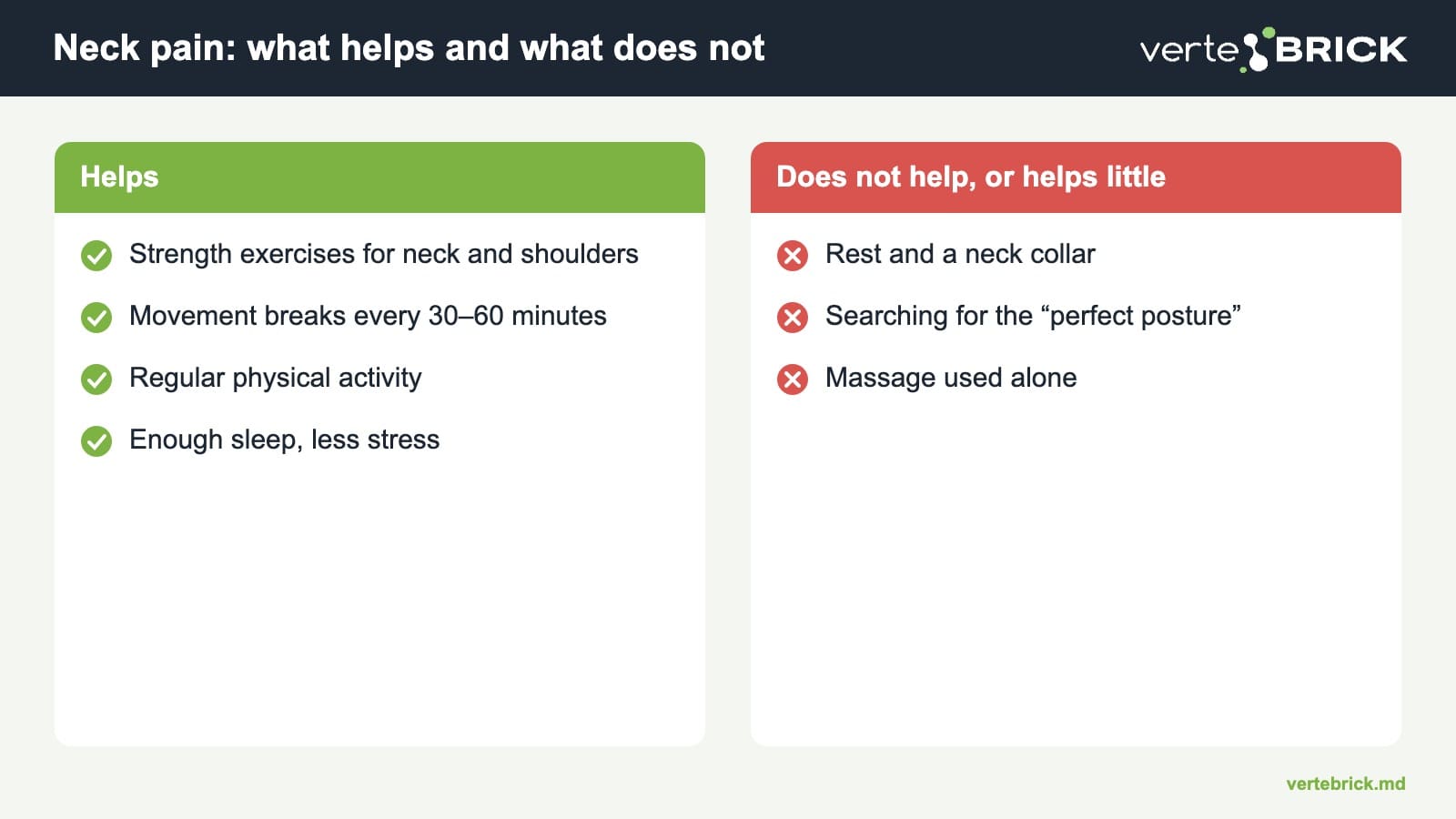
- Strength exercises for the neck, shoulders and shoulder blades, done regularly. They reduce pain, especially when it has lasted a long time.
- Short movement breaks every 30–60 minutes: stand up and move your shoulders and neck.
- Physical activity: walking, the gym, exercises at home.
- Enough sleep and managing stress.
What does not help, or helps little
- Long rest and a neck collar worn for a long time as the only treatment. The neck becomes stiff and weak.
- Searching for the “perfect posture”. There is no single correct position, and any position becomes tiring if you hold it too long.
- Passive treatments used alone, such as massage. They can ease pain for a short time but do not replace exercise.
The neck collar: when it makes sense
A collar is not a treatment on its own, but it can help in the short term. For example, in recent neck pain that spreads down the arm (cervical radiculopathy), a study showed that a semi-hard collar worn for a few weeks reduced pain faster than simply waiting, just like a physiotherapy programme. We use it only as an add-on, for a short time and together with exercise, not instead of movement.
The thoracic spine and the deep neck muscles
The neck does not work alone. When the upper back (thoracic spine) is stiff, the neck takes on more movement and more load. That is why neck pain guidelines recommend, in addition to neck exercises, mobilisation and exercise for the thoracic spine.
Just as important are the deep neck flexors, the longus colli and longus capitis muscles, which lie at the front of the cervical spine. These muscles stabilise the neck and head throughout the day. In people with neck pain and headaches, these muscles often work less well, and the surface muscles take over the load and tense up. In headaches that start in the neck (cervicogenic headache), a clinical trial showed that a programme of gentle exercises to activate the deep neck flexors, together with shoulder blade exercises, reduced how often the headaches occurred, and the effect was still there a year later.
Why the neck causes headaches: the anatomy
Many people do not believe a headache can start in the neck. The explanation lies in the brainstem. Pain from the forehead, around the eyes and the temples travels along the trigeminal nerve to a nucleus in the brainstem that extends down into the top of the spinal cord, to the level of the C2–C3 vertebrae. The C1, C2 and C3 nerves arrive in the same place, carrying pain from the joints between the skull and the first vertebrae (C0–C1, C1–C2, C2–C3), from the muscles under the back of the skull and from the membrane covering the spinal cord (dura mater).
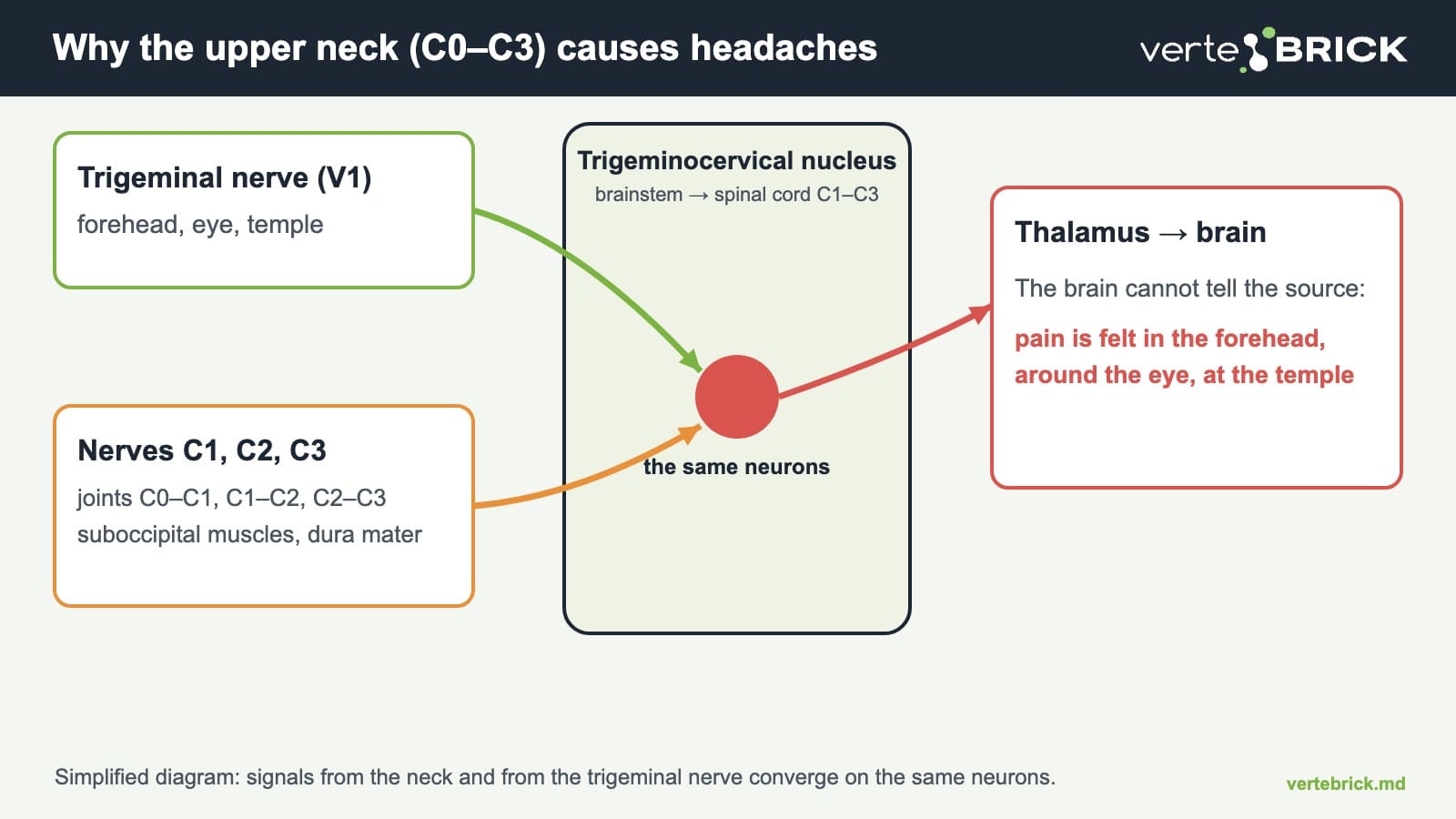
These signals converge on the same neurons, an area called the trigeminocervical nucleus. The brain receives the signal from these neurons but cannot tell where it came from. That is why a problem in the joints or muscles of the upper neck can be felt as pain at the back of the head, but also in the forehead, around the eye or at the temple. This explains cervicogenic headache and why treating the neck can reduce the headache.
Dizziness and the neck: when it is physiotherapy and when it is an emergency
Dizziness and neck pain can have very different causes. Before any treatment, the physiotherapist has to tell them apart.
Ordinary neck pain, with or without mild dizziness: green light for physiotherapy
The pain comes with movement or after long positions, and the dizziness, if any, is mild and linked to neck movements, with no other neurological signs. After an assessment, exercise is the right treatment.
Vertebrobasilar insufficiency: see a doctor first
The vertebral arteries run through the neck and carry blood to the back of the brain. When blood flow through them drops, usually in older people with atherosclerosis, symptoms can appear, especially in certain head positions: dizziness, double vision, slurred speech, difficulty swallowing, sudden falls, nausea, numbness, involuntary eye movements. These signs need a medical assessment (neurologist) before physiotherapy. Once the doctor has found the cause, exercise can be done in an adapted way, avoiding the positions that bring on the symptoms.
Cervical artery dissection: a medical emergency
A dissection is a tear in the wall of a neck artery (carotid or vertebral). It can happen on its own or after a sudden movement or a blow, even a minor one. Signs: a new, very severe neck pain or headache unlike anything you have felt before, often on one side; sometimes a drooping eyelid and a smaller pupil on the same side, a pulsing noise in the ear; then dizziness, problems with vision or speech, weakness on one side of the body. A dissection can lead to a stroke. In this case there should be no massage, manipulation or exercise: call 112 immediately.
Why you should not let just anyone “crack” your neck
Neck manipulation, the quick movement that makes the neck “crack”, is not a trivial act. Rarely, but seriously, cases of artery dissection and stroke have been described after neck manipulation. Some people with an early dissection only feel neck pain and go to have it “fixed”; a sudden movement without proper checks can make things worse.
That is why international guidelines require checking for warning signs involving blood vessels and nerves before any manual technique on the neck. A masseur without medical training, a “handy person” or a relative does not do this check. At Vertebrick, the assessment always comes before treatment, and in most cases exercise is enough, without manipulation.

When to see a doctor urgently
- neck pain after an accident or a fall;
- fever together with a stiff neck and headache;
- numbness or weakness in the arms, clumsy hands or walking problems;
- a sudden, very severe headache, dizziness, or problems with vision or speech;
- constant pain at night and unexplained weight loss.
How we work at Vertebrick
At the assessment, the physiotherapist checks how your neck moves, the strength of your neck and shoulder muscles and how you work every day. You get a short exercise programme that you can also do at the office, plus advice on breaks and setting up your workplace. If we suspect a problem that needs a doctor, we tell you directly.
Frequently asked questions
My MRI shows a herniated disc in my neck. Is it serious?
Usually not. Many bulges and herniations cause no symptoms. What matters is what you feel and what the doctor finds on examination, not just the image.
Which pillow is best for the neck?
No pillow will cure neck pain. Choose the one you sleep comfortably on and wake up without pain.
Can neck pain cause headaches?
Yes. Pain that starts in the neck can spread to the back of the head. Neck exercises often help with these headaches too.
Where can I get neck physiotherapy in Chișinău?
At Vertebrick clinic, 12/2 Traian Blvd, Chișinău. Bookings: +373 69 82 62 12.
🎥 Free video mini-course: exercises for headaches in Vertebrick Academy (in Romanian).
Book an assessment
Come in for an assessment at Vertebrick, 12/2 Traian Blvd, Chișinău. We are open Monday to Saturday, 08:00–20:00.
📞 +373 69 82 62 12 · WhatsApp: wa.me/37369826212 · Fill in the form
Author: the Vertebrick team, physiotherapy clinic in Chișinău. This article is for information only and does not replace a medical consultation.
Sources
- Gross A, Kay TM, Paquin JP, et al. Exercises for mechanical neck disorders. Cochrane Database of Systematic Reviews, 2015.
- Nakashima H, Yukawa Y, Suda K, et al. Abnormal findings on magnetic resonance images of the cervical spines in 1211 asymptomatic subjects. Spine, 2015.
- Damasceno GM, Ferreira AS, Nogueira LAC, et al. Text neck and neck pain in 18–21-year-old young adults. European Spine Journal, 2018.
- Blanpied PR, Gross AR, Elliott JM, et al. Neck Pain: Revision 2017. Clinical Practice Guidelines. Journal of Orthopaedic & Sports Physical Therapy, 2017.
- Kuijper B, Tans JTJ, Beelen A, et al. Cervical collar or physiotherapy versus wait and see policy for recent onset cervical radiculopathy: randomised trial. BMJ, 2009.
- Jull G, Trott P, Potter H, et al. A randomized controlled trial of exercise and manipulative therapy for cervicogenic headache. Spine, 2002.
- Rushton A, Carlesso LC, Flynn T, et al. International Framework for Examination of the Cervical Region for Potential of Vascular Pathologies of the Neck Prior to Musculoskeletal Intervention: International IFOMPT Cervical Framework. Journal of Orthopaedic & Sports Physical Therapy, 2023.
- Bogduk N, Govind J. Cervicogenic headache: an assessment of the evidence on clinical diagnosis, invasive tests, and treatment. The Lancet Neurology, 2009.