
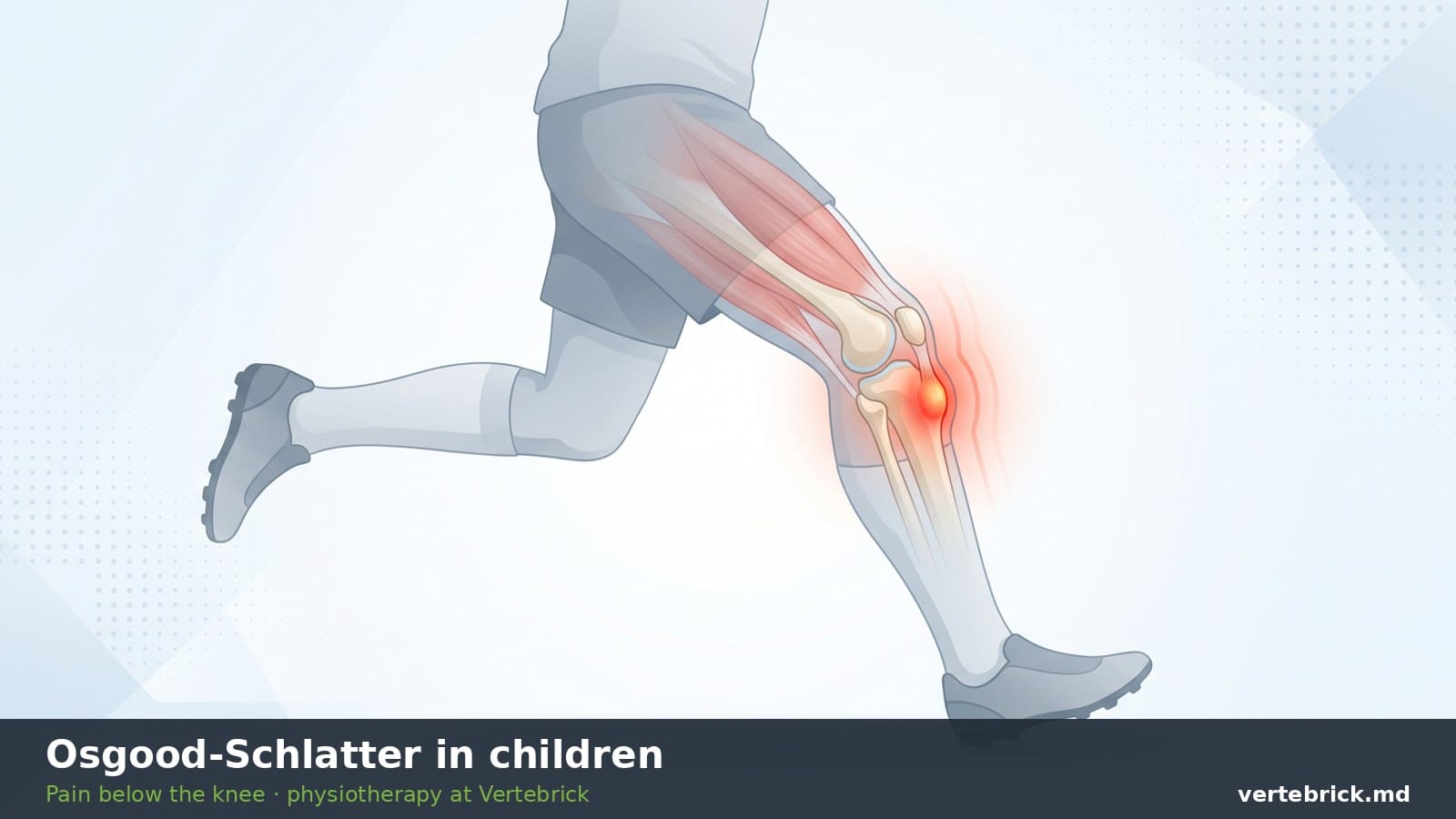
In short: Osgood-Schlatter disease is a common cause of pain below the kneecap in active children and teenagers, usually between 10 and 15 years old, during a growth spurt. A painful bump appears below the knee that hurts with running, jumping and kneeling. It is not dangerous and settles once growth finishes. Adjusting training and doing strength exercises help the child stay active.
What Osgood-Schlatter disease is
The patellar tendon attaches to the shin bone just below the knee, in an area that is still growing in children. With repeated running and jumping, the thigh muscle pulls hard on this point and the area becomes irritated. Over time a bony bump can form. It is an overload, not a serious injury.
Who gets Osgood-Schlatter
It is most common in boys aged 12–15 and girls aged 10–13 who play football, basketball, volleyball, athletics or dance. The risk rises when the child is growing fast and training volume is high. It can affect one or both knees.
Typical signs
- pain below the kneecap, on the front of the shin;
- a tender swelling or bump below the knee;
- pain with running, jumping, climbing stairs and kneeling;
- pain eases with rest and increases after training;
- sometimes tight thigh muscles.
What helps
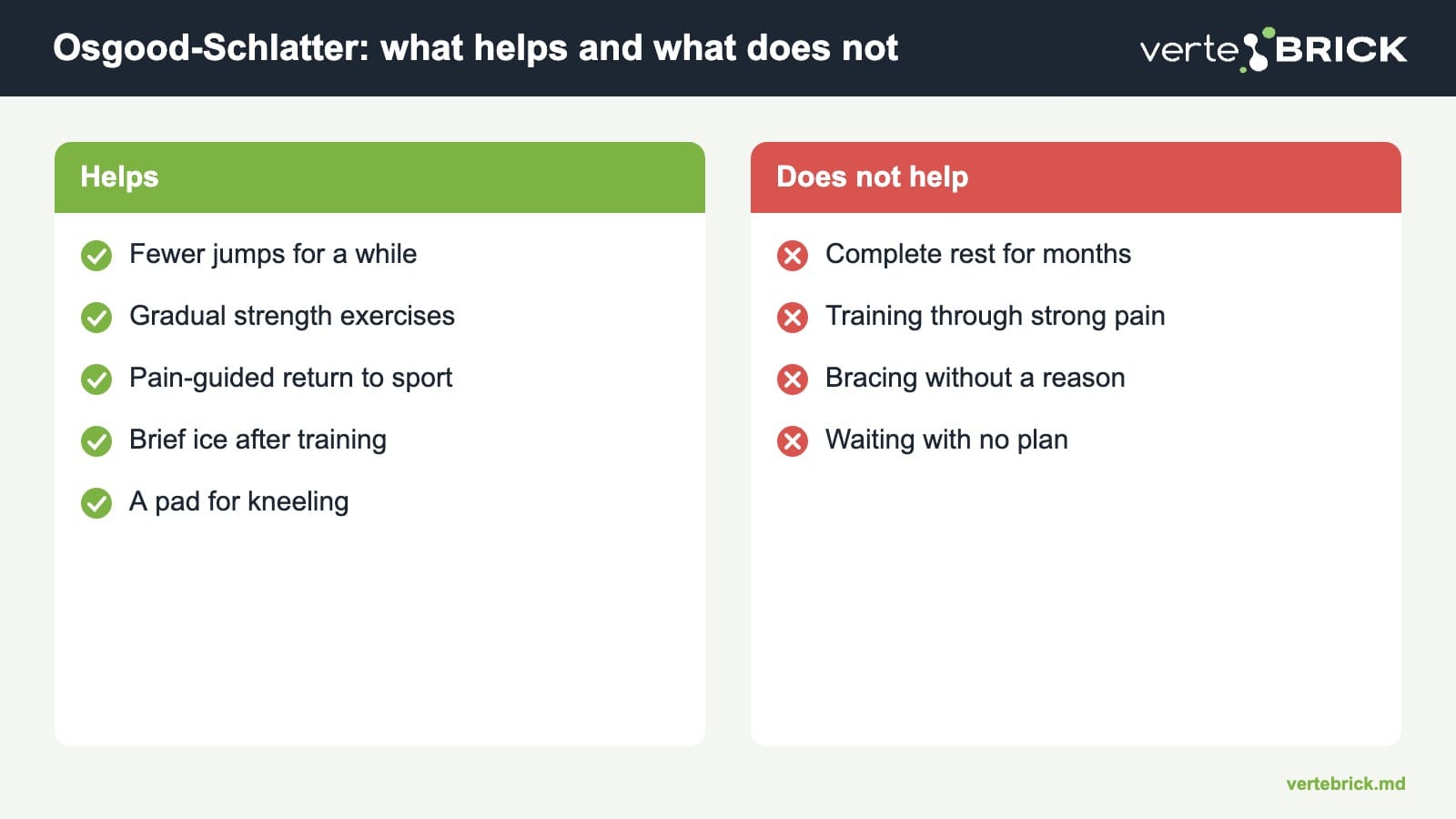
- temporarily reducing jumps and sprints, rather than stopping all activity;
- strength exercises for the thigh and hip, built up gradually;
- a pain-guided return to sport;
- brief ice after training, if it helps;
- a knee pad when the child kneels.
What does not help
- complete rest for months;
- intense training continued through strong pain;
- bracing the knee without a medical reason;
- the idea that you should “just wait” with no plan.
How long it lasts
Symptoms can last several months and sometimes return during growth spurts or heavy training periods. They usually go away once bone growth is complete. With an adjusted training plan, most children can keep playing sport.
When to see a doctor
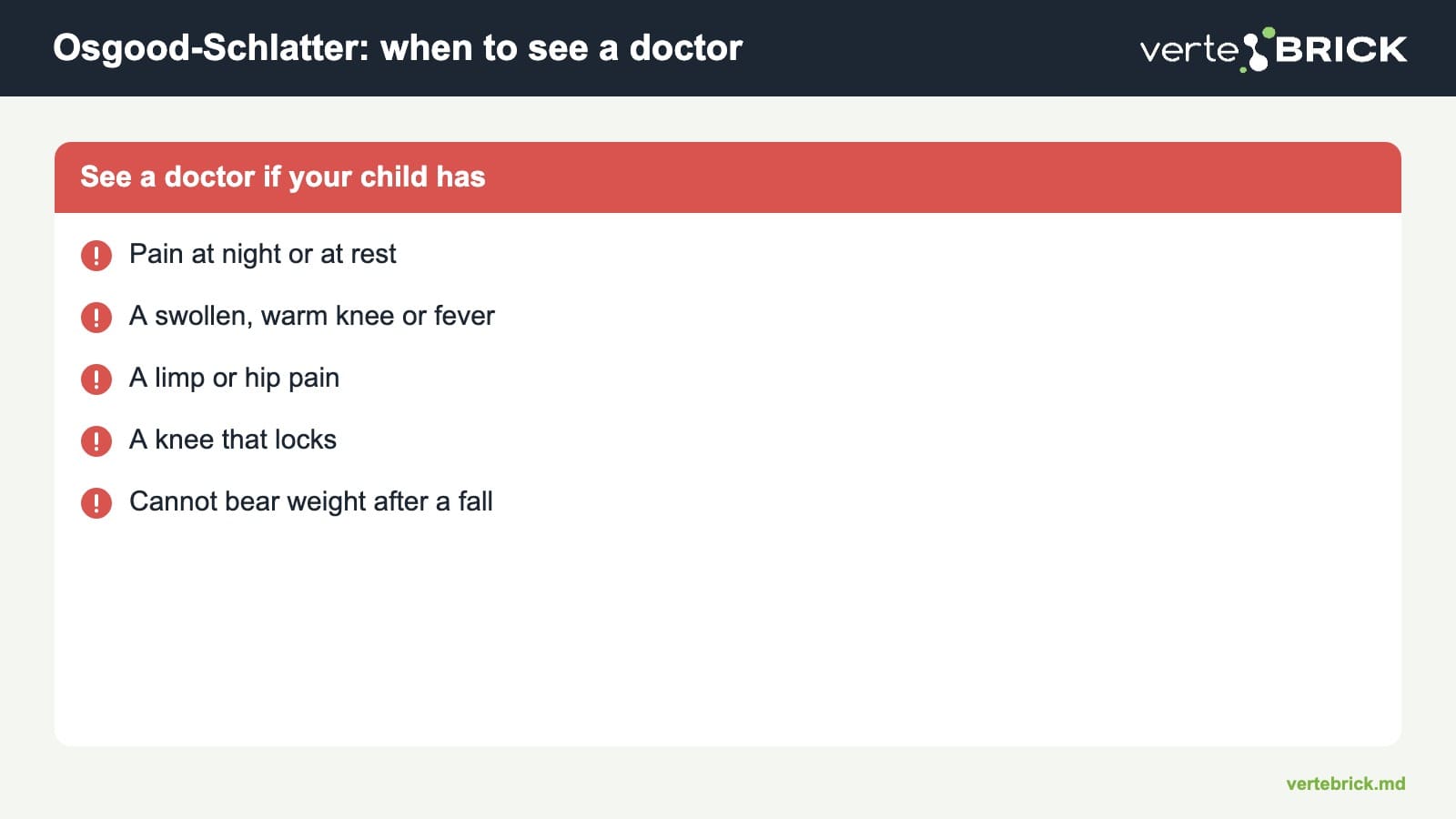
- pain at night or at rest that does not settle;
- the whole knee swollen, red or warm, or a fever;
- a limp, or pain in the hip or groin;
- the knee locks or gives way;
- sudden pain after a fall with inability to put weight on the leg.
How we work at Vertebrick
We assess the knee, strength and flexibility and talk with the child and parents about training volume. We build an exercise programme and a return-to-sport plan, which we can also coordinate with the coach.
Frequently asked questions
What is Osgood-Schlatter disease?
It is an overload of the point where the patellar tendon attaches to the shin bone, in growing children and teenagers who play sport.
Does my child need to stop sport?
Usually not. Jumps and sprints are reduced for a while, strength exercises are added, and the return to sport is guided by pain.
How long does Osgood-Schlatter last?
Several months, sometimes with flare-ups during growth spurts. Symptoms usually go away once bone growth is complete.
Where can my child get physiotherapy for Osgood-Schlatter in Chisinau?
At the Vertebrick clinic in Chisinau, with an assessment, strength exercises and a return-to-sport plan.

Book an assessment
Come in for an assessment at Vertebrick, 12/2 Traian Blvd, Chișinău, Moldova. We are open Monday to Saturday, 08:00–20:00.
📞 +373 69 82 62 12 · WhatsApp: wa.me/37369826212 · Fill in the form
Author: the Vertebrick team, physiotherapy clinic in Chișinău. This article is for information only and does not replace a medical consultation.
Sources
- Rathleff MS et al. Activity modification and knee strengthening for Osgood-Schlatter disease: a prospective cohort study. Orthop J Sports Med. 2020;8(4):2325967120911106.
- Neuhaus C et al. A systematic review on conservative treatment options for Osgood-Schlatter disease. Phys Ther Sport. 2021;49:178–187.
- Circi E, Atalay Y, Beyzadeoglu T. Treatment of Osgood-Schlatter disease: review of the literature. Musculoskelet Surg. 2017;101(3):195–200.