
In short: with osteoporosis, the right kind of movement is not dangerous — it is part of the treatment. Strength exercises twice a week, balance and posture exercises strengthen muscles, support bones and lower the risk of falls, and falls are the main cause of fractures. Exercise does not replace the treatment your doctor prescribes; it complements it.
What osteoporosis is
Osteoporosis means thinner, more fragile bones that can break after a small knock or a fall from standing height. The spine, hip and wrist are affected most often. The disease does not hurt until a fracture happens, so it is often found by chance on a bone density scan.
Why exercise matters
Bone responds to load: when muscles pull on it and it carries body weight, it adapts. Strong muscles and good balance protect you from falls. A straight, strong back reduces the load on the vertebrae. That is why a well-chosen programme works in all three directions.
What helps
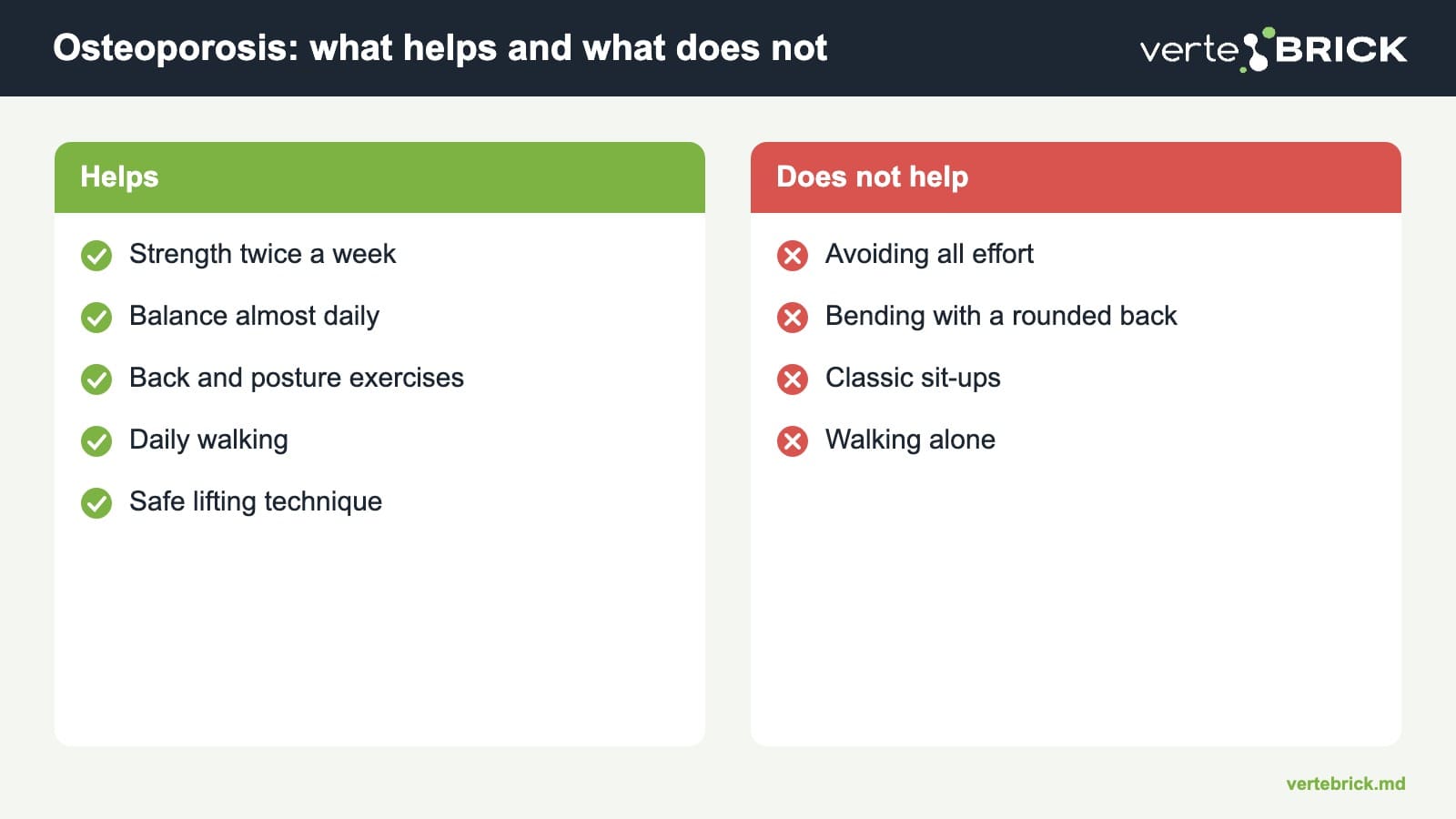
- Strength exercises twice a week for the legs, hips, back and arms, with gradually increasing weight and good technique.
- Balance exercises almost every day: standing on one leg next to a support, walking along a line, heel raises.
- Back muscle and posture exercises that keep the spine upright.
- Daily walking as a base, combined with strength exercises.
- Learning safe movements: how to lift something from the floor with a straight back and bent knees.
What does not help
- Avoiding all effort for fear of a fracture. Muscles weaken and the risk of falling rises.
- Repeated bending with a rounded back and sudden twisting while holding a weight.
- Classic sit-ups and toe touches with a bent back, which put heavy load on the front of the vertebrae.
- Walking alone. It is useful, but on its own it is not enough for bones and muscles.
When you will see results
Strength and balance improve within 6–8 weeks. The effect on bone density is slower and shows after about a year of regular training. The most important result for daily life is fewer falls and more confidence when moving.
When to see a doctor
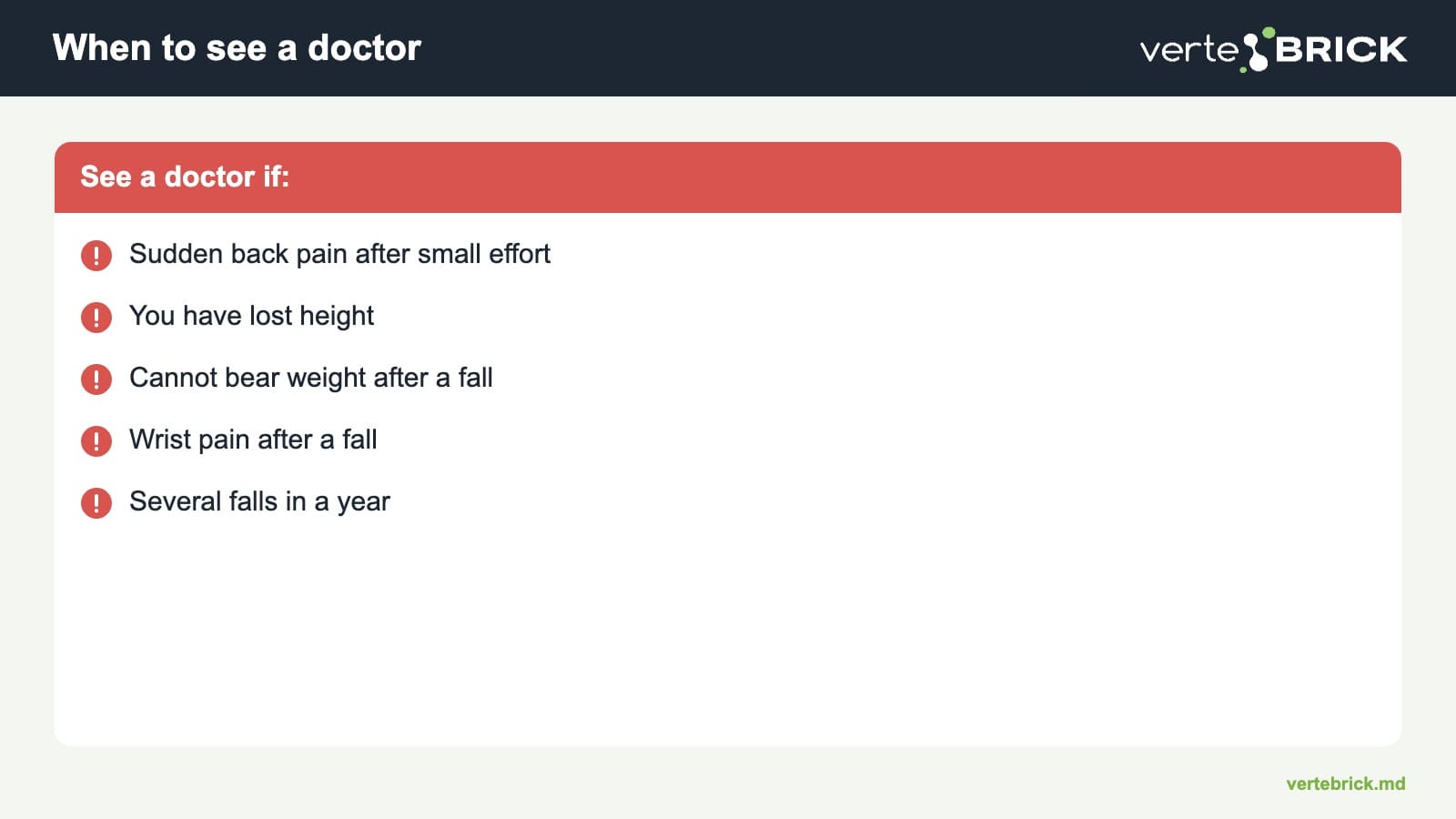
- sudden back pain after a small effort, a cough or bending;
- you have lost height or your back has visibly rounded;
- after a fall you cannot put weight on the leg or the hip hurts badly;
- persistent wrist pain after falling on your hand;
- several falls in the past year.
How we work at Vertebrick
At the first visit we learn your diagnosis and the treatment your doctor prescribed, and test strength, balance, walking and posture. Then we build a safe programme that takes your bone density and fracture history into account, and show you movements you can do at home. We increase the load gradually and measure progress at every session.
Frequently asked questions
Can I exercise if I have osteoporosis?
Yes. Strength and balance exercises are recommended, with good technique and gradually increasing load, after an assessment.
Which exercises are dangerous with osteoporosis?
Repeated bending with a rounded back, classic sit-ups and sudden twists with a weight put heavy load on the vertebrae and are avoided.
Can exercise replace medication?
No. Exercise complements the treatment your doctor prescribes and lowers the risk of falls, but it does not replace it.
Where can I do osteoporosis exercise in Chisinau?
At the Vertebrick clinic in Chisinau, with a strength and balance programme tailored to you and checked at every session.

Book an assessment
Come in for an assessment at Vertebrick, 12/2 Traian Blvd, Chișinău, Moldova. We are open Monday to Saturday, 08:00–20:00.
📞 +373 69 82 62 12 · WhatsApp: wa.me/37369826212 · Fill in the form
Author: the Vertebrick team, physiotherapy clinic in Chișinău. This article is for information only and does not replace a medical consultation.
Sources
- Watson SL et al. High-intensity resistance and impact training improves bone mineral density and physical function in postmenopausal women with osteopenia and osteoporosis: the LIFTMOR randomized controlled trial. J Bone Miner Res. 2018;33(2):211–220.
- Giangregorio LM et al. Too Fit To Fracture: exercise recommendations for individuals with osteoporosis or osteoporotic vertebral fracture. Osteoporos Int. 2014;25(3):821–835.
- Sherrington C et al. Exercise for preventing falls in older people living in the community. Cochrane Database Syst Rev. 2019;1:CD012424.
- Howe TE et al. Exercise for preventing and treating osteoporosis in postmenopausal women. Cochrane Database Syst Rev. 2011;(7):CD000333.
- Kanis JA et al. European guidance for the diagnosis and management of osteoporosis in postmenopausal women. Osteoporos Int. 2019;30(1):3–44.