

In short: pain between the shoulder blades most often comes from the muscles and joints of the upper back and neck, especially in people who sit a lot at a desk or look at their phone. In most cases it is not dangerous and responds well to movement, back and shoulder exercises and regular breaks. There are, however, signs that need a doctor straight away, because pain in this area can sometimes come from the heart or lungs.
Why it happens
The area between the shoulder blades is the upper back (thoracic spine), connected to the ribs and shoulders. Long hours leaning forward, lifting, a strong cough or sleeping in an awkward position can irritate the muscles and joints here. Sometimes the pain actually starts in the neck and spreads down between the shoulder blades.
Typical signs
- pain or "burning" between the shoulder blades, especially after a day at the desk;
- stiffness when turning or bending;
- pain with a deep breath or certain arm movements;
- tender spots in the muscles next to the spine;
- relief after moving and worse after keeping still.
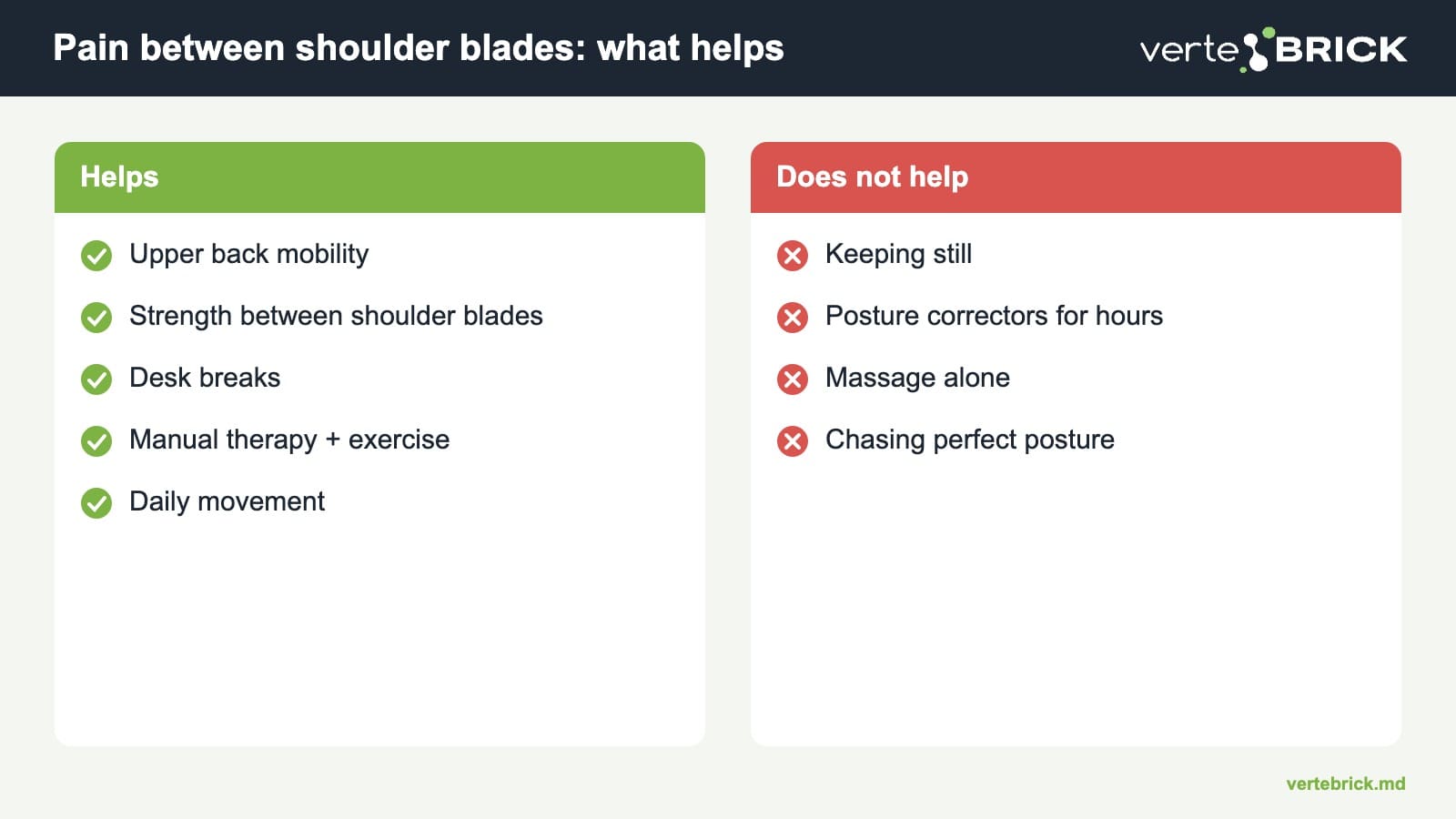
What helps
- Mobility exercises for the upper back: rotations, gentle extensions over the back of a chair.
- Strength exercises for the muscles between the shoulder blades and for the shoulders, progressed gradually.
- Short breaks from the desk every 30–45 minutes.
- Manual therapy for the thoracic spine, combined with exercise.
- Daily movement: walking, activities that use the arms.
What does not help
- Keeping still for fear of pain.
- Braces and "posture correctors" worn for hours.
- Massage alone, without exercise. The relief does not last.
- Chasing the "perfect posture". Your best posture is your next one: changing position often matters more.
How long it lasts
A typical episode eases within a few days to a few weeks. If the pain keeps coming back, a 4–6 week exercise programme usually reduces how often it happens and how strong it is.

When to see a doctor urgently
- chest pain or pain between the shoulder blades with sweating, nausea or shortness of breath (call 112);
- sudden, very severe, "tearing" pain in the back;
- fever, coughing up blood or unexplained weight loss;
- pain that does not change at all with movement and is severe at night;
- numbness or weakness in the legs, problems passing urine.
How we work at Vertebrick
At the first visit we check for warning signs, test the mobility of your neck and upper back, the strength of the muscles between your shoulder blades and your desk posture. Then we build a step-by-step exercise programme and adjust it at every session.
Frequently asked questions
Why do I have pain between my shoulder blades?
Most often from the muscles and joints of the upper back and neck, especially after long hours at a desk. Rarely, it can come from the heart or lungs.
Which exercises help?
Upper back mobility exercises and strength exercises for the muscles between the shoulder blades, done daily.
When is pain between the shoulder blades dangerous?
When it comes with chest pain, sweating, nausea or shortness of breath. Then call 112.
Where can I get treatment for pain between the shoulder blades in Chisinau?
At the Vertebrick clinic in Chisinau, after an assessment of your neck and back, with an exercise programme checked at every session.

Book an assessment
Come in for an assessment at Vertebrick, 12/2 Traian Blvd, Chișinău, Moldova. We are open Monday to Saturday, 08:00–20:00.
📞 +373 69 82 62 12 · WhatsApp: wa.me/37369826212 · Fill in the form
Author: the Vertebrick team, physiotherapy clinic in Chișinău. This article is for information only and does not replace a medical consultation.
Sources
- Briggs AM et al. Thoracic spine pain in the general population: prevalence, incidence and associated factors in children, adolescents and adults. A systematic review. BMC Musculoskelet Disord. 2009;10:77.
- Heneghan NR, Rushton A. Understanding why the thoracic region is the 'Cinderella' region of the spine. Man Ther. 2016;21:274–276.
- Finucane LM et al. International framework for red flags for potential serious spinal pathologies. J Orthop Sports Phys Ther. 2020;50(7):350–372.
- Gross A et al. Exercises for mechanical neck disorders. Cochrane Database Syst Rev. 2015;(1):CD004250.