

In short: piriformis syndrome is deep pain in the buttock, sometimes spreading down the back of the thigh, blamed on the piriformis muscle irritating the sciatic nerve. It is rarer than people think: most buttock pain that travels down the leg actually comes from the lower back. That is why a proper assessment matters. When the piriformis really is the cause, strength and mobility exercises for the hip and less prolonged sitting help.
What the piriformis muscle is
The piriformis is a small muscle deep in the buttock that turns the thigh outwards. The sciatic nerve runs very close to it. Long hours of sitting, especially on a hard surface or with a wallet in the back pocket, or overload from running can irritate the area.
Typical signs
- deep pain in one buttock;
- pain that gets worse with prolonged sitting;
- sometimes tingling down the back of the thigh, rarely below the knee;
- pain when pressing in the middle of the buttock;
- pain when rotating the thigh or crossing your legs.
What helps
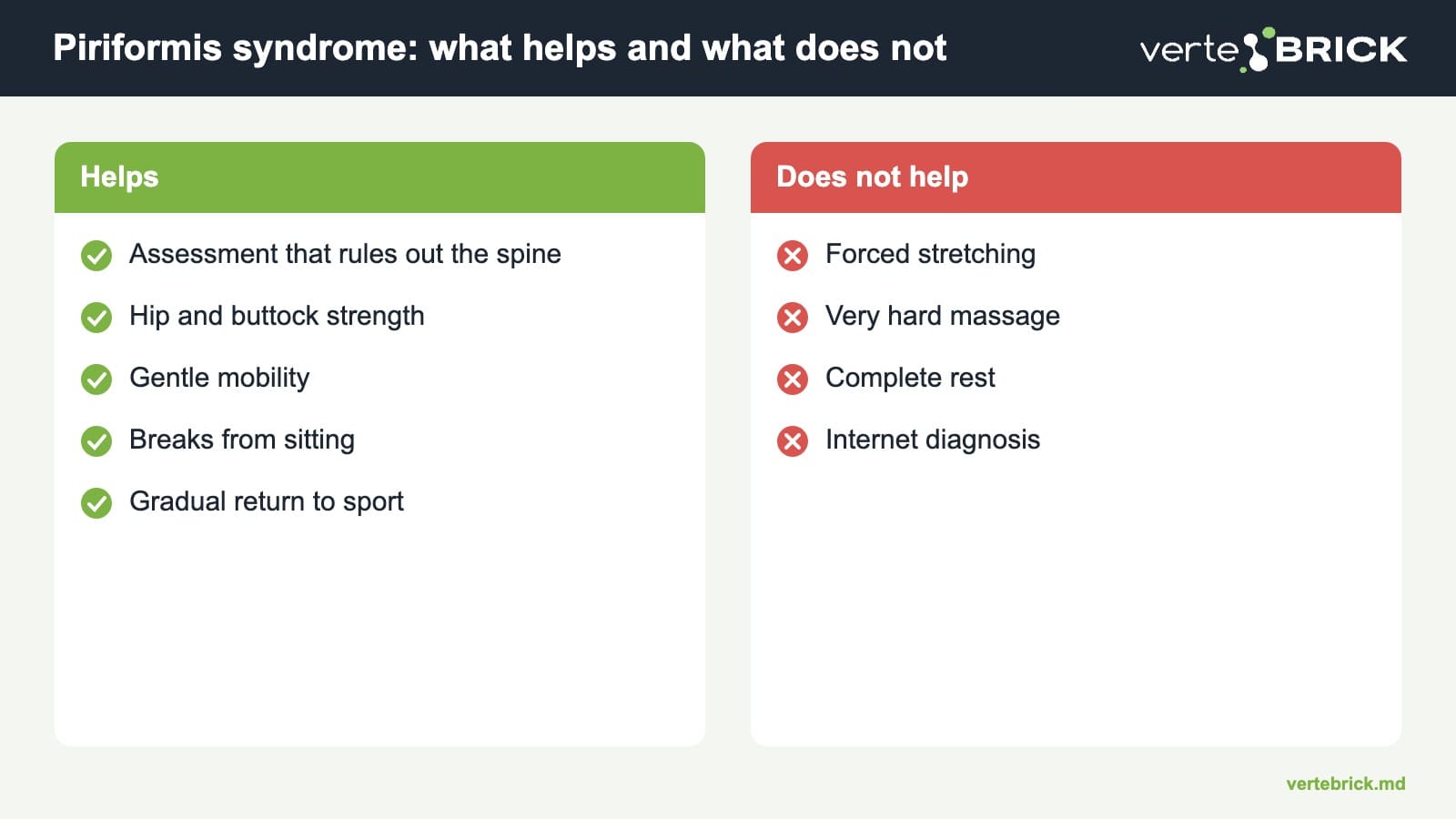
- An assessment that rules out the lower back as the source of the pain.
- Hip and buttock strength exercises, progressed gradually.
- Gentle mobility exercises for the hip and the sciatic nerve.
- Breaks from sitting every 30–45 minutes, and no wallet in the back pocket.
- A gradual return to running and sport.
What does not help
- Forced, painful stretching, which can irritate the nerve further.
- Very hard massage directly on the area.
- Complete rest. Muscles weaken and the pain lasts longer.
- A diagnosis "from the internet" without checking the spine.
How long it lasts
With a well-chosen programme, many patients feel better within 4–8 weeks. If the pain does not change, the assessment is repeated: the source is often elsewhere, for example the spine or the hip joint.
When to see a doctor urgently
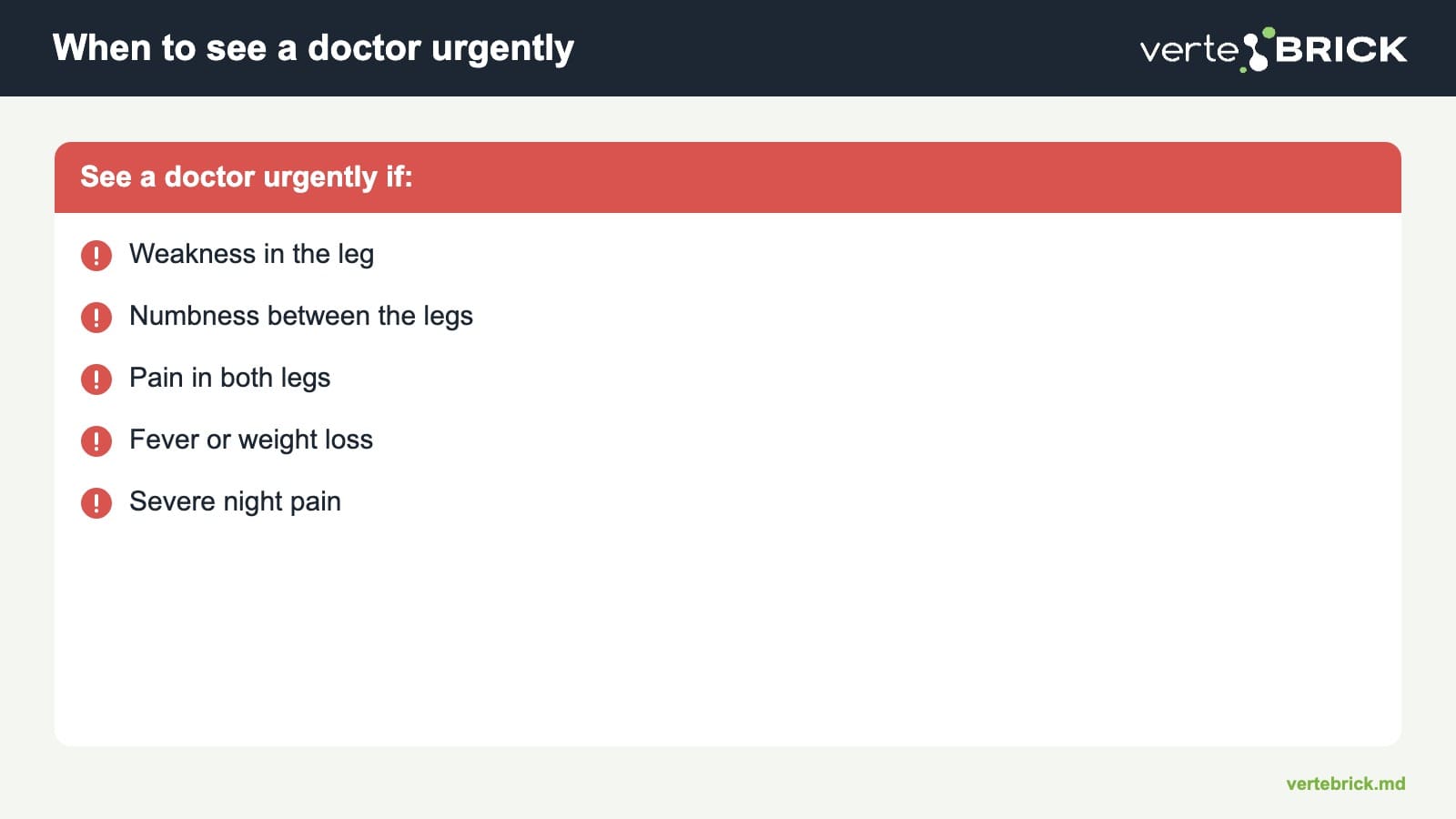
- weakness in the leg or the foot "slaps" when you walk;
- numbness between the legs or problems passing urine;
- pain in both legs that worsens quickly;
- fever or unexplained weight loss;
- severe night pain that does not depend on position.
How we work at Vertebrick
At the first visit we check whether the pain comes from the spine, the hip joint or the buttock muscles, and test hip strength, mobility and signs of nerve irritation. Then we set a step-by-step exercise programme and check it at every session.
Frequently asked questions
What is piriformis syndrome?
It is deep buttock pain attributed to the piriformis muscle irritating the sciatic nerve. It is rarer than people think.
How is it different from sciatica from the spine?
Through an assessment: tests for the spine, the nerve and the hip show where the pain comes from. Sciatica from the spine is far more common.
Which exercises help?
Strength exercises for the buttocks and hip and gentle mobility exercises, without forced stretching.
Where can I get treatment for buttock pain in Chisinau?
At the Vertebrick clinic in Chisinau, after an assessment of the spine and hip, with an exercise programme checked at every session.

Book an assessment
Come in for an assessment at Vertebrick, 12/2 Traian Blvd, Chișinău, Moldova. We are open Monday to Saturday, 08:00–20:00.
📞 +373 69 82 62 12 · WhatsApp: wa.me/37369826212 · Fill in the form
Author: the Vertebrick team, physiotherapy clinic in Chișinău. This article is for information only and does not replace a medical consultation.
Sources
- Hopayian K et al. The clinical features of the piriformis syndrome: a systematic review. Eur Spine J. 2010;19(12):2095–2109.
- Jankovic D, Peng P, van Zundert A. Brief review: piriformis syndrome: etiology, diagnosis, and management. Can J Anaesth. 2013;60(10):1003–1012.
- Hicks BL, Lam JC, Varacallo M. Piriformis Syndrome. StatPearls. Treasure Island (FL): StatPearls Publishing; 2023.
- Finucane LM et al. International framework for red flags for potential serious spinal pathologies. J Orthop Sports Phys Ther. 2020;50(7):350–372.