
In short: after birth, the body needs months, not weeks, to recover. Diastasis recti, back pain and leaking urine on effort are common and, most of the time, improve with the right exercises, started gradually. Below you will find what is normal, what helps and when you need to see a doctor.
What diastasis recti is
During pregnancy the two straight abdominal muscles move apart to make room for the baby. The tissue between them stretches and thins. This is called diastasis recti. You may notice it as a ridge or a dip along the middle of your abdomen when you get out of bed.
How common it is and when it goes away
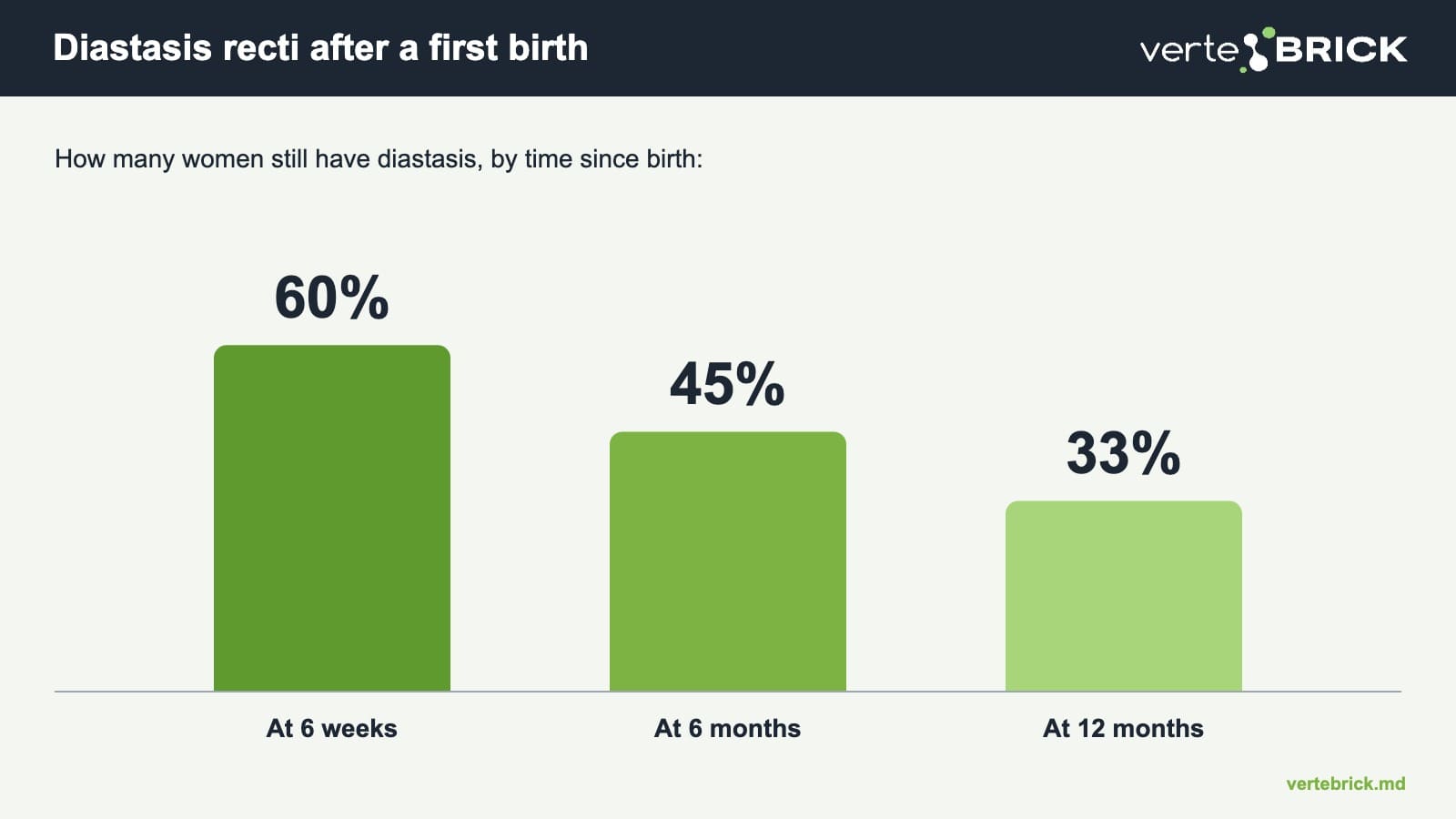
In a study of 300 first-time mothers, diastasis was present in 60% of them 6 weeks after birth, in 45% at 6 months and in 33% at one year. In other words, for many women it reduces on its own during the first year, but for one in three it remains.
In the same study, women with diastasis did not have more back or pelvic pain than women without it. Diastasis in itself is not dangerous. How well the abdominal muscles work and how firm the midline is matter more than the number of centimetres.
What helps
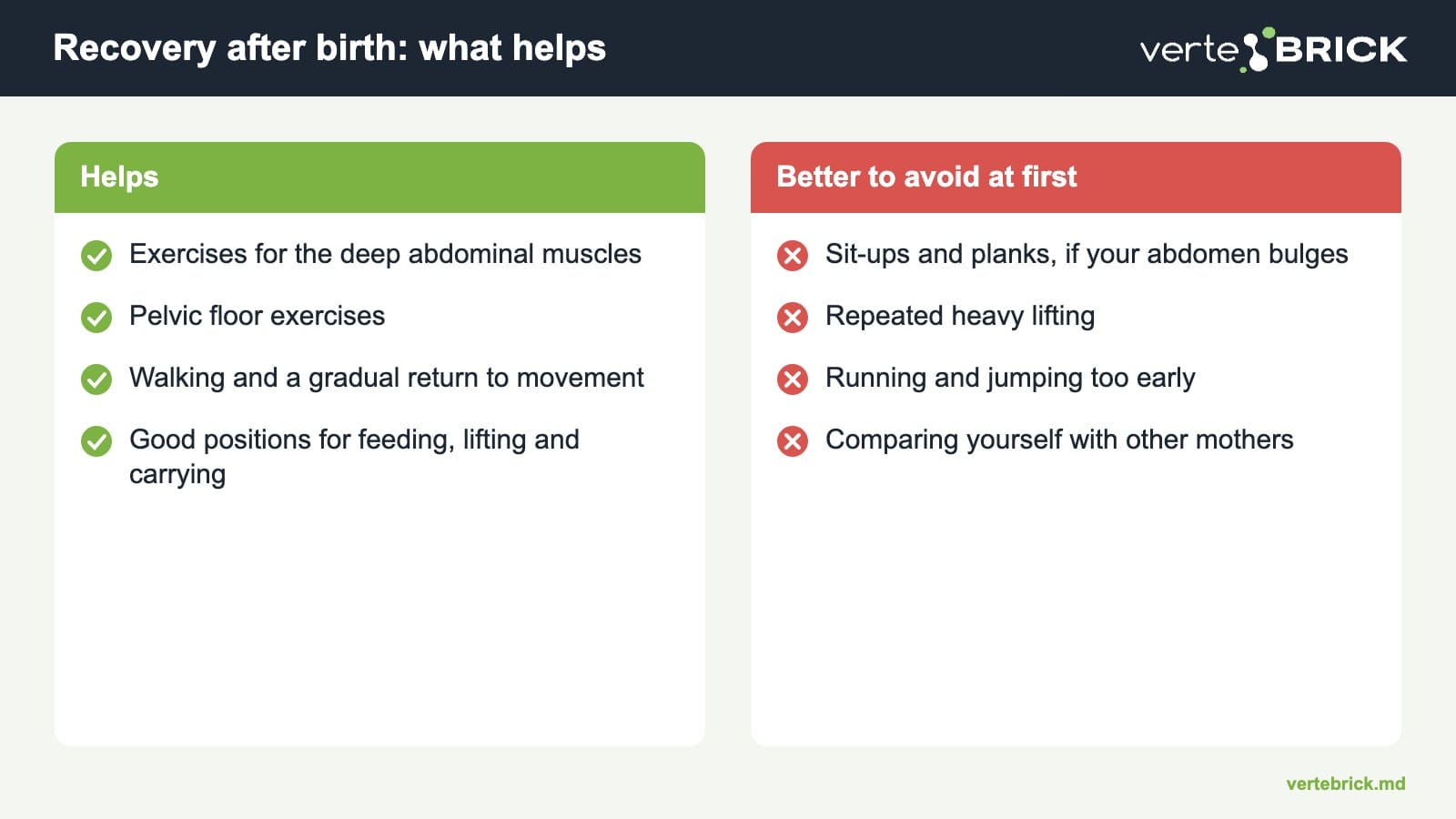
- Exercises for the deep abdominal muscles. Most of the programmes studied last 6–12 weeks and start with activating the transverse muscle, then become gradually harder.
- Pelvic floor exercises. In women who started them during pregnancy, the risk of leaking urine was 62% lower in late pregnancy and 29% lower 3–6 months after birth.
- Walking and a gradual return to movement. You build up step by step, depending on how you feel and on the type of birth.
- Good positions for feeding, lifting and carrying the baby. The back and neck get tired mostly from positions repeated every day.
There is no single “best exercise” for diastasis. Studies have not reached agreement, so the programme is chosen according to what you can do now and is progressed gradually.
What is better to avoid at first
- classic sit-ups and planks early on, if your abdomen bulges along the midline while you do them;
- repeated heavy lifting in the first weeks;
- running and jumping before the pelvic floor is ready;
- comparing yourself with other mothers: every body recovers at its own pace.
When you can start
Breathing, gentle pelvic floor activation and walking can start in the first days, if you feel well. More demanding exercises are introduced gradually, usually after the 6-week medical check. After a caesarean, follow the advice of the doctor who operated on you.
When to see a doctor
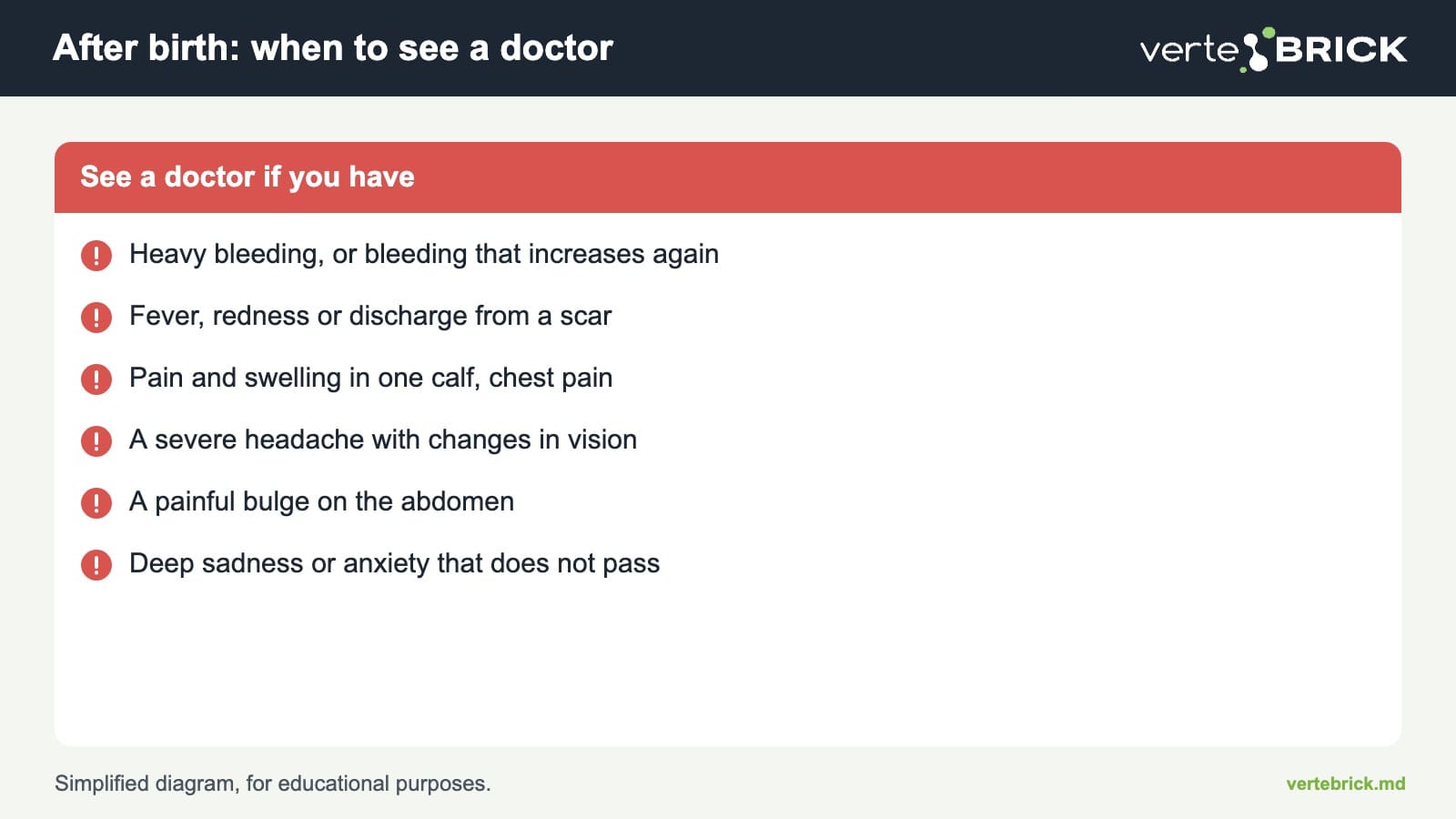
- heavy bleeding, or bleeding that increases again;
- fever, or redness and discharge from a caesarean or episiotomy scar;
- pain and swelling in one calf, chest pain or difficulty breathing;
- a severe headache with changes in vision;
- a bulge on the abdomen that hurts or does not go back in;
- deep sadness or anxiety that does not pass.
How we work at Vertebrick after birth
At the assessment the physiotherapist asks about the birth and about what bothers you, and checks your abdomen, your back and the way you breathe and move. You receive a home exercise programme that we progress gradually, and advice for feeding, lifting and carrying your baby. If we suspect a problem that needs a doctor, we tell you directly.
Frequently asked questions
Does diastasis go away on its own?
For many women it reduces during the first year. For about one in three it is still present at 12 months. Exercises help rebuild the strength and control of the abdomen.
When is surgery needed for diastasis?
Rarely. Surgery is discussed with a surgeon only after at least 6 months of exercise-based recovery, if problems that limit you remain.
Can I exercise after a caesarean?
Yes, gradually, once your doctor agrees. You start with breathing, walking and gentle activation, then build up.
Where can I do postnatal recovery in Chișinău?
At Vertebrick clinic, 12/2 Traian Blvd, Chișinău. Bookings: +373 69 82 62 12.

Book an assessment
Come in for an assessment at Vertebrick, 12/2 Traian Blvd, Chișinău. We are open Monday to Saturday, 08:00–20:00.
📞 +373 69 82 62 12 · WhatsApp: wa.me/37369826212 · Fill in the form
Author: the Vertebrick team, physiotherapy clinic in Chișinău. This article is for information only and does not replace a medical consultation.
Sources
- Sperstad JB, Tennfjord MK, Hilde G, Ellström-Engh M, Bø K. Diastasis recti abdominis during pregnancy and 12 months after childbirth: prevalence, risk factors and report of lumbopelvic pain. British Journal of Sports Medicine, 2016.
- Skoura A, Billis E, Papanikolaou DT, et al. Diastasis Recti Abdominis Rehabilitation in the Postpartum Period: A Scoping Review of Current Clinical Practice. International Urogynecology Journal, 2024.
- Woodley SJ, Lawrenson P, Boyle R, et al. Pelvic floor muscle training for preventing and treating urinary and faecal incontinence in antenatal and postnatal women. Cochrane Database of Systematic Reviews, 2020.
- American College of Obstetricians and Gynecologists. Physical Activity and Exercise During Pregnancy and the Postpartum Period. Committee Opinion No. 804, 2020.