
In short: scoliosis is a sideways curve of the spine combined with a rotation of the vertebrae. It most often appears in children during a growth spurt, with no known cause. It is not caused by school bags or by how a child sits. Found early, it can be kept under control with specific exercises and, when needed, a brace.
What scoliosis is
Seen from behind, a healthy spine is straight. In scoliosis the spine forms a “C” or “S” shaped curve and the vertebrae rotate. Doctors measure it on an X-ray using the Cobb angle: from 10 degrees upwards, it is called scoliosis.
The most common form is adolescent idiopathic scoliosis. It affects about 2–3 in 100 children, usually between the ages of 10 and 15. Small curves are equally common in boys and girls, but the curves that grow and need treatment are much more common in girls.
Note: a slouched posture is not the same as scoliosis. Posture corrects when the child stands up straight; scoliosis does not.
How to spot it at home
- one shoulder is higher than the other;
- one shoulder blade sticks out more;
- the waist is uneven and one hip looks higher;
- when the child bends forward with arms hanging, one side of the back is higher (a rib “hump”).
If you notice any of these signs, see a doctor or physiotherapist for an assessment. An X-ray confirms the diagnosis and shows how large the curve is.
What helps
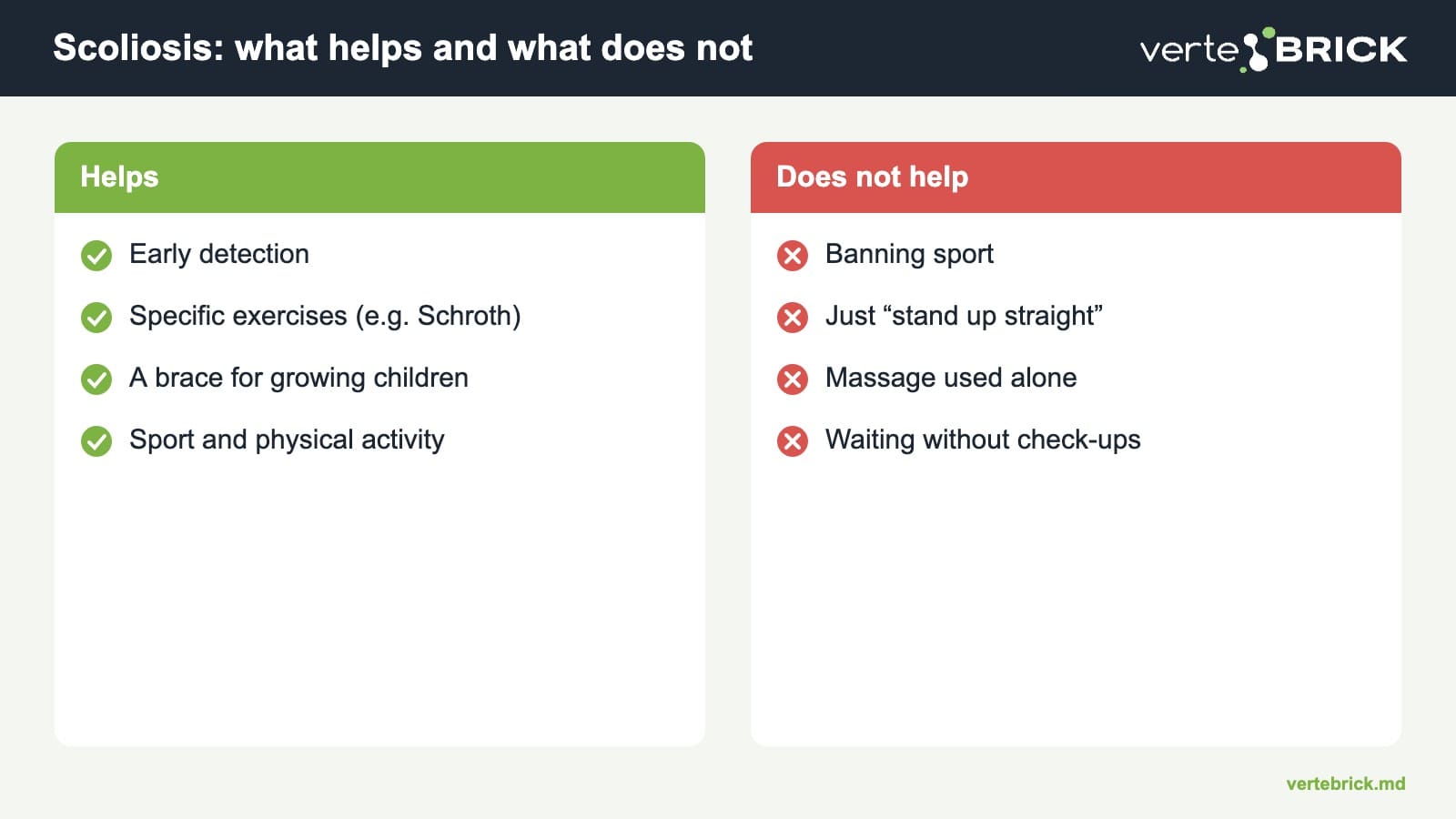
- Early detection. The earlier a curve is found during growth, the more options there are.
- Scoliosis-specific exercises, for example the Schroth method, done with a physiotherapist. They teach the body to actively correct the curve and are recommended by international guidelines, especially together with bracing.
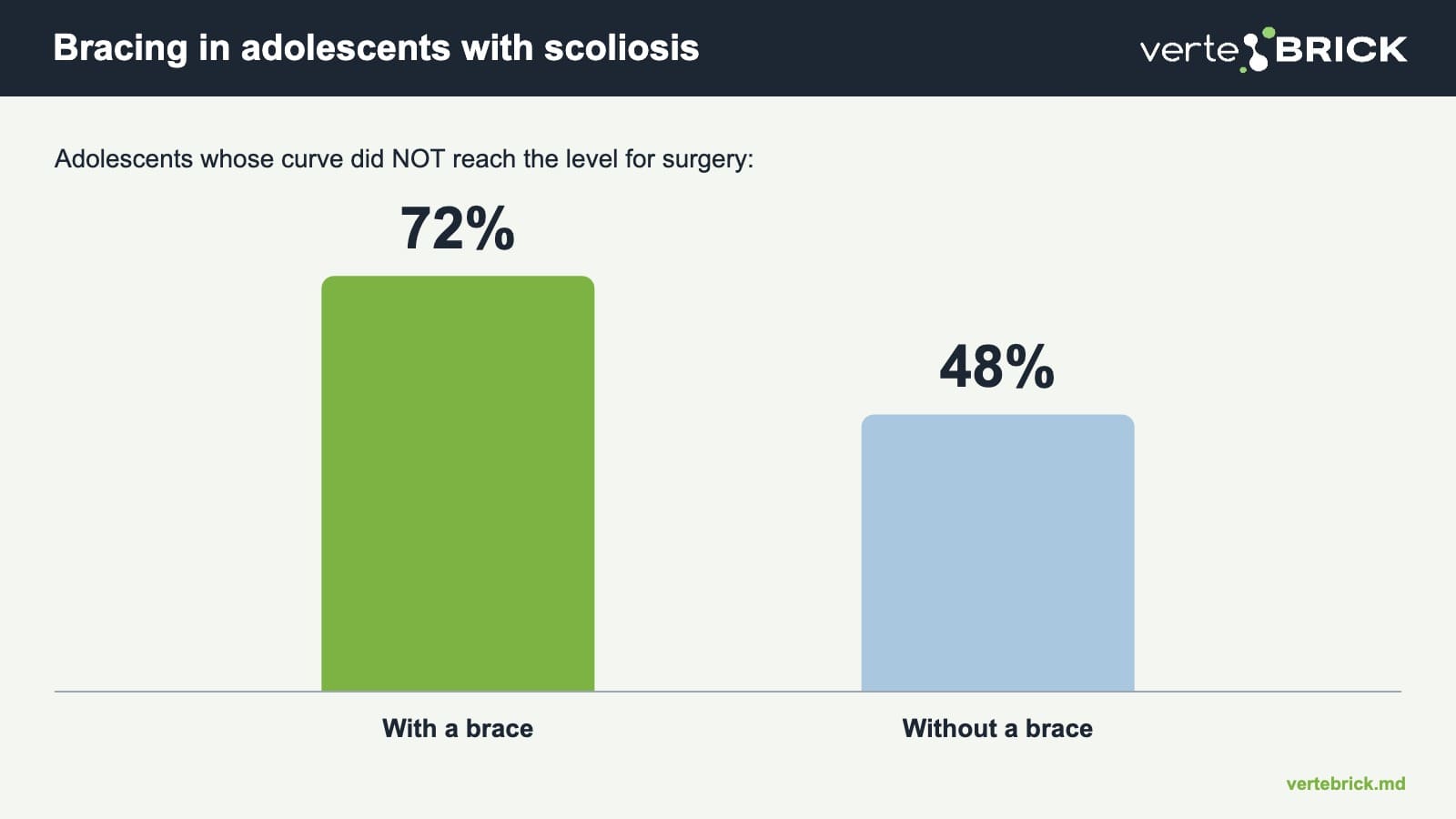
- A brace for children who are still growing and have moderate curves. In a large study, a brace worn for enough hours a day clearly reduced the risk of the curve reaching the level where surgery is needed.
- Sport and normal physical activity. A child with scoliosis can and should do sport.
What does not help
- Banning sport. It does not stop scoliosis and weakens the muscles.
- Just “stand up straight”. Paying attention to posture does not correct true scoliosis.
- Massage or passive treatments used alone. They can ease muscle tension but do not change the curve.
- Waiting without check-ups during the years of fast growth.
Scoliosis in adults
Once growth has finished, small curves (under 30 degrees) usually stop progressing. Large curves (over 50 degrees) may keep growing slowly in adulthood, by about one degree a year. Many adults with scoliosis live active lives without severe pain. When back pain appears, exercise and movement help just as they do for other back pain.
When surgery is needed
Surgery is usually discussed for large curves, around 45–50 degrees or more, especially if the scoliosis keeps progressing. The decision is made together with an orthopaedic surgeon. Physiotherapy is useful both before and after the operation.
When to see a doctor urgently
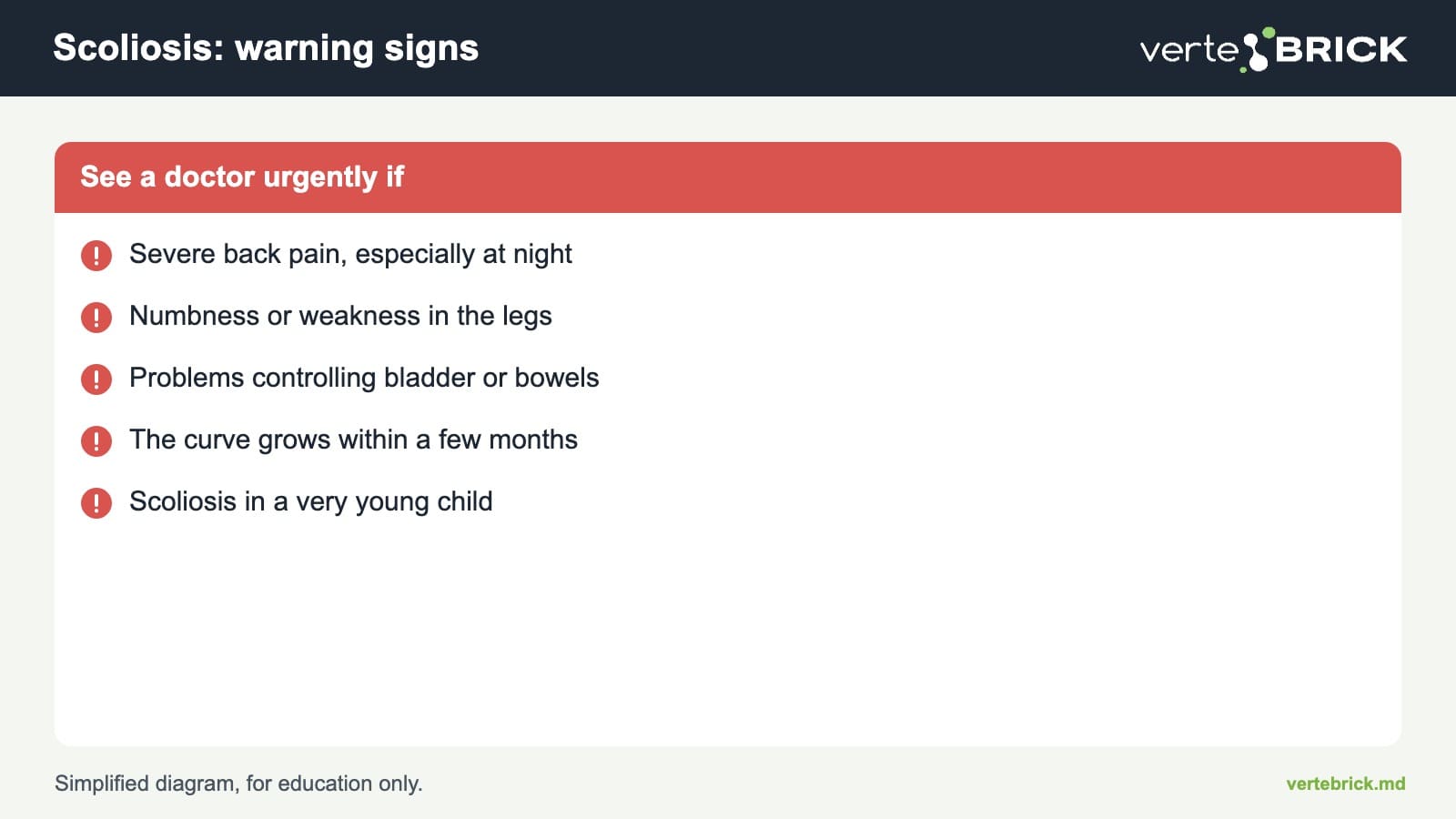
- the child has severe back pain, especially at night;
- numbness, weakness in the legs or walking problems appear;
- problems controlling the bladder or bowels appear;
- the curve gets visibly worse within a few months;
- scoliosis appears in a very young child.
How we work at Vertebrick
At the assessment, the physiotherapist checks posture, the symmetry of the back, mobility and strength, and looks at the X-ray if you have one. You get a programme of specific exercises for your type of curve, which you learn in the clinic and continue at home. We work with both children and adults. If a brace or an orthopaedic opinion is needed, we tell you directly.
Frequently asked questions
Does a heavy school bag cause scoliosis?
No. A heavy bag can tire the back, but it does not cause scoliosis.
Can scoliosis be cured with exercise?
Specific exercises can help control the curve and improve posture, especially in small and moderate curves. Large curves do not disappear with exercise alone, but exercise is still useful for strength and pain.
Can a child with scoliosis do sport?
Yes. Sport is recommended. Only in rare cases, after surgery, may the doctor limit some activities.
Where can I get scoliosis physiotherapy in Chișinău?
At Vertebrick clinic, 12/2 Traian Blvd, Chișinău. Bookings: +373 69 82 62 12.
Book an assessment
Come in for an assessment at Vertebrick, 12/2 Traian Blvd, Chișinău. We are open Monday to Saturday, 08:00–20:00.
📞 +373 69 82 62 12 · WhatsApp: wa.me/37369826212 · Fill in the form
Author: the Vertebrick team, physiotherapy clinic in Chișinău. This article is for information only and does not replace a medical consultation.
Sources
- Weinstein SL, Dolan LA, Wright JG, Dobbs MB. Effects of bracing in adolescents with idiopathic scoliosis. New England Journal of Medicine, 2013.
- Negrini S, Donzelli S, Aulisa AG, et al. 2016 SOSORT guidelines: orthopaedic and rehabilitation treatment of idiopathic scoliosis during growth. Scoliosis and Spinal Disorders, 2018.
- Weinstein SL, Dolan LA, Spratt KF, et al. Health and function of patients with untreated idiopathic scoliosis: a 50-year natural history study. JAMA, 2003.
- Konieczny MR, Senyurt H, Krauspe R. Epidemiology of adolescent idiopathic scoliosis. Journal of Children's Orthopaedics, 2013.