
In short: a shoulder dislocation means the head of the arm bone has come out of the joint. The first time, the shoulder must be put back by a doctor, after an X-ray. Rehab with exercises for the shoulder and shoulder blade muscles then lowers the risk of it "popping out" again. In young people who play contact sports the risk of recurrence is high, and surgery is discussed with an orthopaedic surgeon.
What happens in the shoulder
The shoulder is the most mobile joint in the body, but also the least stable. A fall on an outstretched arm or a blow with the arm raised and turned outwards can force the shoulder out of the joint. The ligaments and the cartilage rim around the joint can tear, and the shoulder becomes "unstable". There is also instability without injury, in people with very mobile joints.
Typical signs
- severe pain and a deformed shoulder after a fall or blow (dislocation);
- a feeling that the shoulder "comes out" or "slips" with certain movements;
- fear of lifting the arm overhead or throwing;
- weakness and fatigue in the shoulder;
- repeated partial dislocations.
What helps
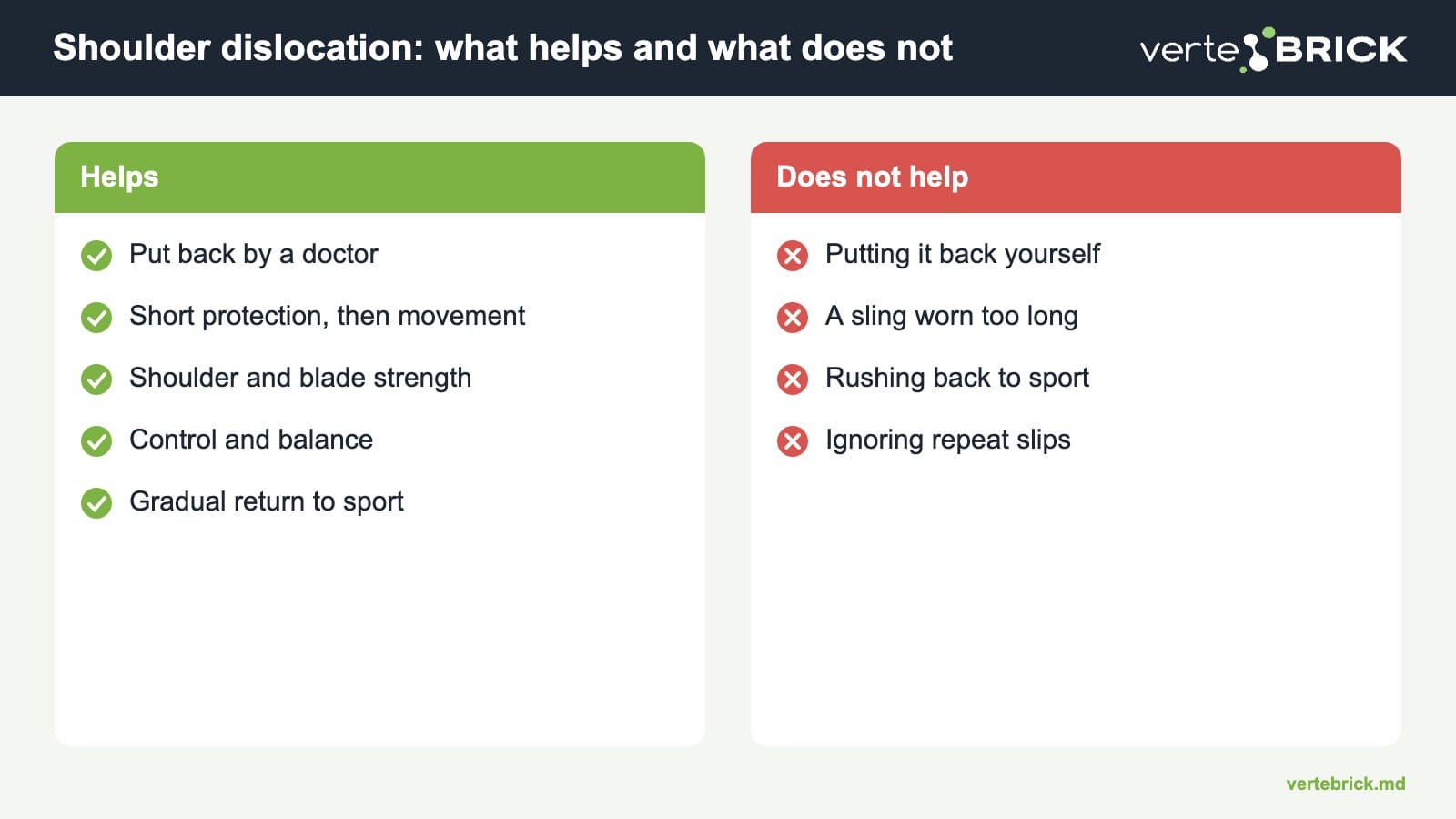
- Having a doctor put the shoulder back, with X-rays before and after.
- A short period of protection, then movement restored gradually, as the doctor advises.
- Strength exercises for the muscles that stabilise the shoulder and shoulder blade, progressed gradually.
- Control and balance exercises for the shoulder, including in sport positions.
- A gradual return to sport after strength and control tests.
What does not help
- Putting the shoulder back yourself or with a friend's help. Blood vessels, nerves or bone can be damaged.
- Wearing a sling for too long, which stiffens the shoulder.
- Rushing back to sport without strength and control.
- Ignoring repeated "slips", which can damage the cartilage.
How long it takes
Returning to daily activities usually takes a few weeks, and returning to sport without surgery usually 3–4 months, depending on strength and control. After surgery, recovery takes longer, usually 4–6 months.
When to see a doctor urgently
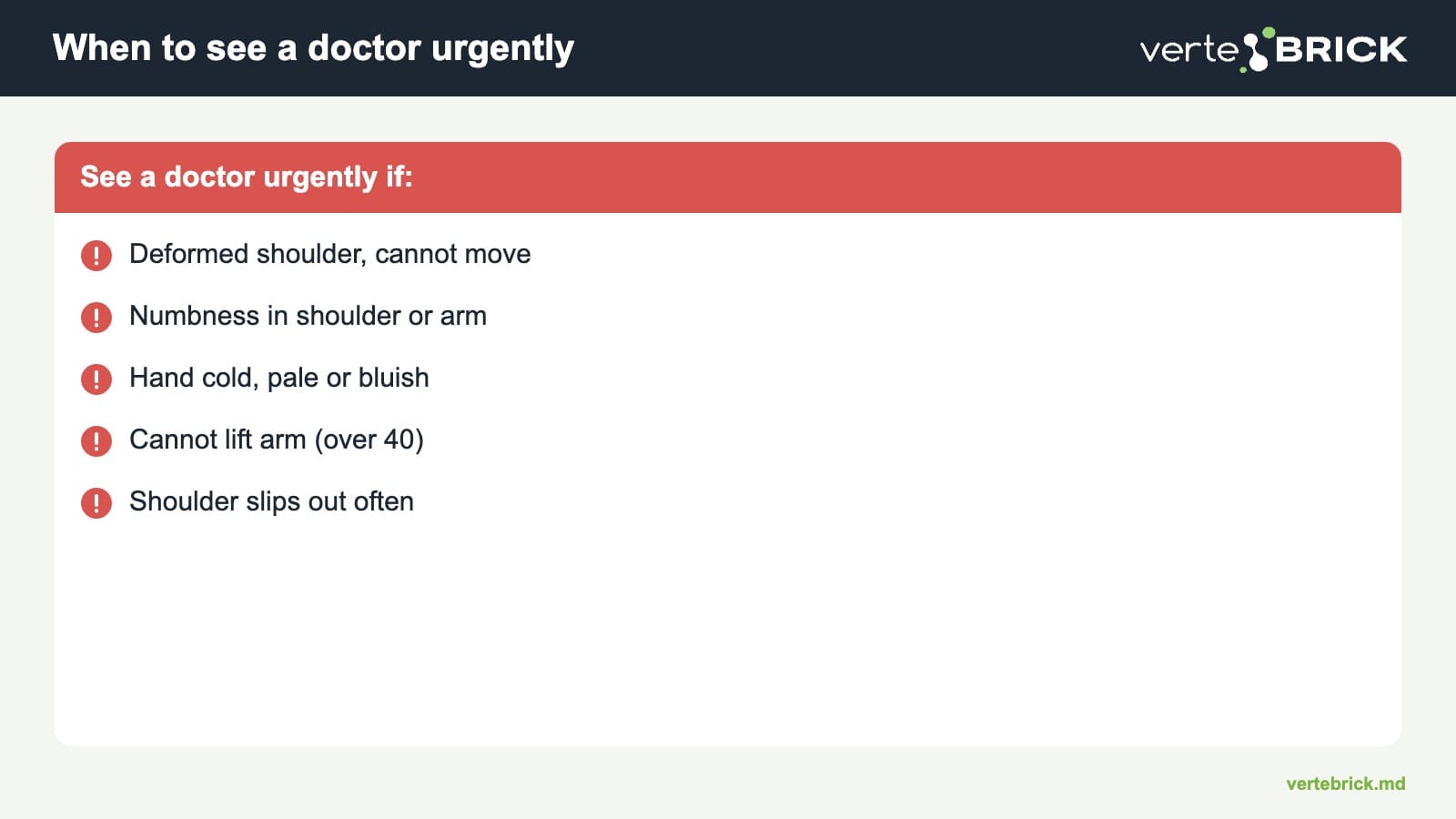
- the shoulder is deformed and you cannot move it after a fall;
- numbness on the outer shoulder or in the arm;
- the hand turns cold, pale or bluish;
- over age 40, you cannot lift the arm after a dislocation;
- the shoulder slips out often, even with ordinary movements.
How we work at Vertebrick
At the first visit we check mobility, the strength of the shoulder and shoulder blade muscles and the situations in which the shoulder feels unstable. We follow the orthopaedic surgeon's advice, build a step-by-step programme and test strength and control before you return to sport.
Frequently asked questions
What should I do after a shoulder dislocation?
See a doctor to have it put back and X-rayed. After a short period of protection, rehab with exercises begins.
How long is recovery after a shoulder dislocation?
A few weeks for daily activities and usually 3–4 months to return to sport without surgery.
Do I need surgery?
Not always. In young people who play contact sports or after repeated dislocations, surgery is discussed with an orthopaedic surgeon.
Where can I get rehab for an unstable shoulder in Chisinau?
At the Vertebrick clinic in Chisinau, with step-by-step strength and control exercises checked at every session.

Book an assessment
Come in for an assessment at Vertebrick, 12/2 Traian Blvd, Chișinău, Moldova. We are open Monday to Saturday, 08:00–20:00.
📞 +373 69 82 62 12 · WhatsApp: wa.me/37369826212 · Fill in the form
Author: the Vertebrick team, physiotherapy clinic in Chișinău. This article is for information only and does not replace a medical consultation.
Sources
- Kavaja L et al. Treatment after traumatic shoulder dislocation: a systematic review with a network meta-analysis. Br J Sports Med. 2018;52(23):1498–1506.
- Olds M et al. Risk factors which predispose first-time traumatic anterior shoulder dislocations to recurrent instability in adults: a systematic review and meta-analysis. Br J Sports Med. 2015;49(14):913–922.
- Warby SA et al. The effect of exercise-based management for multidirectional instability of the glenohumeral joint: a systematic review. J Shoulder Elbow Surg. 2014;23(1):128–142.
- Hayes K et al. Shoulder instability: management and rehabilitation. J Orthop Sports Phys Ther. 2002;32(10):497–509.