
In short: the most common cause of shoulder pain in adults is overload of the tendons around the joint (the rotator cuff). Most of the time it is treated with exercise, not surgery. Below you will find why the shoulder hurts, what an MRI really shows, what works and when you need to see a doctor urgently.
Why the shoulder hurts
The shoulder is the most mobile joint in the body. Its stability depends on the muscles and tendons of the rotator cuff and on the muscles that move the shoulder blade. When these structures are overloaded, for example after work with the arms raised, sport or a period of carrying a lot, pain appears.
Typical signs: pain at the front or side of the shoulder, sometimes spreading down the arm, pain when lifting the arm out to the side or overhead, when getting dressed and when sleeping on the painful side.
Another cause is frozen shoulder (adhesive capsulitis): the shoulder becomes painful and very stiff without a previous injury. It is more common between 40 and 60 and in people with diabetes. It usually lasts several months, but in most cases it improves, and tailored exercise helps you regain movement.
An MRI does not tell the whole story
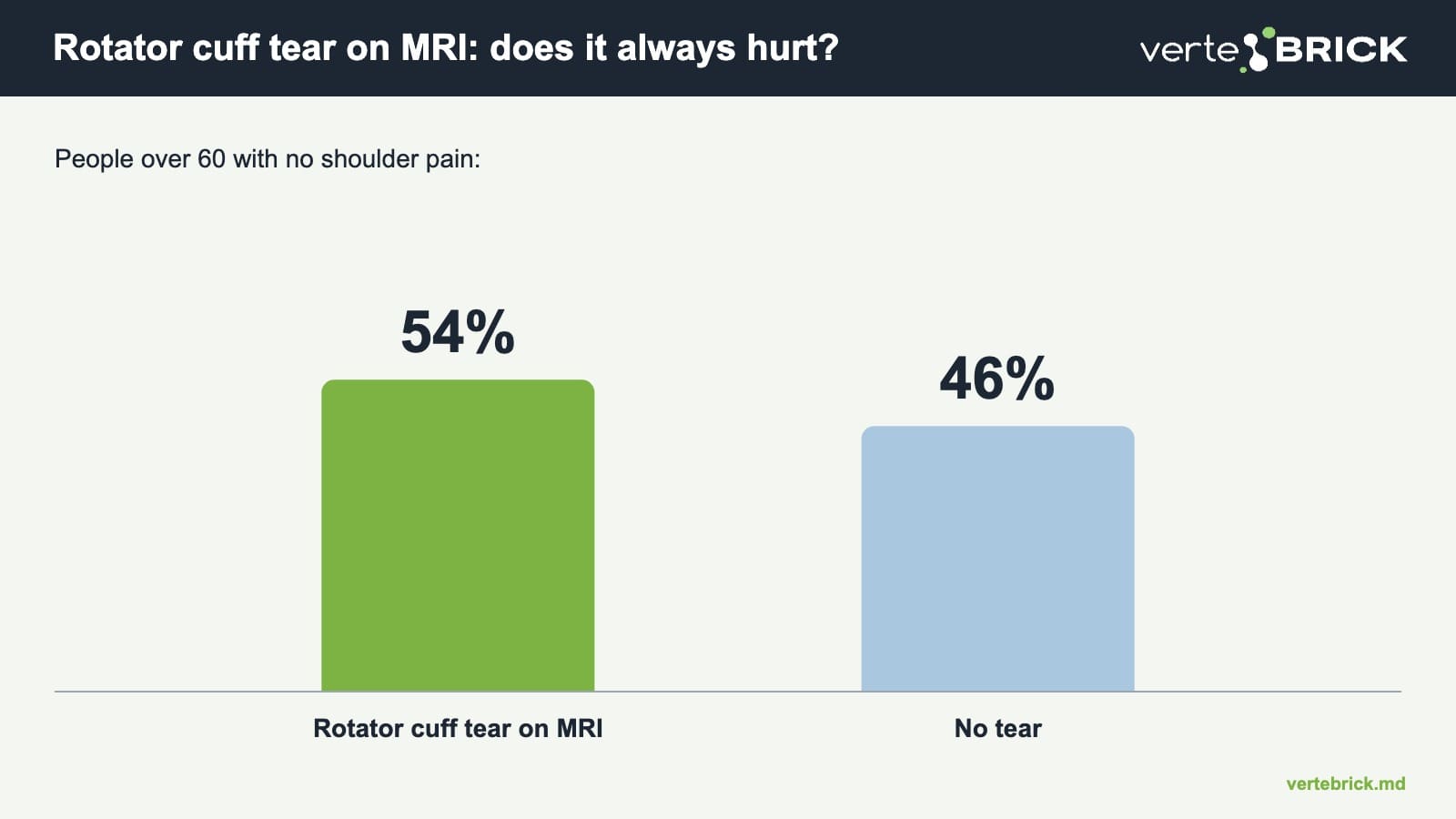
Many people are frightened when they read “rotator cuff tear” on an MRI report. In a study of people with no shoulder pain at all, more than half of those over 60 had a rotator cuff tear on MRI. Such changes are common with age and do not automatically mean they cause the pain or that you need surgery.
What helps
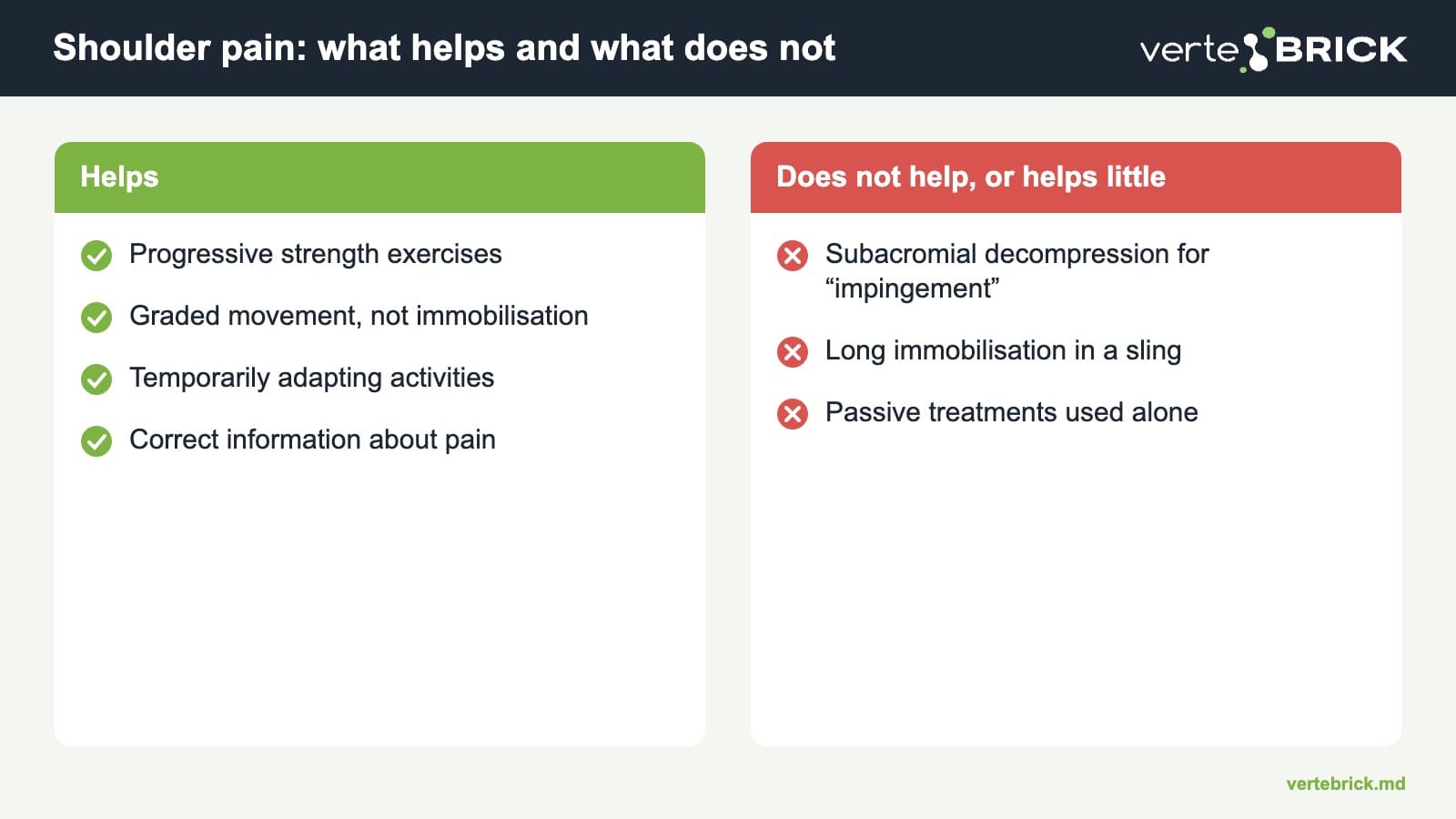
- Progressive strength exercises for the shoulder and shoulder blade. Studies show that exercise reduces pain and improves shoulder function.
- Graded movement, not immobilisation. Use the arm for activities that do not hurt too much.
- Temporarily adapting overhead activities, then returning to them gradually.
- Correct information. Pain does not mean the shoulder is “tearing” with every movement.
What does not help, or helps little
- Subacromial decompression surgery for “impingement” type shoulder pain. In a large trial its results were no better than placebo surgery, and international guidelines recommend against it.
- Long immobilisation in a sling. The shoulder becomes stiff and weak.
- Passive treatments used alone. They can ease pain for a short time, but they do not replace exercise.
When surgery is needed
Surgery is discussed, for example, after an injury in which a tendon tore suddenly and you can no longer lift the arm, especially in young and active people, or after a dislocation that keeps happening. The decision is made together with an orthopaedic surgeon. Physiotherapy is needed both before and after the operation.
When to see a doctor urgently
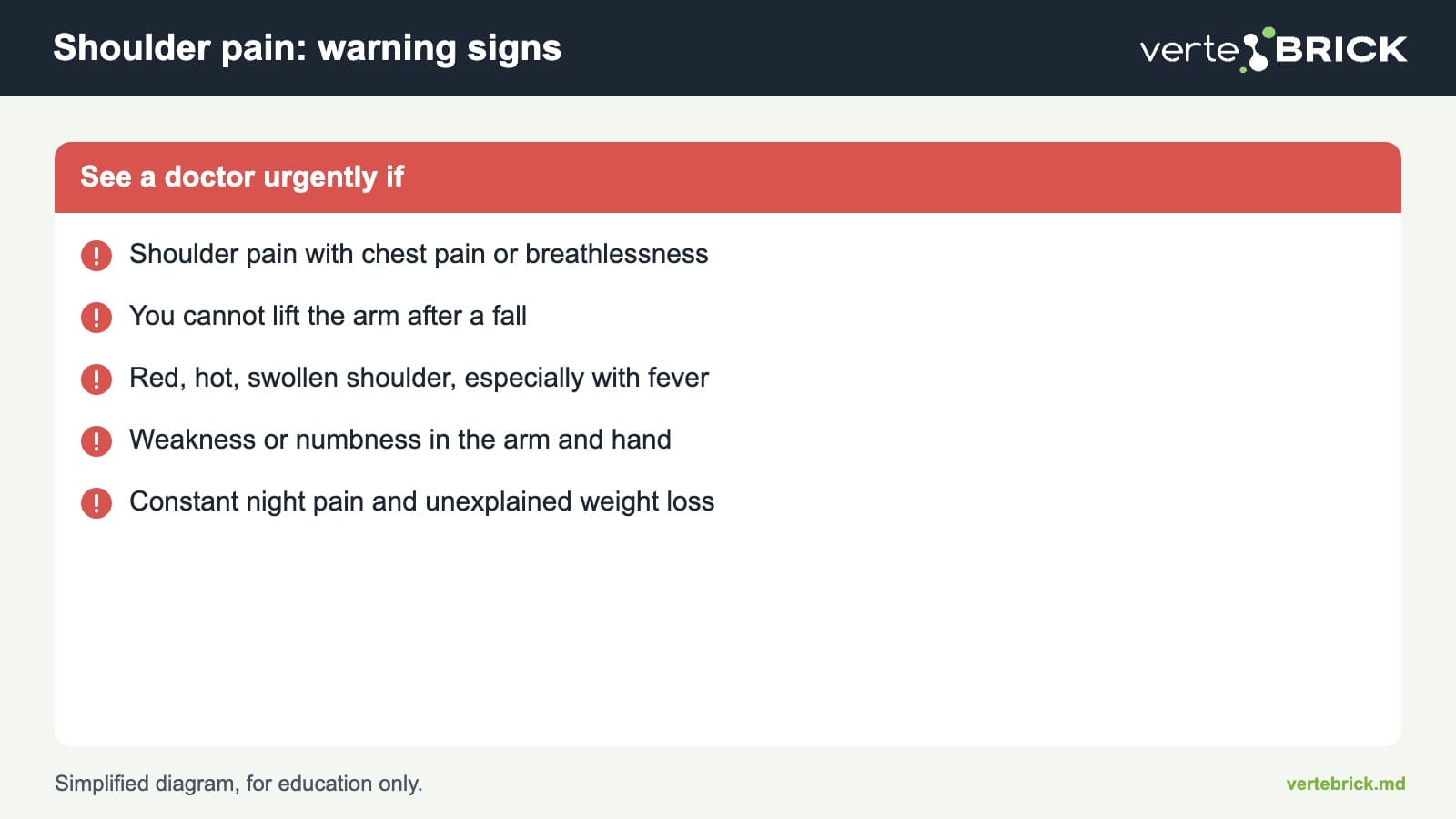
- shoulder pain together with chest pain, difficulty breathing or a cold sweat: call 112;
- after a fall you cannot lift the arm or the shoulder looks deformed;
- a red, hot and swollen shoulder, especially with fever;
- weakness or numbness spreading down the arm and hand;
- constant pain at night together with unexplained weight loss.
How we work at Vertebrick
At the assessment, the physiotherapist checks the movement and strength of your shoulder, the position and movement of the shoulder blade, your neck and the activities that cause pain. You get an exercise programme adapted to your pain, which we build up gradually, plus advice for work, sport and sleep. If we suspect a problem that needs an orthopaedic doctor, we tell you directly.
Frequently asked questions
My MRI shows a rotator cuff tear. Do I need surgery?
Not necessarily. Many tears, especially age-related ones, cause no symptoms or improve with exercise. Surgery is discussed mainly after a recent injury with loss of strength.
Can I exercise if my shoulder hurts?
Yes. Mild pain during exercise that settles quickly afterwards is acceptable. The programme is adjusted to how your shoulder responds.
How long does recovery take?
It depends on the cause. With tendon overload, many people feel better after a few weeks of regular exercise. Frozen shoulder usually takes longer.
Where can I get shoulder physiotherapy in Chișinău?
At Vertebrick clinic, 12/2 Traian Blvd, Chișinău. Bookings: +373 69 82 62 12.
🎥 Free video mini-course: exercises for shoulder pain in Vertebrick Academy (in Romanian).
Book an assessment
Come in for an assessment at Vertebrick, 12/2 Traian Blvd, Chișinău. We are open Monday to Saturday, 08:00–20:00.
📞 +373 69 82 62 12 · WhatsApp: wa.me/37369826212 · Fill in the form
Author: the Vertebrick team, physiotherapy clinic in Chișinău. This article is for information only and does not replace a medical consultation.
Sources
- Sher JS, Uribe JW, Posada A, Murphy BJ, Zlatkin MB. Abnormal findings on magnetic resonance images of asymptomatic shoulders. Journal of Bone and Joint Surgery (Am), 1995.
- Beard DJ, Rees JL, Cook JA, et al. Arthroscopic subacromial decompression for subacromial shoulder pain (CSAW): a multicentre, pragmatic, parallel group, placebo-controlled, three-group, randomised surgical trial. The Lancet, 2018.
- Vandvik PO, Lähdeoja T, Ardern C, et al. Subacromial decompression surgery for adults with shoulder pain: a clinical practice guideline. BMJ, 2019.
- Steuri R, Sattelmayer M, Elsig S, et al. Effectiveness of conservative interventions including exercise, manual therapy and medical management in adults with shoulder impingement: a systematic review and meta-analysis of RCTs. British Journal of Sports Medicine, 2017.
- Kelley MJ, Shaffer MA, Kuhn JE, et al. Shoulder pain and mobility deficits: adhesive capsulitis. Clinical practice guidelines. Journal of Orthopaedic & Sports Physical Therapy, 2013.