
In short: “osteochondrosis” is a diagnosis given very often in Moldova and other former Soviet countries, but international medicine does not use it to explain back pain. It describes the ordinary wear of the discs and vertebrae that appears in almost everyone with age, including people with no pain at all. The good news: back pain responds well to movement and exercise, whatever the X-ray report says.
What “osteochondrosis” really means
The term describes age-related changes in the spine: the discs lose water and height, and small bony growths (osteophytes) may appear at the edges of the vertebrae. On an X-ray or MRI these show up as “wear”.
International guidelines call the same changes “disc degeneration” or “spondylosis” and consider them part of normal ageing, like grey hair or wrinkles.
Wear is common in people without pain
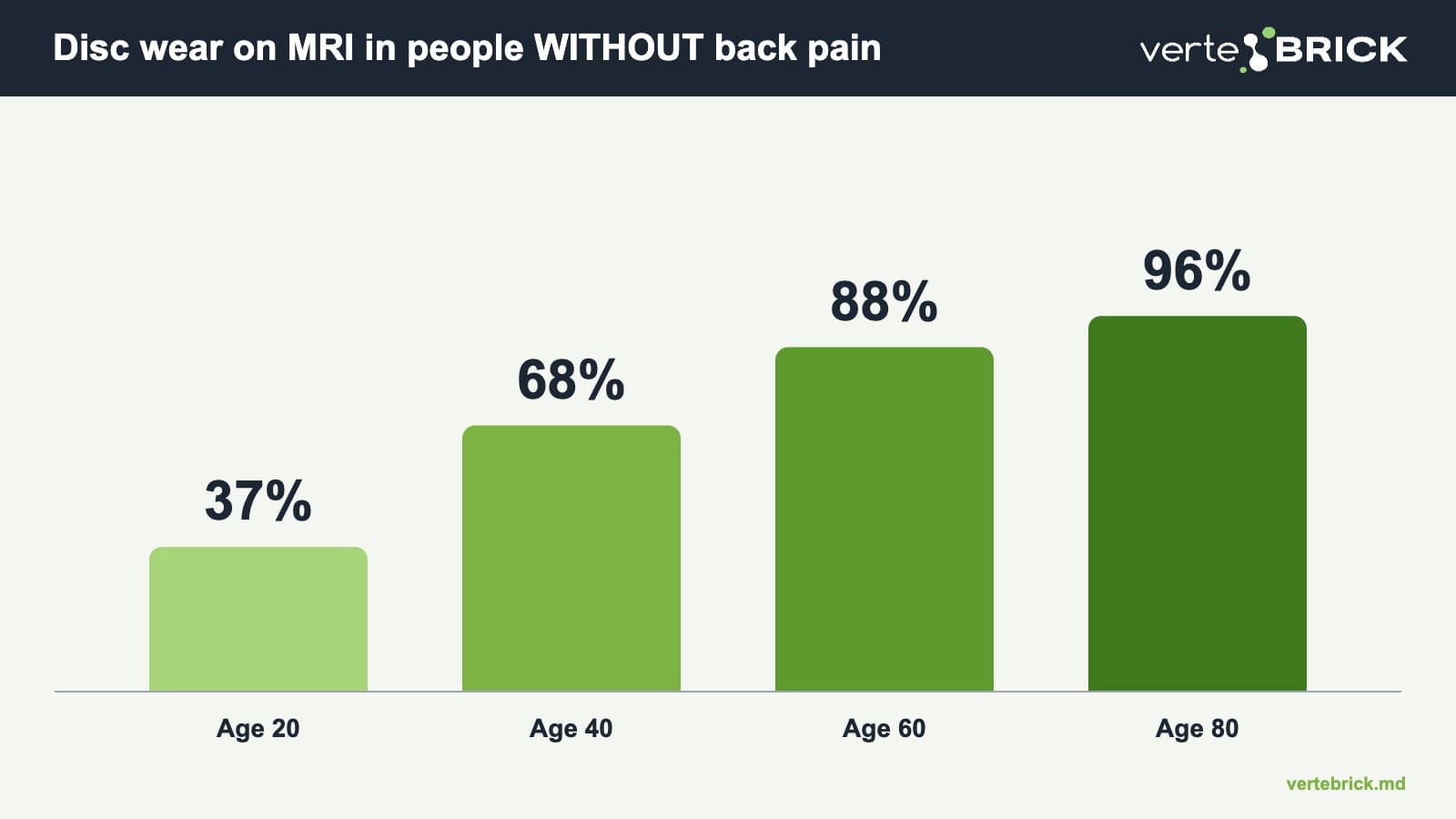
Studies of people with no back pain at all show signs of disc wear in more than a third of 20-year-olds and in almost all 80-year-olds. So the “osteochondrosis” on your scan does not, on its own, explain why your back hurts now.
So why does the back hurt?
In most cases back pain has no single cause that can be seen on a scan. Daily load, muscle strength and endurance, sleep, stress, fear of movement and how much you move all play a part. The good news is that all of these can change.
What helps
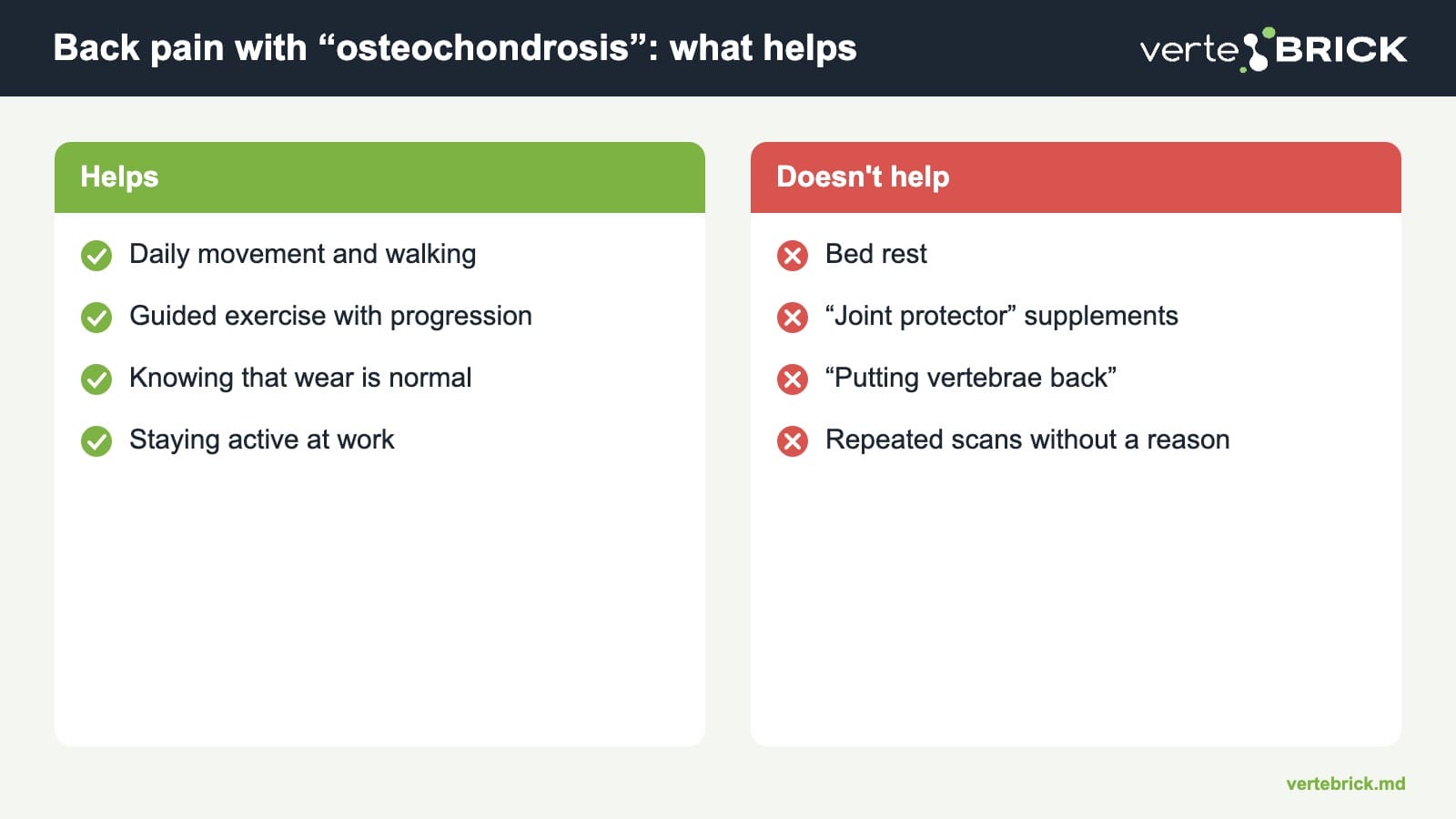
- Daily movement and walking, even if it hurts a little at first.
- Guided exercise for back strength and mobility, with gradual progression. There is no single “magic” exercise; what matters is doing them regularly.
- Clear explanations: once you understand that wear is normal, fear goes down and recovery becomes easier.
- Staying active at work, with breaks and changes of position.
- Pain medication for a short time and agreed with your doctor.
What does not help or needs caution
- Bed rest. It prolongs pain and weakens the muscles.
- “Joint protectors” (glucosamine, chondroitin). A well-run trial found no benefit over placebo for back pain.
- Promises to “put the vertebrae back in place”. Vertebrae do not “slip out” because of wear, and sudden manipulations by unqualified people can be dangerous.
- Repeated X-rays and MRI scans without a clear reason. They do not change treatment and can cause needless worry.
When to see a doctor urgently
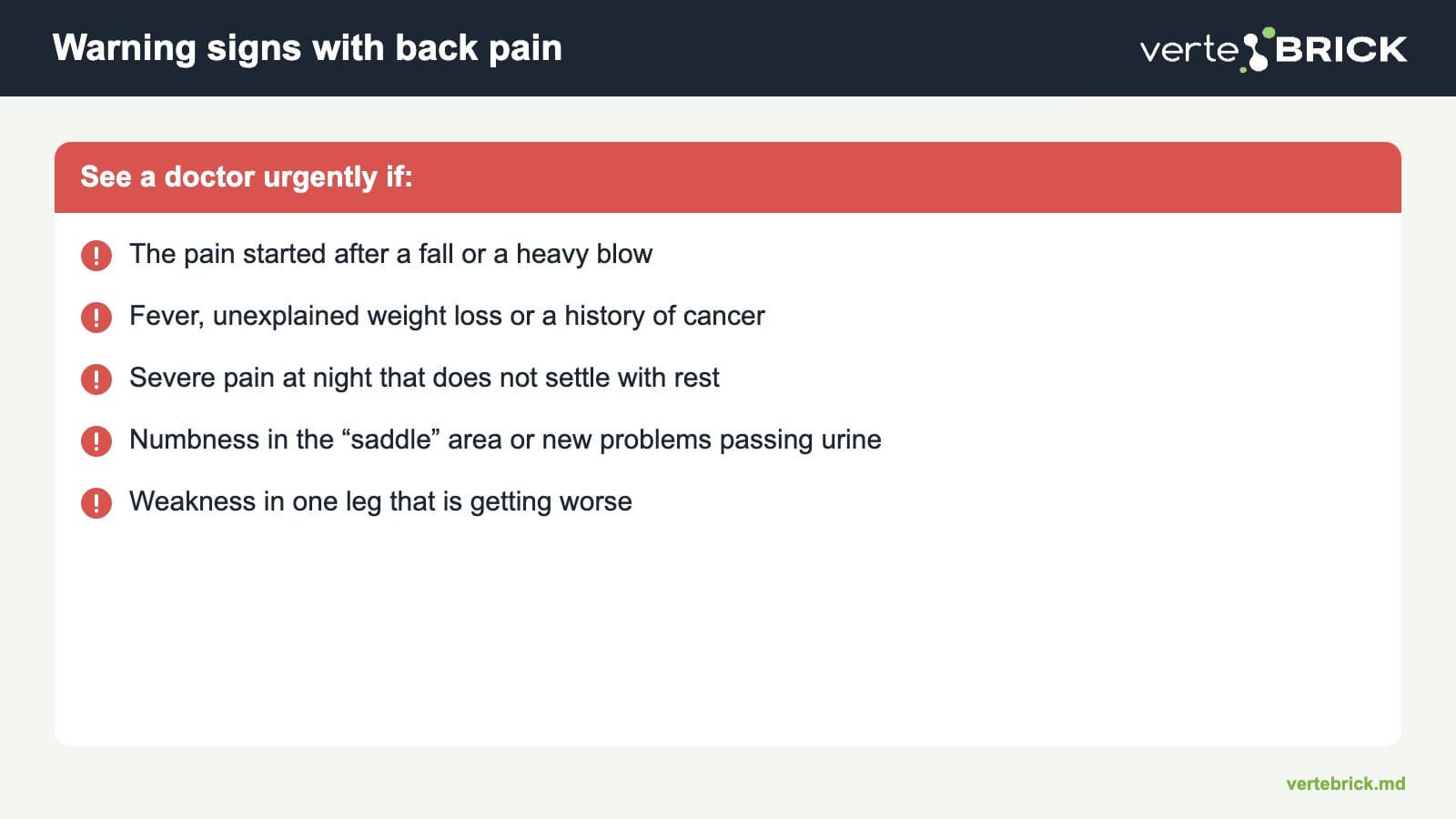
- the pain started after a fall or a heavy blow;
- you have a fever, unexplained weight loss or a history of cancer;
- the pain is severe at night and does not settle with rest;
- numbness between the legs (the “saddle” area) or new problems passing urine;
- weakness in one leg that is getting worse.
How we work at Vertebrick
At the assessment, the physiotherapist listens to you, checks spinal movement, strength and warning signs, and explains in plain words what your X-ray or MRI report actually means. You get an exercise programme with clear progression and a re-assessment so you can see your progress.
Frequently asked questions
Can osteochondrosis be cured?
Disc wear does not go away, just as grey hair does not. But the pain can be greatly reduced and kept under control with movement and exercise.
Can I do sport if I have osteochondrosis?
Yes. Regular physical activity is recommended. A physiotherapist helps you choose the right load and increase it gradually.
Do I need an MRI for osteochondrosis?
Usually not. An MRI is done only when there are warning signs or when surgery is being considered.
Where can I get physiotherapy for back pain in Chișinău?
At the Vertebrick clinic, 12/2 Traian Blvd, Chișinău. Book on +373 69 82 62 12.
Book an assessment
Come in for an assessment at Vertebrick, 12/2 Traian Blvd, Chișinău, Moldova. We are open Monday to Saturday, 08:00–20:00.
📞 +373 69 82 62 12 · WhatsApp: wa.me/37369826212 · Fill in the form
Author: the Vertebrick team, physiotherapy clinic in Chișinău. This article is for information only and does not replace a medical consultation.
Sources
- Brinjikji W, Luetmer PH, Comstock B, et al. Systematic literature review of imaging features of spinal degeneration in asymptomatic populations. American Journal of Neuroradiology, 2015.
- Maher C, Underwood M, Buchbinder R. Non-specific low back pain. The Lancet, 2017.
- Foster NE, Anema JR, Cherkin D, et al. Prevention and treatment of low back pain: evidence, challenges, and promising directions. The Lancet, 2018.
- Wilkens P, Scheel IB, Grundnes O, Hellum C, Storheim K. Effect of glucosamine on pain-related disability in patients with chronic low back pain and degenerative lumbar osteoarthritis: a randomized controlled trial. JAMA, 2010.
- National Institute for Health and Care Excellence. Low back pain and sciatica in over 16s: assessment and management (NG59), 2016, updated 2020.