
In short: spondylolisthesis means one vertebra has slipped slightly forward over the one below, most often in the lower back. It sounds worrying, but many people with a mild slip have few or no symptoms. Most cases are treated without surgery, with exercise and load management. Surgery is considered when the slip squeezes the nerves and symptoms are severe.
What spondylolisthesis is
The vertebrae sit on top of one another, joined by discs, joints and ligaments. In spondylolisthesis, one of them slips forward. Doctors grade it from grade I (a small slip, the most common) to grade IV (a large slip, rare).
The two main forms
- In young people and athletes (isthmic): it follows a small stress crack in the arch of the vertebra (spondylolysis), more often in sports with a lot of back bending backwards, such as gymnastics, dance or football.
- In adults over 50 (degenerative): it develops with wear of the disc and joints, more often in women and usually between the L4 and L5 vertebrae.
Typical signs
- pain in the lower back, especially when standing for long or bending backwards;
- in young athletes, pain during activity that eases with rest;
- in adults, sometimes pain or numbness in the legs when walking that eases when sitting or bending forward (a sign that the nerve canal is narrowing).
What helps
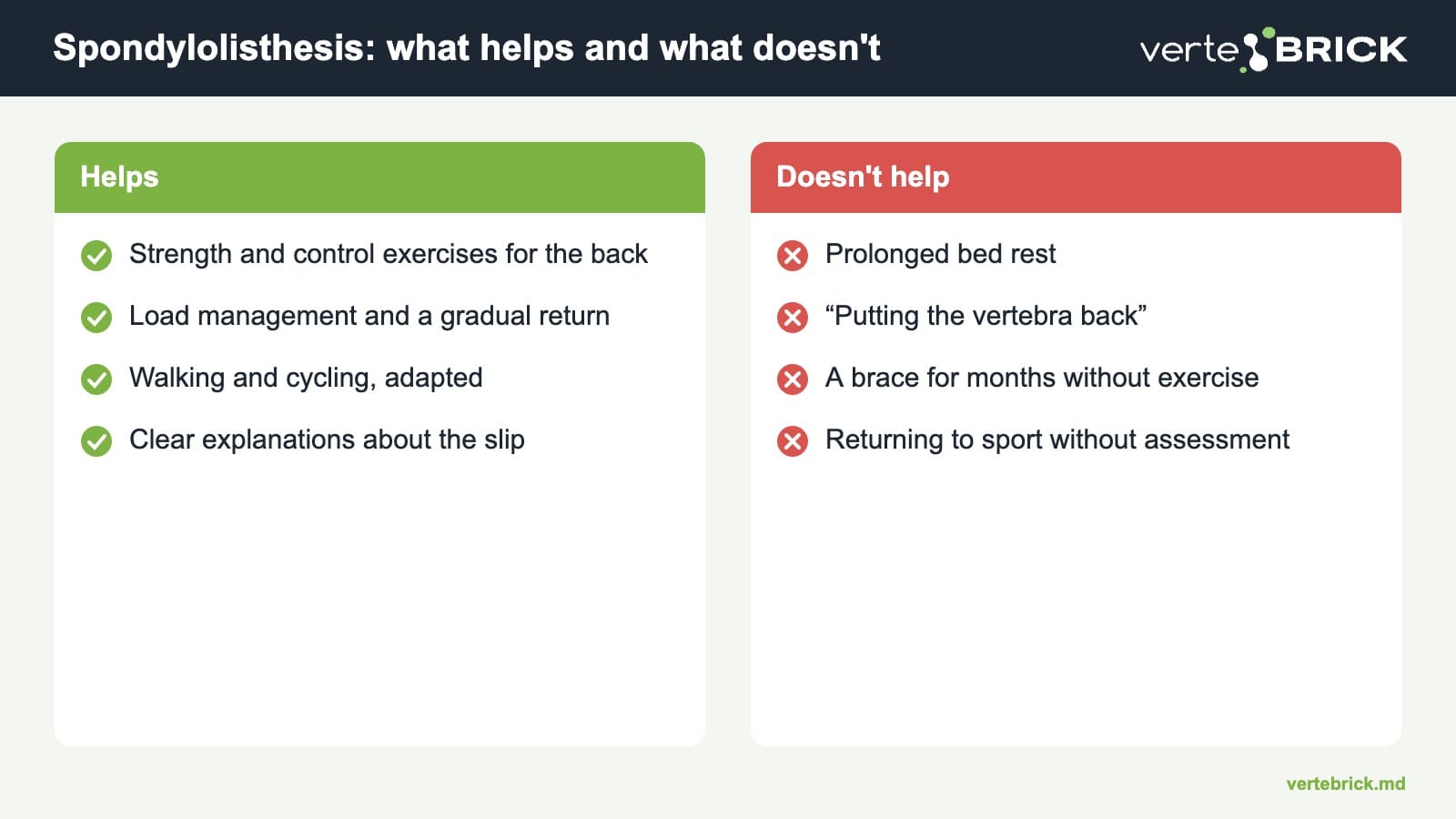
- Exercises for strength and control of the back, abdomen and hips, progressed gradually.
- Load management: for athletes, a temporary break from the movements that hurt, then a gradual, supervised return.
- Walking and physical activity, adapted: some people find cycling or walking with a slight forward lean more comfortable.
- Clear explanations: a mild slip is common and does not mean the vertebra will “fall out”.
- Pain medication for a short time and agreed with your doctor.
What does not help or needs caution
- Prolonged bed rest. It weakens the muscles that support the spine.
- Sudden manipulation to “put the vertebra back”. A slipped vertebra cannot be put back by manipulation, and manoeuvres by unqualified people can be dangerous.
- Wearing a brace for months without exercise. It is sometimes used short term on a doctor’s advice, but it does not replace exercise.
- Returning to sport without an assessment after a stress crack in a vertebra.
When surgery is needed
Most people with a mild slip do not need surgery. It is considered when the slip is large, when leg pain and numbness on walking are severe and do not improve after several months of proper treatment, or when leg weakness appears. In a large study of people with degenerative spondylolisthesis and a narrowed canal, surgery gave better results than non-surgical treatment. The decision is made together with a neurosurgeon.
When to see a doctor urgently
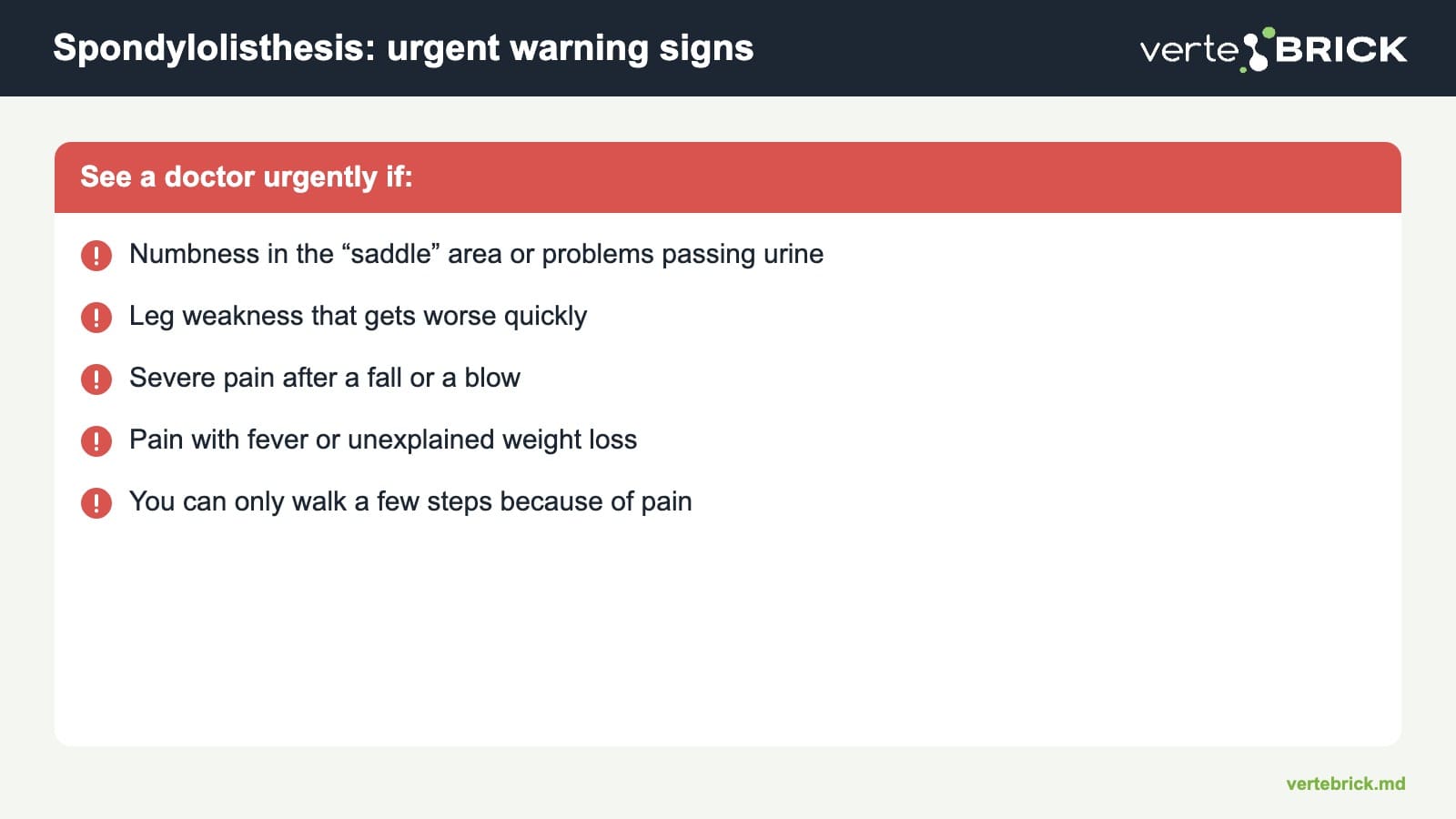
- numbness between the legs (the “saddle” area) or new problems passing urine or controlling your bowels;
- weakness in one or both legs that gets worse quickly;
- severe pain after a fall or a blow;
- pain with fever or unexplained weight loss;
- you can only walk a few steps because of leg pain or numbness.
How we work at Vertebrick
At the assessment we check spinal movement, strength, sensation and reflexes, and explain what the grade of slip in your X-ray or MRI report means. You get an exercise programme suited to your type of spondylolisthesis, a plan for returning to sport or to walking longer distances, and regular re-assessments. We work with your doctor when further tests are needed.
Frequently asked questions
Can spondylolisthesis be treated without surgery?
Yes, in most cases. Exercise and load management help most people with a mild slip.
Can I do sport with spondylolisthesis?
Usually yes, after an assessment and with a gradual return. Sports with a lot of backward bending are resumed more carefully, under supervision.
Can a slipped vertebra be put back in place?
Not by manipulation. Exercise strengthens the muscles that support the spine and reduces symptoms, even if the slip remains on the scan.
Where can I get physiotherapy for spondylolisthesis in Chișinău?
At the Vertebrick clinic, 12/2 Traian Blvd, Chișinău. Book on +373 69 82 62 12.
Book an assessment
Come in for an assessment at Vertebrick, 12/2 Traian Blvd, Chișinău, Moldova. We are open Monday to Saturday, 08:00–20:00.
📞 +373 69 82 62 12 · WhatsApp: wa.me/37369826212 · Fill in the form
Author: the Vertebrick team, physiotherapy clinic in Chișinău. This article is for information only and does not replace a medical consultation.
Sources
- Weinstein JN, Lurie JD, Tosteson TD, et al. Surgical versus nonsurgical treatment for lumbar degenerative spondylolisthesis. New England Journal of Medicine, 2007.
- Matz PG, Meagher RJ, Lamer T, et al. Guideline summary review: an evidence-based clinical guideline for the diagnosis and treatment of degenerative lumbar spondylolisthesis. The Spine Journal, 2016.
- Kalichman L, Hunter DJ. Diagnosis and conservative management of degenerative lumbar spondylolisthesis. European Spine Journal, 2008.
- Selhorst M, Fischer A, MacDonald J. Prevalence of spondylolysis in symptomatic adolescent athletes: an assessment of sport risk in nonelite athletes. Clinical Journal of Sport Medicine, 2019.
- Maher C, Underwood M, Buchbinder R. Non-specific low back pain. The Lancet, 2017.