
In short: trigger finger happens when the tendon that bends a finger no longer glides freely through its sheath. The finger catches in a bent position and then “snaps” straight, often in the morning. A night splint, less repeated forceful gripping and gentle tendon gliding exercises help. A doctor may suggest an injection and, if the locking continues, a short procedure.
What trigger finger is
The tendons that bend the fingers run through “rings” at the base of each finger. When the tendon or the ring thickens, the tendon catches as it passes. At first there is only a click, then the finger may lock bent and need straightening with the other hand.
Who gets it most
It is more common after 40, in women, in people with diabetes or rheumatoid arthritis and in people who do a lot of forceful gripping with tools or scissors. The ring finger and the thumb are most often affected.
Typical signs
- a click or “snap” when bending and straightening the finger;
- the finger locks bent, especially in the morning;
- pain or a tender lump in the palm at the base of the finger;
- stiffness that eases during the day;
- sometimes several fingers are affected.
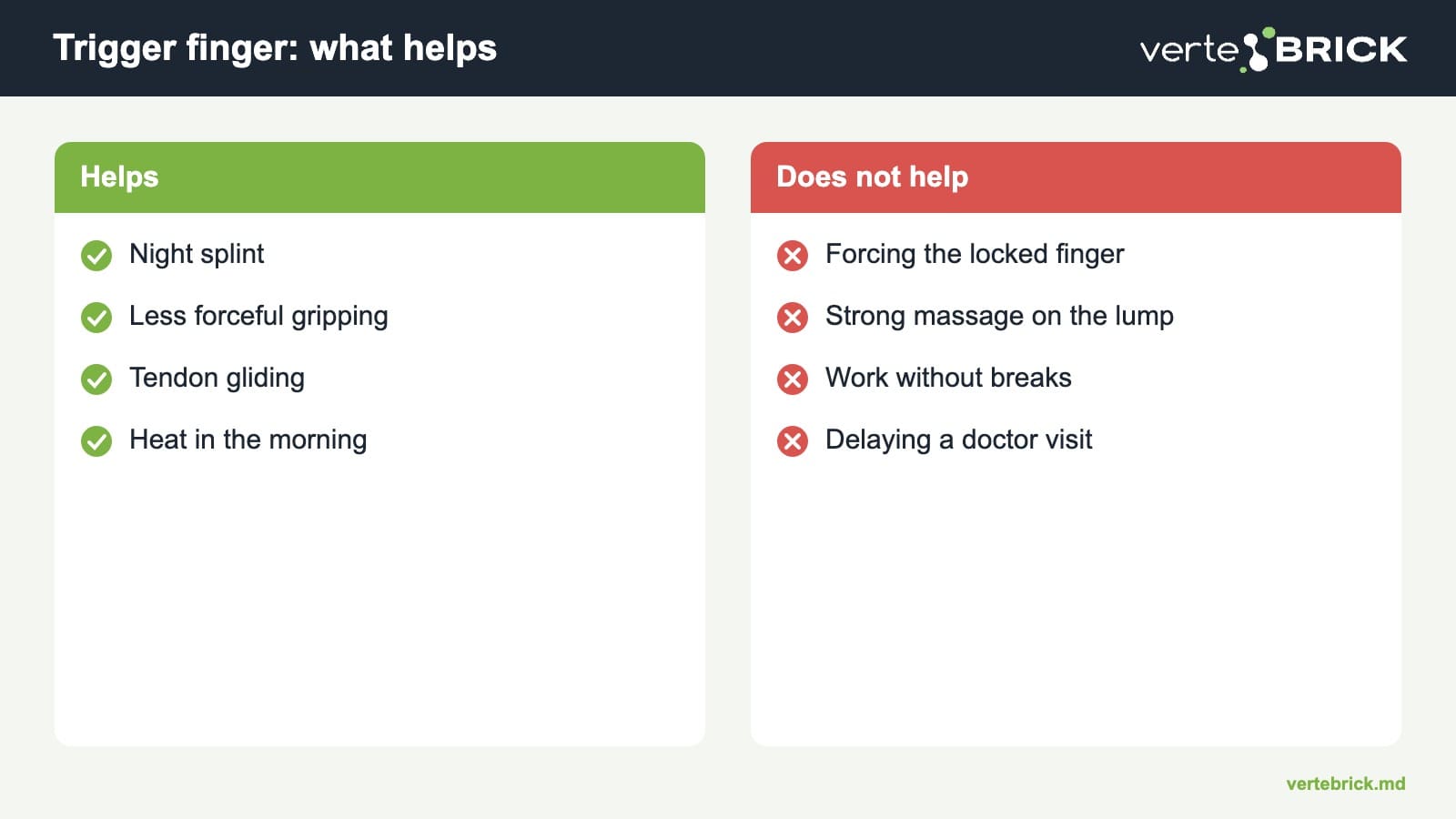
What helps
- a splint that keeps the finger straight at night for a few weeks;
- less forceful, repeated gripping and thicker tool handles;
- gentle tendon gliding exercises without strong pain;
- local heat in the morning before moving;
- seeing a doctor about an injection if the locking continues.
What doesn't help
- repeatedly forcing the locked finger to “snap”;
- strong massage on the lump in the palm;
- carrying on with forceful gripping without breaks;
- putting off a doctor's visit when the finger stays locked.
How long it takes
In mild cases, a splint and activity changes help within 6–10 weeks. An injection works well for many people. If the finger stays locked, a short procedure releases the tendon, and exercises afterwards help restore movement.
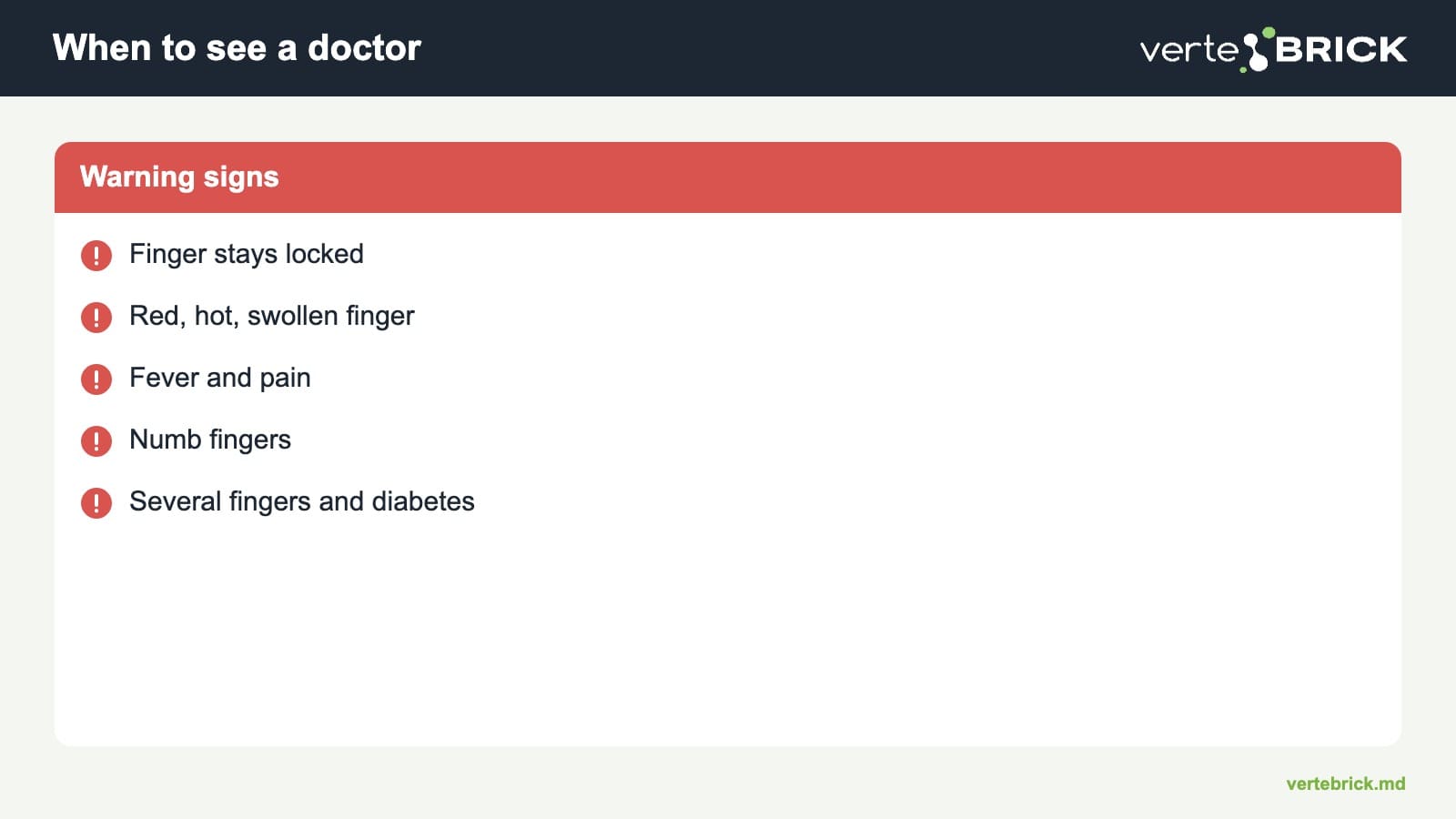
When to see a doctor
- the finger stays locked and will not straighten;
- the finger or palm is red, hot and swollen;
- fever together with finger pain;
- numbness in the fingers, especially at night;
- several fingers lock and you have diabetes.
How we work at Vertebrick
We assess finger movement, grip strength and the activities that trigger the locking. We show you tendon gliding exercises, how to use a splint and how to adapt your work. After an injection or surgery, we help you get full movement back.
Frequently asked questions
What is trigger finger?
It is a problem with the tendon that bends the finger: it catches in its sheath, so the finger locks and snaps when you straighten it.
Does a splint help trigger finger?
Yes, a splint worn at night for a few weeks reduces locking for many people, especially in mild cases.
When is surgery needed for trigger finger?
When the finger stays locked or the locking continues after splinting and an injection. The procedure is short and recovery is usually quick.
Where can I get treatment for trigger finger in Chișinău?
At the Vertebrick clinic in Chișinău, with a hand assessment, exercises and splint advice.

Book an assessment
Come in for an assessment at Vertebrick, 12/2 Traian Blvd, Chișinău, Moldova. We are open Monday to Saturday, 08:00–20:00.
📞 +373 69 82 62 12 · WhatsApp: wa.me/37369826212 · Fill in the form
Author: the Vertebrick team, physiotherapy clinic in Chișinău. This article is for information only and does not replace a medical consultation.
Sources
- Makkouk AH et al. Trigger finger: etiology, evaluation, and treatment. Curr Rev Musculoskelet Med. 2008;1(2):92–96.
- Colbourn J et al. Effectiveness of splinting for the treatment of trigger finger. J Hand Ther. 2008;21(4):336–343.
- Huisstede BM et al. Effectiveness of conservative, surgical, and postsurgical interventions for trigger finger, Dupuytren disease, and De Quervain disease: a systematic review. Arch Phys Med Rehabil. 2018;99(8):1635–1649.