

In short: pain on the outer side of the hip, often called "trochanteric bursitis", most often comes from the tendons of the buttock muscles. It hurts when you lie on that side, climb stairs or walk for a long time. An exercise programme of about 8 weeks, together with a few changes in posture, gives better long-term results than an injection or waiting.
Why it happens
On the outer side of the hip, the tendons of the gluteus medius and minimus attach to a bony bump. When these tendons are compressed often — for example when you sit with your legs crossed, sleep on your side or stand "hanging" on one hip — and the muscles are weak, the tendon becomes irritated and painful. The problem is common in women over 40.
Typical signs
- pain on the outer side of the hip, sometimes spreading down the thigh;
- pain when lying on the affected side, especially at night;
- pain when climbing stairs, walking for long or getting up from a chair;
- a tender spot when you press on the outer side of the hip;
- pain when standing on one leg for a while.
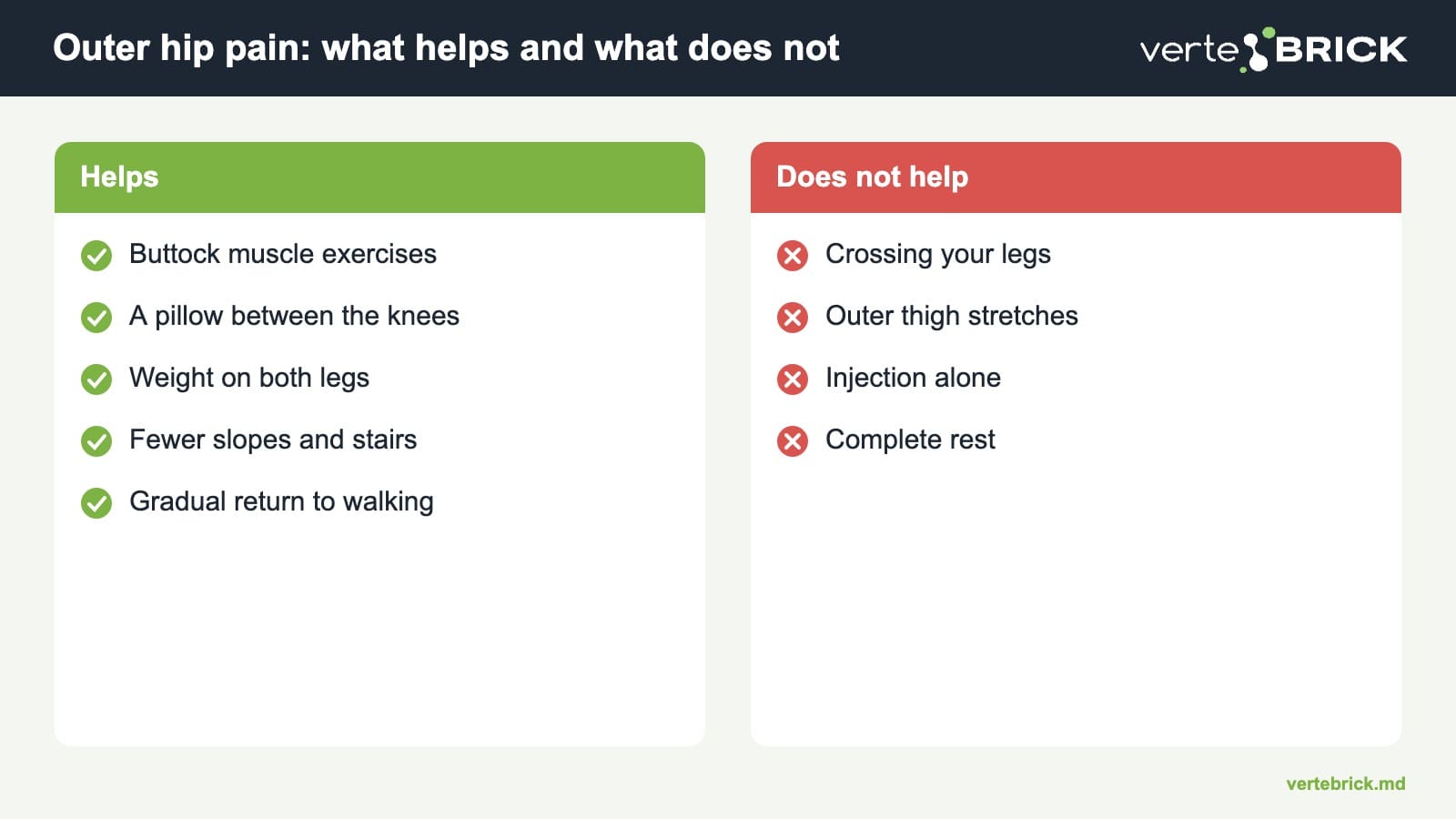
What helps
- Buttock muscle exercises, starting with static holds and moving on to gradually progressed strength exercises.
- A pillow between your knees when you sleep on your side.
- Standing with weight on both legs, without hanging on one hip.
- Temporarily reducing very long walks, many stairs and slopes.
- A gradual return to walking and sport as strength improves.
What does not help
- Sitting with your legs crossed and on very low chairs.
- Stretches for the outer thigh, which press even more on the tendon.
- An injection alone, without exercise. It helps short term, but the pain often comes back.
- Complete rest. The tendon needs graded load to adapt.
How long it takes
With a regular exercise programme, many patients feel a clear improvement after 8 weeks, and the effect lasts at one year. Pain that has lasted several months needs patience, but it responds well to correctly graded exercise.
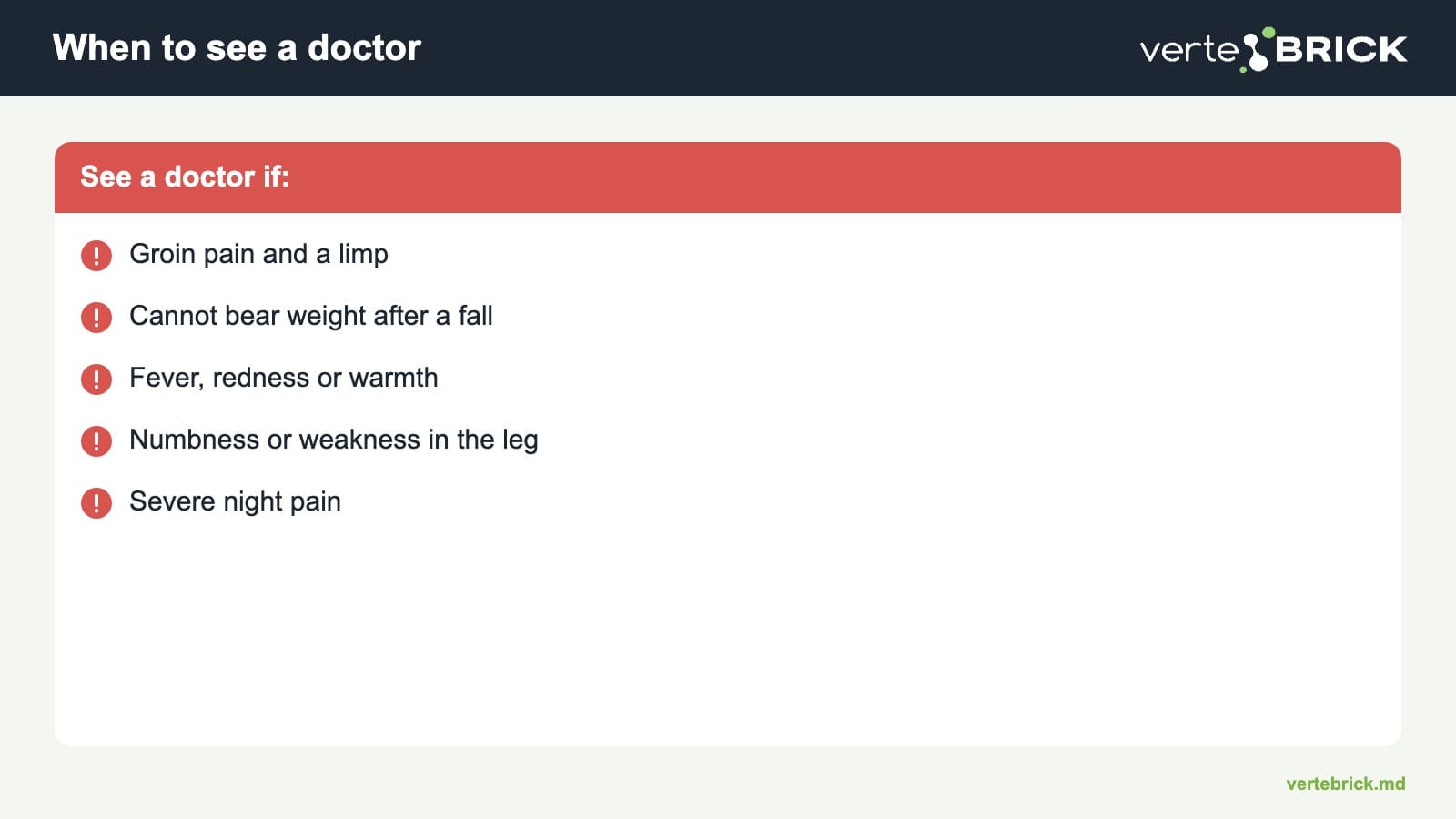
When to see a doctor
- groin pain and a limp, which may come from the hip joint;
- you cannot put weight on the leg after a fall;
- fever, redness or warmth around the hip;
- numbness or weakness in the leg;
- severe night pain that does not depend on position.
How we work at Vertebrick
At the first visit we check whether the pain comes from the tendons, the hip joint or the spine, and test buttock muscle strength, your walking and standing on one leg. Then we set a step-by-step exercise programme and teach you positions that reduce pain day to day.
Frequently asked questions
What is trochanteric bursitis?
It is pain on the outer side of the hip. In most cases it is not an inflamed bursa but a problem with the buttock muscle tendons.
How should I sleep with outer hip pain?
Avoid sleeping on the painful side. If you sleep on the other side, put a pillow between your knees.
How long does treatment take?
Usually about 8 weeks of regular exercise for a clear improvement.
Where can I get treatment for outer hip pain in Chisinau?
At the Vertebrick clinic in Chisinau, with a buttock muscle exercise programme checked at every session.

Book an assessment
Come in for an assessment at Vertebrick, 12/2 Traian Blvd, Chișinău, Moldova. We are open Monday to Saturday, 08:00–20:00.
📞 +373 69 82 62 12 · WhatsApp: wa.me/37369826212 · Fill in the form
Author: the Vertebrick team, physiotherapy clinic in Chișinău. This article is for information only and does not replace a medical consultation.
Sources
- Mellor R et al. Education plus exercise versus corticosteroid injection use versus a wait and see approach on global outcome and pain from gluteal tendinopathy: prospective, single blinded, randomised clinical trial. BMJ. 2018;361:k1662.
- Grimaldi A et al. Gluteal tendinopathy: a review of mechanisms, assessment and management. Sports Med. 2015;45(8):1107–1119.
- Ganderton C et al. Gluteal loading versus sham exercises to improve pain and dysfunction in postmenopausal women with greater trochanteric pain syndrome: a randomized controlled trial. J Womens Health. 2018;27(6):815–829.
- Speers CJ, Bhogal GS. Greater trochanteric pain syndrome: a review of diagnosis and management in general practice. Br J Gen Pract. 2017;67(663):479–480.