
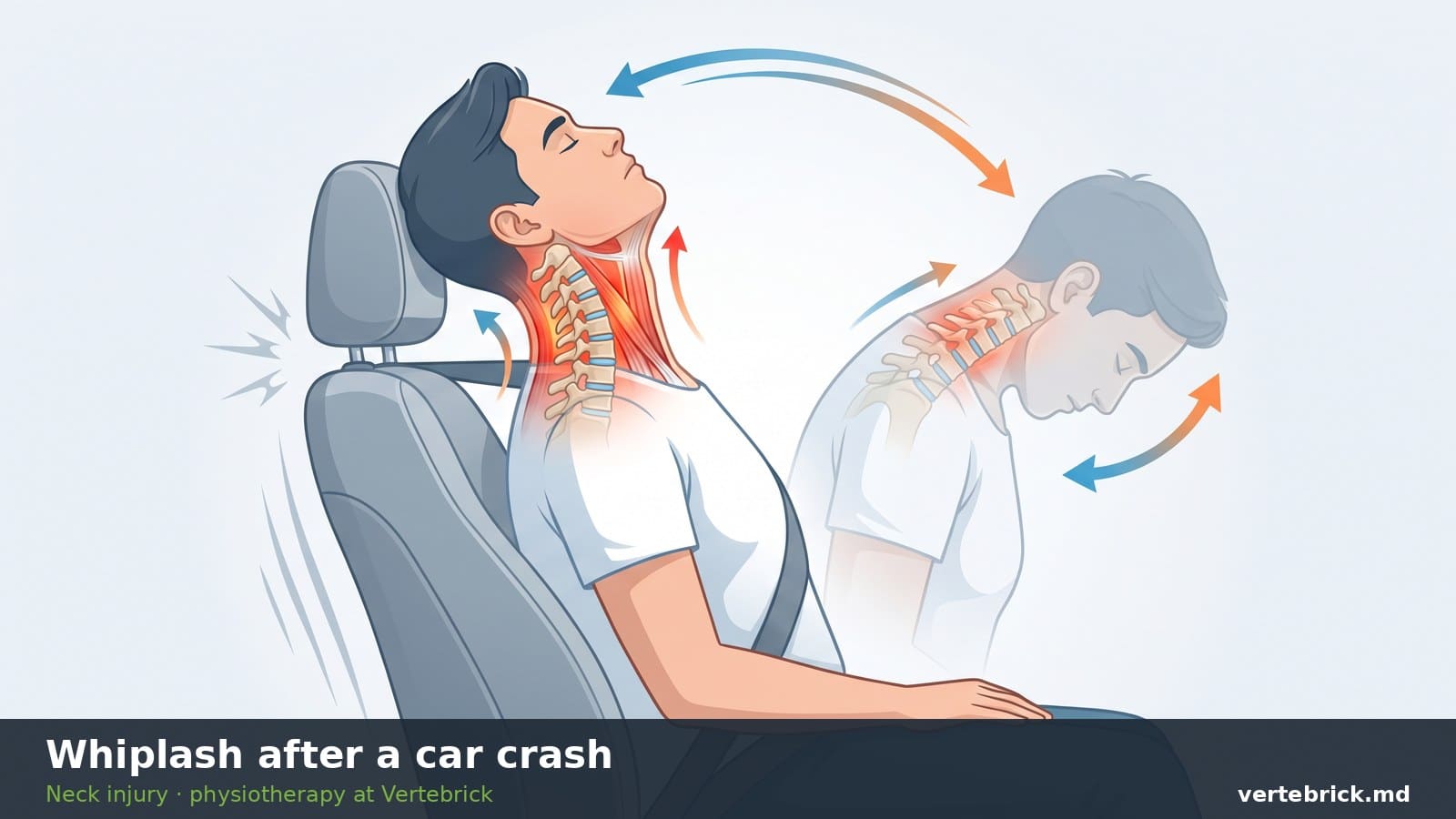
In short: whiplash happens when the head is thrown suddenly forwards and backwards, most often in a rear-end car crash. It causes neck pain and stiffness, sometimes headaches and shoulder pain. Once a doctor has ruled out a serious injury, gentle movement and exercise help more than keeping the neck still. Most people recover within weeks to a few months.
What whiplash is
During a sudden impact the neck moves quickly one way and then the other. The muscles, ligaments and small joints of the neck are overloaded. Pain often starts a few hours later or the next day, not straight away. X-rays are usually normal, but that does not mean the pain is not real.
When are scans needed?
After a crash, the doctor decides whether an X-ray or CT scan is needed using clear rules: age, type of crash, pain in the midline of the neck, numbness or weakness. If the tests show no fracture or nerve injury, you can start moving gradually.
Typical signs
- neck pain and stiffness, especially when turning the head;
- headaches starting at the back of the head;
- pain in the shoulders or between the shoulder blades;
- fatigue and poorer sleep in the first weeks;
- sometimes mild dizziness or difficulty concentrating.
What helps
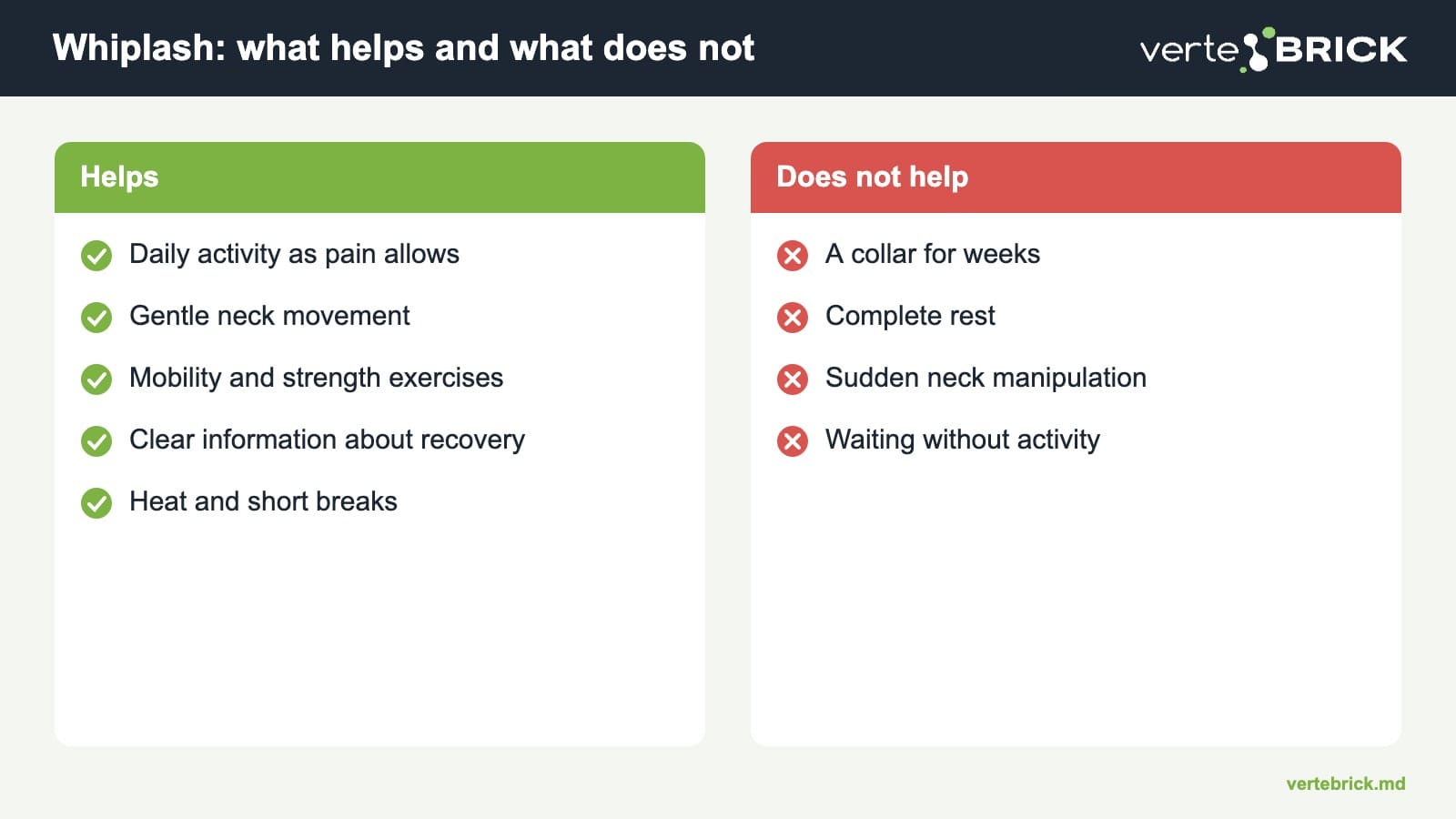
- keeping up daily activities as far as pain allows;
- gentle neck movement from the first days, once your doctor agrees;
- mobility and strength exercises for the neck and shoulders, built up gradually;
- clear information about recovery, so you are not afraid to move;
- local heat and short breaks at work.
What does not help
- a soft collar worn for days or weeks;
- complete rest and avoiding all neck movement;
- sudden neck manipulation right after the crash;
- waiting for the pain to go away without any activity.
How long it lasts
Many people feel much better within 2–3 months. For some, symptoms last longer, especially when the pain was very strong from the start. An exercise programme started early and a gradual return to activity lower the risk of the pain becoming long-term.

When to see a doctor urgently
- numbness, tingling or weakness in the arms or legs;
- severe dizziness, double vision or slurred speech;
- difficulty swallowing or walking;
- a worsening headache or loss of consciousness;
- severe pain in the middle of the neck after a crash.
How we work at Vertebrick
We start once a doctor has ruled out a serious injury. We assess the mobility, strength and control of the neck and shoulders and build a gradually progressed exercise programme. We help you return to work, driving and sport safely.
Frequently asked questions
What is whiplash?
It is an overload of the neck structures after a sudden forward-and-back movement of the head, most often in a car crash.
Should I wear a neck collar after whiplash?
Usually not. Wearing a collar for a long time can slow recovery. Gentle movement, once a serious injury is ruled out, helps more.
How long does whiplash recovery take?
Many people feel much better within 2–3 months. Early exercise and a gradual return to activity support recovery.
Where can I get physiotherapy for whiplash in Chisinau?
At the Vertebrick clinic in Chisinau, with a neck assessment and a gradually progressed exercise programme.

Book an assessment
Come in for an assessment at Vertebrick, 12/2 Traian Blvd, Chișinău, Moldova. We are open Monday to Saturday, 08:00–20:00.
📞 +373 69 82 62 12 · WhatsApp: wa.me/37369826212 · Fill in the form
Author: the Vertebrick team, physiotherapy clinic in Chișinău. This article is for information only and does not replace a medical consultation.
Sources
- Sterling M. Physiotherapy management of whiplash-associated disorders (WAD). J Physiother. 2014;60(1):5–12.
- Côté P et al. Management of neck pain and associated disorders: a clinical practice guideline from the OPTIMa Collaboration. Eur Spine J. 2016;25(7):2000–2022.
- Stiell IG et al. The Canadian C-spine rule for radiography in alert and stable trauma patients. JAMA. 2001;286(15):1841–1848.