

In short: pain at the front of the knee, around or behind the kneecap, is very common in teenagers, runners and active people. It is called patellofemoral pain. What helps most is strengthening the hip and thigh muscles, together with sensible load management. Without treatment, pain can last for years in many people, so it is worth treating early.
What patellofemoral pain is
The kneecap glides in a groove on the thigh bone as you bend and straighten your knee. When the joint between the kneecap and the thigh bone is loaded more than it can handle, for example by suddenly increasing running or jumping, pain appears. It is usually not damage that shows on a scan, but increased sensitivity to load.
Typical signs
- pain at the front of the knee, around or behind the kneecap;
- pain going up and especially down stairs, when squatting and jumping;
- pain after sitting for a long time with bent knees, for example at the cinema or in the car;
- often no swelling and no clear injury at the start.
What helps
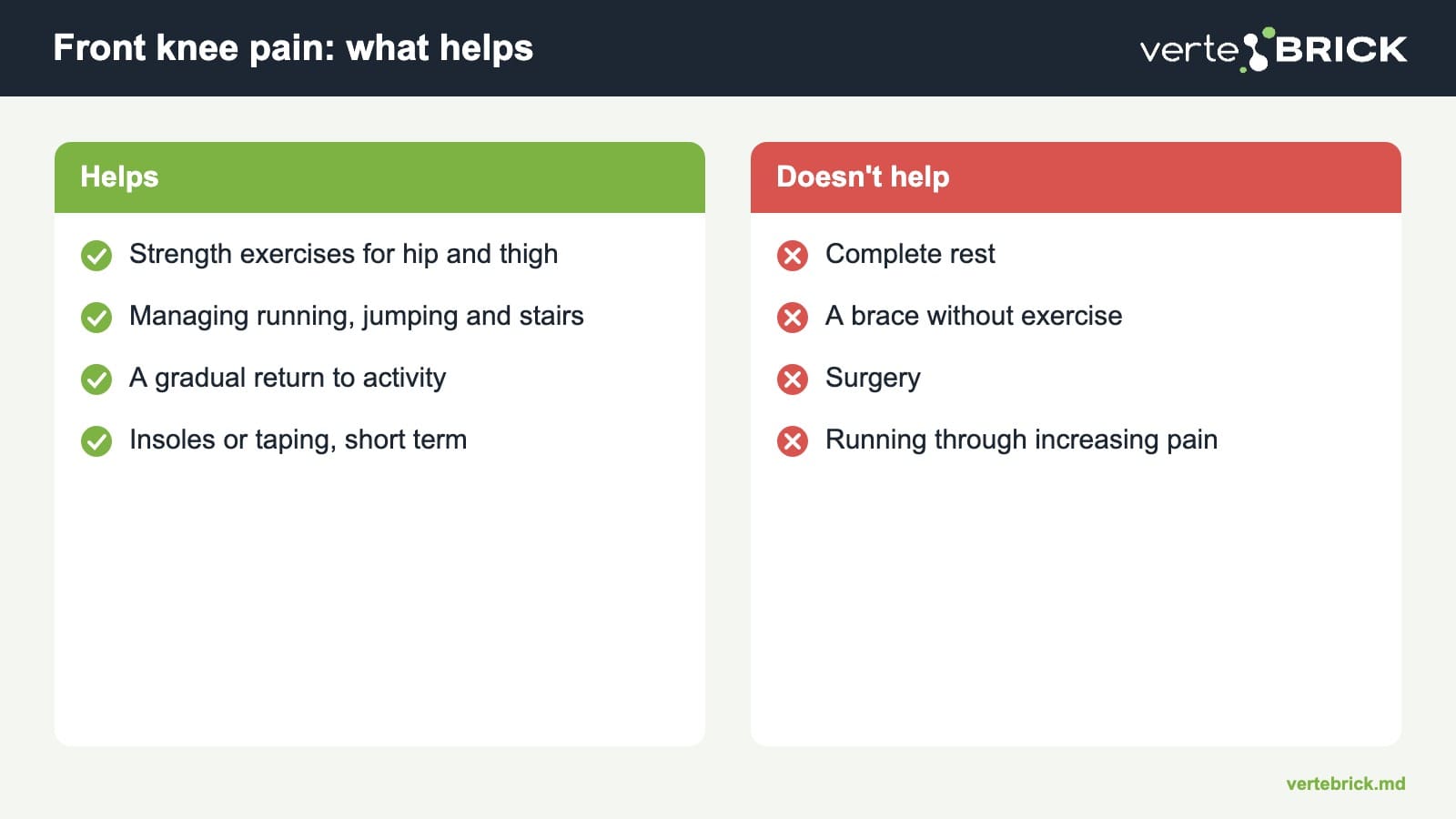
- Strength exercises for the hip and thigh. Combined, they gave better results than exercises for the knee alone.
- Load management: temporarily reduce the activities that hurt (running, jumping, stairs), then return gradually. In teenagers, this change alone helped many young people.
- Clear explanations: pain does not mean the knee is “wearing out”, and well-dosed movement is safe.
- Insoles or kneecap taping for a short time, as help in the first weeks alongside exercise.
What does not help or needs caution
- Complete rest. Muscles weaken, and the pain returns when you get active again.
- Knee supports and braces used on their own, without exercise. They do not fix the cause.
- Surgery for patellofemoral pain. It is not recommended in most cases.
- Running on through increasing pain. Mild pain during activity is acceptable if it settles by the next day; if it gets worse, reduce the load.
How long it takes
Many people feel better after 6–12 weeks of regular exercise. Long-standing pain and low strength are linked to slower recovery, so it matters to start early and not give up on the exercises.
When to see a doctor
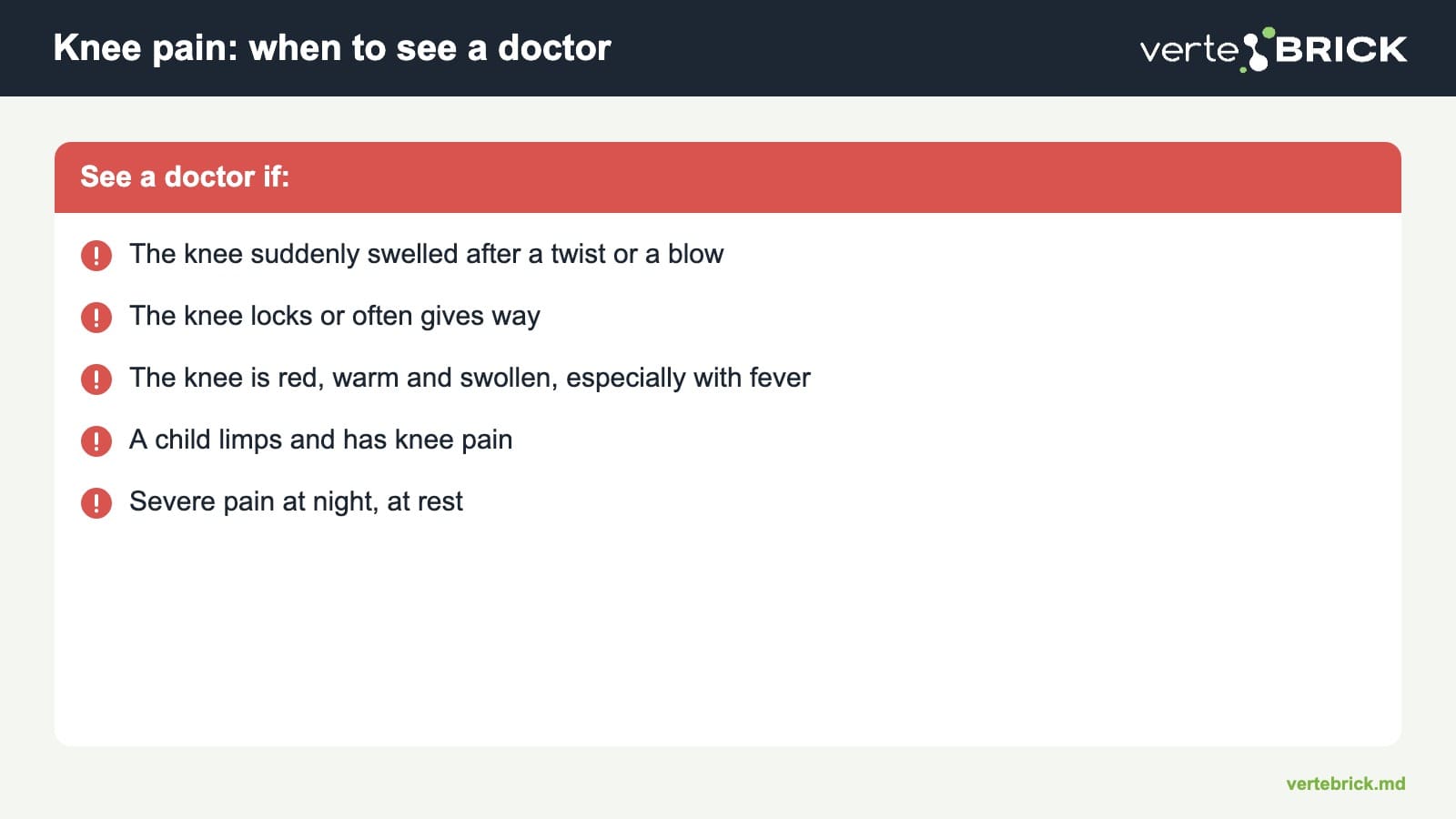
- the knee suddenly swelled after a twist or a blow;
- the knee locks or often gives way;
- the knee is red, warm and swollen, especially with a fever;
- a child or teenager limps and has knee pain (sometimes the cause is the hip);
- the pain is severe at night, at rest.
How we work at Vertebrick
At the assessment we check the knee, hip and thigh strength, and how you go down stairs, squat or run, and we find out how your activity has changed recently. You get an exercise programme with clear progression, a plan for managing your activities and a re-assessment so you can see the pain going down.
Frequently asked questions
Why does the front of my knee hurt going down stairs?
Going down stairs puts a large load on the joint between the kneecap and the thigh bone. When it is irritated, this is one of the first movements to hurt.
Can I run with patellofemoral pain?
Often yes, but at a lower volume, if the pain stays mild and settles by the next day. Strength exercises are done alongside.
Which exercises help pain at the front of the knee?
Strength exercises for the hip and thigh muscles, increased gradually. A physiotherapist chooses and adapts them to how irritated the knee is.
Where can I get physiotherapy for knee pain in Chișinău?
At the Vertebrick clinic, 12/2 Traian Blvd, Chișinău. Book on +373 69 82 62 12.

Book an assessment
Come in for an assessment at Vertebrick, 12/2 Traian Blvd, Chișinău, Moldova. We are open Monday to Saturday, 08:00–20:00.
📞 +373 69 82 62 12 · WhatsApp: wa.me/37369826212 · Fill in the form
Author: the Vertebrick team, physiotherapy clinic in Chișinău. This article is for information only and does not replace a medical consultation.
Sources
- Collins NJ, Barton CJ, van Middelkoop M, et al. 2018 Consensus statement on exercise therapy and physical interventions (orthoses, taping and manual therapy) to treat patellofemoral pain: recommendations from the 5th International Patellofemoral Pain Research Retreat, Gold Coast, Australia, 2017. British Journal of Sports Medicine, 2018.
- Willy RW, Hoglund LT, Barton CJ, et al. Patellofemoral pain: clinical practice guidelines linked to the International Classification of Functioning, Disability and Health. Journal of Orthopaedic & Sports Physical Therapy, 2019.
- Crossley KM, van Middelkoop M, Callaghan MJ, et al. 2016 Patellofemoral pain consensus statement from the 4th International Patellofemoral Pain Research Retreat, Manchester. Part 2: recommended physical interventions. British Journal of Sports Medicine, 2016.
- Rathleff MS, Graven-Nielsen T, Hölmich P, et al. Activity modification and load management of adolescents with patellofemoral pain: a prospective intervention study including 151 adolescents. American Journal of Sports Medicine, 2019.
- Lankhorst NE, van Middelkoop M, Crossley KM, et al. Factors that predict a poor outcome 5–8 years after the diagnosis of patellofemoral pain: a multicentre observational analysis. British Journal of Sports Medicine, 2016.